Alpha-Lipoic Acid With Food: Absorption Versus Stomach Comfort
Food may reduce alpha-lipoic acid absorption, but whether it eases nausea is a separate, unanswered question.
You can take alpha-lipoic acid with food, but there’s a tradeoff: a research review describes a human study in which taking it in food reduced absorption.5 That finding doesn’t show how much your product’s absorption would change or whether fasting improves its effects. Nausea has been reported during use, but the study did not test whether food prevents it.3
If you’re deciding whether to take alpha-lipoic acid with breakfast or on an empty stomach, it helps to separate two questions: how much reaches your bloodstream, and how your stomach feels. The evidence speaks more clearly to the first than the second.
Food may lower absorption, but the size of the tradeoff is uncertain
A review of alpha-lipoic acid research describes a study in human volunteers that found lower uptake when the supplement was administered in food. The review also notes that absorption can vary with the form of alpha-lipoic acid used.5 So taking it with a meal may change how much you absorb, but that finding doesn’t give you a reliable percentage to apply to a particular bottle.
Another human study compared several tablet forms with a liquid form in 24 healthy adults, including 12 women. Participants fasted for every treatment, so it shows how those forms behaved under fasting conditions, not what would have happened if the same people had taken them with breakfast.4 A laboratory study of intestinal cell layers offers clues about how alpha-lipoic acid crosses those cells, but it can’t settle the meal question in people.2
More absorption isn’t automatically a better outcome. A change in blood levels does not, by itself, establish that one meal schedule will make the supplement more useful for the reason you’re taking it. Fasting is therefore not a requirement established by these findings.45
Stomach comfort is a different question
Nausea and vomiting were among the adverse events recorded in a four-year observational study of 322 adults taking alpha-lipoic acid. The study included women and men, but it did not compare people who took it with food against people who took it on an empty stomach.3 Food might seem like an appealing option if a supplement upsets your stomach. That study cannot tell you whether a meal prevents alpha-lipoic-acid-related symptoms or does so reliably.3
That leaves a practical distinction: taking it with food may mean accepting potentially lower absorption; taking it without food doesn’t guarantee you’ll avoid nausea. If symptoms persist, changing the meal schedule alone may not solve the problem.35
Keep diabetes medicines separate from the meal decision
Meal timing for the supplement is not a substitute for reviewing diabetes treatment. Low blood glucose can occur in people taking insulin or certain other diabetes medicines, particularly when they don’t eat enough carbohydrates.1 Hypoglycemia was also reported in the observational alpha-lipoic acid study, though that study cannot establish a specific interaction with glucose-lowering medicine or show that taking the supplement with food prevents low blood glucose.3 If you use glucose-lowering treatment, review the supplement alongside your medication and meal plan rather than adjusting either around an assumed interaction.
Likewise, these findings don’t establish an interval for separating alpha-lipoic acid from other medicines. If you’re pregnant or breastfeeding, the fasting absorption study offers no guidance about use in those circumstances: it excluded pregnant and breastfeeding participants.4 Those are questions about whether to use the supplement, not reasons to choose one meal schedule over another.
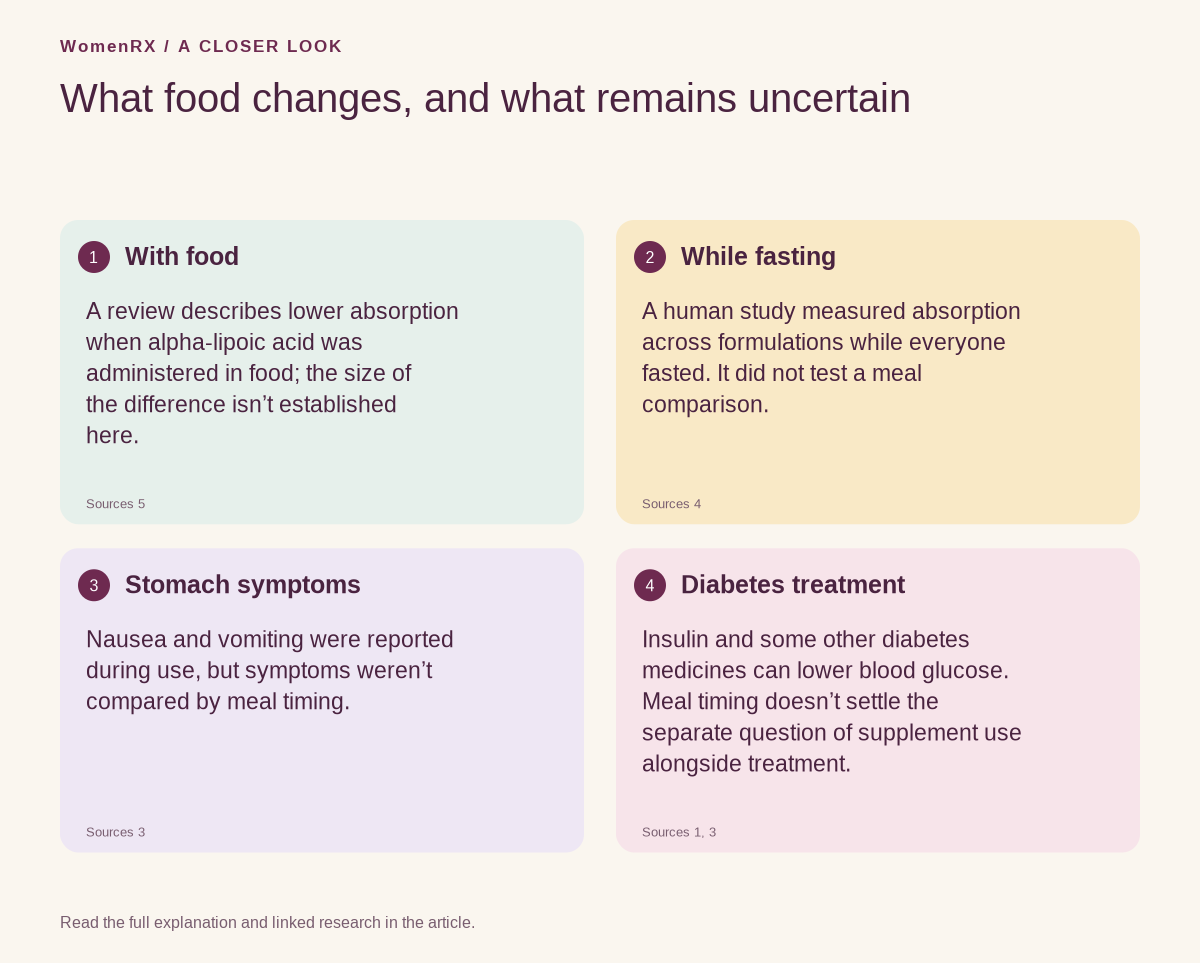
What food changes, and what remains uncertain
With food: A review describes lower absorption when alpha-lipoic acid was administered in food; the size of the difference isn’t established here.5
While fasting: A human study measured absorption across formulations while everyone fasted. It did not test a meal comparison.4
Stomach symptoms: Nausea and vomiting were reported during use, but symptoms weren’t compared by meal timing.3
Diabetes treatment: Insulin and some other diabetes medicines can lower blood glucose. Meal timing doesn’t settle the separate question of supplement use alongside treatment.13
Read the figure as text
Absorption, stomach comfort, and glucose-lowering treatment are distinct considerations.- With food: A review describes lower absorption when alpha-lipoic acid was administered in food; the size of the difference isn’t established here.5
- While fasting: A human study measured absorption across formulations while everyone fasted. It did not test a meal comparison.4
- Stomach symptoms: Nausea and vomiting were reported during use, but symptoms weren’t compared by meal timing.3
- Diabetes treatment: Insulin and some other diabetes medicines can lower blood glucose. Meal timing doesn’t settle the separate question of supplement use alongside treatment.13
More questions, answered
Does an empty stomach make alpha-lipoic acid work better?
A review reports lower absorption when alpha-lipoic acid was administered in food, but greater absorption has not been shown here to produce a better health outcome. A fasting-only human study cannot answer that comparison.45
Sources you can check
- Hypoglycemia: MedlinePlusAccessed 2026-09-25Return to first citation
- Transepithelial transport of alpha-lipoic acid across human intestinal Caco-2 cell monolayers.Takaishi N, Yoshida K, Satsu H, Shimizu M. · Journal of agricultural and food chemistry · 2007Return to first citation
- Safety and Efficacy of Alpha Lipoic Acid During 4 Years of Observation: A Retrospective, Clinical Trial in Healthy Subjects in Primary Prevention.Derosa G, D'Angelo A, Preti P, Maffioli P. · Drug design, development and therapy · 2020Return to first citation
- Enantiomer-selective pharmacokinetics, oral bioavailability, and sex effects of various alpha-lipoic acid dosage formsAccessed 2026-09-26Return to first citation
- Alpha-lipoic acid as a dietary supplement: Molecular mechanisms and therapeutic potential - PMCAccessed 2026-09-26Return to first citation