Alpha-Lipoic Acid: Does Timing or Food Matter?
A small study measured alpha-lipoic acid absorption while participants were fasting, but it didn’t compare taking it with food or show that a particular schedule improves health outcomes.
There isn’t enough evidence here to say that taking alpha-lipoic acid with food or at a particular time improves results. A small study in healthy adults measured absorption after a single dose while fasting; it compared tablet forms, not meals. Clinical benefits are a separate question, and the studies described don’t show that a timing rule makes treatment work better. 2
What the timing study actually tested
The most directly relevant absorption study included 24 healthy adults, 12 women and 12 men. Each received a single 600 mg dose while fasting, in one of several tablet forms or as a solution. The researchers measured blood levels over the next eight hours. Because participants were fasting in every comparison, the study can’t tell you whether taking alpha-lipoic acid with food changes absorption. It also didn’t compare morning with evening use or test whether one schedule leads to better health outcomes. 2
The different tablet forms produced different peak blood levels and total exposure compared with the solution. Those are measures of how much of the substance appeared in the bloodstream, not proof that one form or schedule works better for a health condition. 2
Absorption is not the same as benefit
A supplement can be absorbed into the bloodstream without improving the symptom or condition you’re taking it for. A clinical trial needs to test that outcome directly. For example, a randomized trial in 100 patients with low-grade cervical cell changes tested daily alpha-lipoic acid or placebo for three months and reported a reduction in the proportion with low-grade cytological abnormalities in the supplement group. That study didn’t compare food timing, and its specific result doesn’t establish benefits for other conditions. 1
A separate 12-week trial in people with type 2 diabetes and painful diabetic neuropathy compared alpha-lipoic acid, pregabalin, and their combination. Its reported main comparison found pregabalin alone non-inferior to the combination for pain; that finding doesn’t answer whether taking alpha-lipoic acid with food, or at a certain hour, improves pain relief. 3
So if you’re considering alpha-lipoic acid, start with the health goal and the evidence for that goal. Don’t treat an absorption result, a product’s suggested schedule, or a study of a different condition as proof that a particular timing strategy will help you.
If you take medicine for blood sugar
The available studies here don’t establish a specific interaction between alpha-lipoic acid and glucose-lowering medicines, or tell us whether a medication schedule needs changing. One research paper describes effects on insulin-related pathways, while also saying the clinical significance of those mechanisms needs confirmation. A biological mechanism alone doesn’t prove a harmful interaction in people. 1
Before adding it, ask your prescriber or pharmacist: “Is alpha-lipoic acid appropriate with my current treatment?” and “Would you want me to monitor my blood sugar differently?” Bring the supplement’s exact label and your medication list. Don’t change prescribed diabetes treatment based on a supplement’s timing or absorption claims.
The pharmacokinetic study excluded people taking prescription or over-the-counter medicines and excluded people who were pregnant or breastfeeding. Its results therefore don’t answer how alpha-lipoic acid behaves alongside medicines or establish safety during pregnancy or breastfeeding. 2
What the research says about women
Women were included in the small absorption study, but it wasn’t a study of women’s health outcomes. The researchers found no significant sex difference in peak blood levels; exposure measures were higher in women in this small sample. The paper said this modest difference did not appear to require a dose adjustment in clinical practice. That finding doesn’t establish a different timing rule for women, or tell us about pregnancy or breastfeeding. 2
For now, there’s no evidence-backed meal-timing rule in these studies. If you choose to use alpha-lipoic acid, follow the directions for your specific product and ask about your health goal and medicines rather than assuming that fasting or taking it with a meal guarantees a better result.
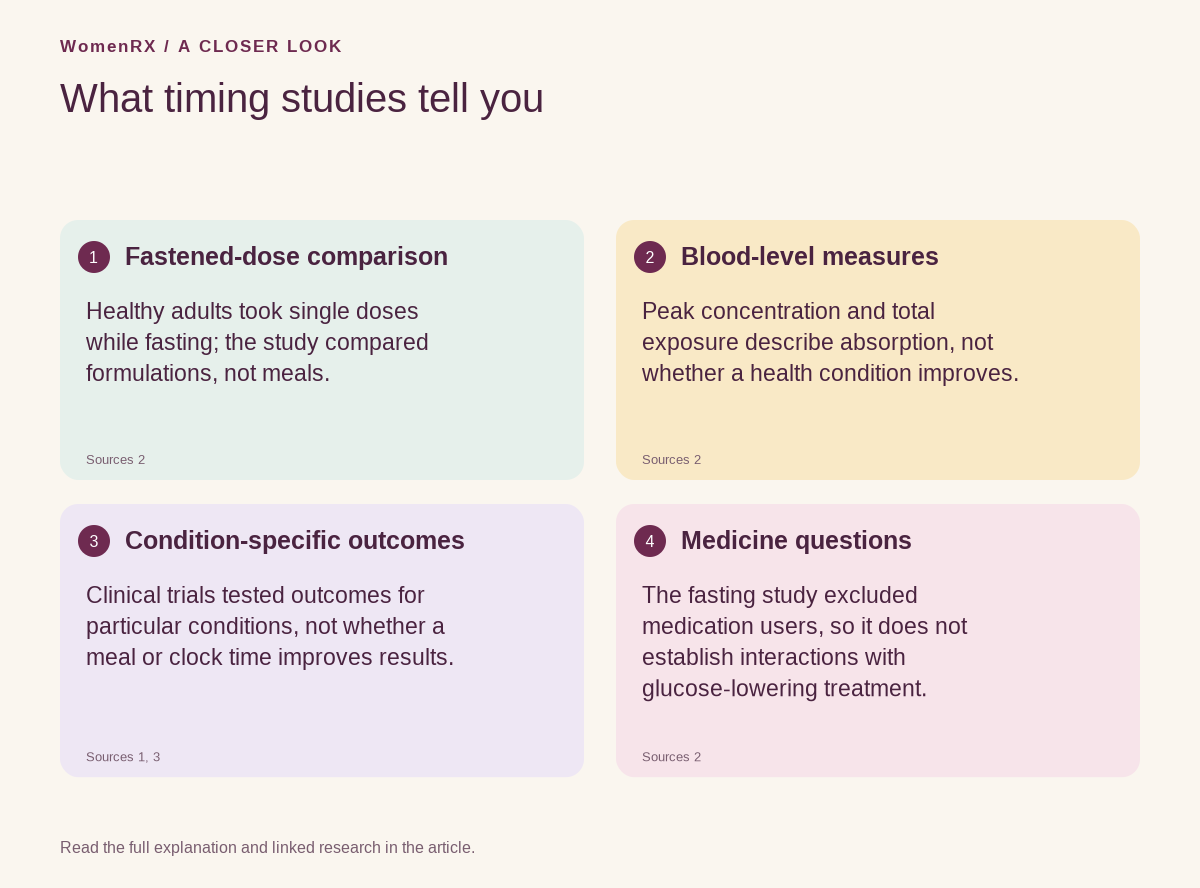
What timing studies tell you
Fastened-dose comparison: Healthy adults took single doses while fasting; the study compared formulations, not meals.2
Blood-level measures: Peak concentration and total exposure describe absorption, not whether a health condition improves.2
Condition-specific outcomes: Clinical trials tested outcomes for particular conditions, not whether a meal or clock time improves results.13
Medicine questions: The fasting study excluded medication users, so it does not establish interactions with glucose-lowering treatment.2
Read the figure as text
Absorption measurements and health outcomes answer different questions. This comparison shows what the cited research did and did not test.- Fastened-dose comparison: Healthy adults took single doses while fasting; the study compared formulations, not meals.2
- Blood-level measures: Peak concentration and total exposure describe absorption, not whether a health condition improves.2
- Condition-specific outcomes: Clinical trials tested outcomes for particular conditions, not whether a meal or clock time improves results.13
- Medicine questions: The fasting study excluded medication users, so it does not establish interactions with glucose-lowering treatment.2
More questions, answered
Does alpha-lipoic acid need to be taken on an empty stomach?
The study described here tested participants while fasting but did not compare fasting with taking alpha-lipoic acid alongside food. It can’t establish that an empty stomach is necessary or leads to better results. 2
Is alpha-lipoic acid studied in pregnancy or while breastfeeding?
The small absorption study excluded people who were pregnant or breastfeeding, so it doesn’t establish safety in either situation. 2
Sources you can check
- Effect of Alpha-Lipoic Acid Supplementation on Low-Grade Squamous Intraepithelial Lesions-Double-Blind, Randomized, Placebo-Controlled Trial.Divković A, Radić K, Sabitović D, Golub N, Rajković MG, Rumora Samarin I, Karasalihović Z, Šerak A, Trnačević E, Turčić P, Butorac D, Vitali Čepo D. · Healthcare (Basel, Switzerland) · 2022Return to first citation
- Enantiomer-selective pharmacokinetics, oral bioavailability, and sex effects of various alpha-lipoic acid dosage forms.Hermann R, Mungo J, Cnota PJ, Ziegler D. · Clinical pharmacology : advances and applications · 2014Return to first citation
- Efficacy and Safety of Pregabalin and Alpha-Lipoic Acid Combination in Patients With Painful Diabetic Peripheral Neuropathy: A Randomized, Open-Label, Non-Inferiority, Phase IV Clinical Trial and Subgroup Analysis (OPTIMUM Study).Oh TJ, Kim SS, Lee SH, Kwon HS, Kim ES, Rhee EJ, Yoo HJ, Jang HN, Lee WJ, Kim ES, Kim SY, Koh G, Hong EG, Park TS, Won JC. · Diabetes, obesity & metabolism · 2026Return to first citation