Alpha-Lipoic Acid Doses Depend on What It’s For
The clearest dose evidence is for short-term diabetic nerve symptoms, not blood sugar control or other conditions.
In a five-week trial for diabetic nerve symptoms, oral alpha-lipoic acid (ALA) was studied at 600, 1,200, and 1,800 mg once daily; 600 mg had the best balance of symptom results and side effects in that study. That is not a general-purpose dose. A study of ALA with pregabalin found no clinically relevant pharmacokinetic interaction for that pairing, but it doesn’t establish broader medication safety. 2 3
The dose depends on the condition
Alpha-lipoic acid (ALA), also called thioctic acid, has been studied for several different reasons. A dose tested for diabetic nerve symptoms cannot automatically be applied to blood sugar concerns, fibromyalgia, or another condition. The studies also vary in duration and whether ALA was used by itself or alongside a prescription medicine.
Diabetic nerve symptoms: the clearest dose comparison
In a randomized, placebo-controlled trial, 181 people with diabetes and distal symmetric polyneuropathy took oral ALA once daily for five weeks. The trial compared 600, 1,200, and 1,800 mg with placebo. Symptoms improved more in all three ALA groups than in the placebo group, but the higher doses did not show a clear advantage over 600 mg. Nausea, vomiting, and vertigo became more common as the dose increased. The researchers judged 600 mg once daily to have the best risk-to-benefit balance in this particular short trial. That describes a study result, not a dose recommendation for every person or every product. 2
A separate 2026 trial studied a different situation: adults with painful diabetic neuropathy who had not responded to an initial pregabalin titration. For 12 weeks, one group received pregabalin 150 mg twice daily and another received a fixed combination of pregabalin 80 mg plus ALA 400 mg twice daily. The combination met the study’s criteria for non-inferior pain control in the per-protocol analysis, but this does not show that ALA alone works at that dose. It also does not make the combination a self-directed substitute for diabetes or nerve-pain care. 3
Diabetic neuropathy can involve numbness, pain, or other nerve problems, and managing blood sugar can help prevent nerve problems or keep them from worsening. ALA should not be treated as a replacement for diabetes care. 1
Blood sugar or weight concerns: don’t borrow the nerve-pain dose
A small six-week study added 600 mg of oral ALA per day to usual care for 23 people with type 2 diabetes and peripheral neuropathy. It did not find significant changes in the measured metabolic markers, including fasting glucose and HbA1c, or a statistically significant weight change. This study does not establish ALA as a blood sugar or weight treatment, and its small size and short duration limit what can be concluded. 5
That matters if you’re considering ALA because of a blood sugar concern: a dose used in a nerve-symptom trial is not evidence that the same dose will manage blood sugar. The studies summarized here don’t establish a dependable interaction profile across medicines. A reported Phase 1 crossover trial found no clinically relevant pharmacokinetic interaction when pregabalin and ALA were taken together, but that finding applies to this specific pairing; it doesn’t establish general interaction safety or an individual’s safety. Don’t use a trial dose to change prescribed diabetes treatment. 3
Fibromyalgia: a higher tested dose did not show benefit
In a small randomized crossover trial, 24 people with fibromyalgia completed both the ALA and placebo treatment periods. The median maximum tolerated ALA dose was 1,663 mg per day, but pain and several other outcomes did not differ significantly between ALA and placebo. An exploratory analysis found a treatment difference favoring ALA for men, but not women. This finding does not establish a useful dose for women with fibromyalgia, and the study does not support taking a high dose for this condition. 4
What safety evidence can and can’t tell you
In the five-week diabetic neuropathy trial, nausea, vomiting, and vertigo increased with higher ALA doses. That makes dose escalation a poor assumption: more was not shown to mean better symptom relief. 2
Pregnant and breastfeeding people were excluded from the 2026 combination trial. That means the trial does not establish safety during pregnancy or breastfeeding; it is not evidence that ALA is safe or unsafe in those circumstances. 3 The specific pregabalin-ALA interaction finding also does not settle how ALA interacts with other medicines or establish safety for an individual. The practical takeaway is to match any discussion of ALA to the specific condition and medicines involved, rather than treating a dose from one trial as a general daily target.
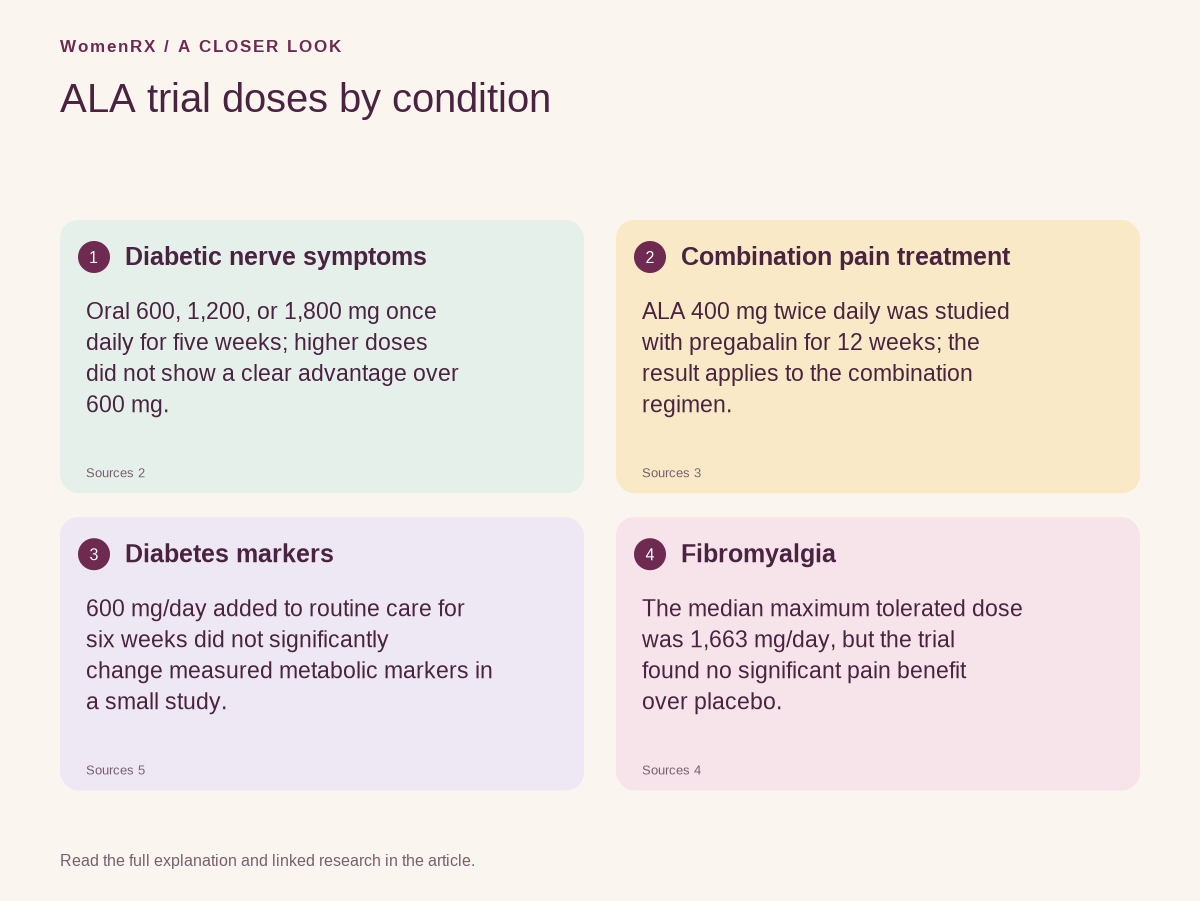
ALA trial doses by condition
Diabetic nerve symptoms: Oral 600, 1,200, or 1,800 mg once daily for five weeks; higher doses did not show a clear advantage over 600 mg.2
Combination pain treatment: ALA 400 mg twice daily was studied with pregabalin for 12 weeks; the result applies to the combination regimen.3
Diabetes markers: 600 mg/day added to routine care for six weeks did not significantly change measured metabolic markers in a small study.5
Fibromyalgia: The median maximum tolerated dose was 1,663 mg/day, but the trial found no significant pain benefit over placebo.4
Read the figure as text
These are study regimens, not interchangeable daily targets. The condition and whether ALA was used alone or in combination change what each result means.- Diabetic nerve symptoms: Oral 600, 1,200, or 1,800 mg once daily for five weeks; higher doses did not show a clear advantage over 600 mg.2
- Combination pain treatment: ALA 400 mg twice daily was studied with pregabalin for 12 weeks; the result applies to the combination regimen.3
- Diabetes markers: 600 mg/day added to routine care for six weeks did not significantly change measured metabolic markers in a small study.5
- Fibromyalgia: The median maximum tolerated dose was 1,663 mg/day, but the trial found no significant pain benefit over placebo.4
More questions, answered
Did the diabetic neuropathy trial show that higher doses worked better?
No. The 1,200 mg and 1,800 mg groups did not show a clear advantage over 600 mg in the five-week trial, while nausea, vomiting, and vertigo increased with dose. 2
Is there a proven ALA dose for blood sugar control?
The small six-week study described here found no significant change in fasting glucose or HbA1c with 600 mg per day added to usual care. It does not establish a dose for blood sugar treatment. 5
Sources you can check
- Diabetic Neuropathy | MedlinePlusAccessed 2026-09-25Return to first citation
- Oral treatment with alpha-lipoic acid improves symptomatic diabetic polyneuropathy: the SYDNEY 2 trial.Ziegler D, Ametov A, Barinov A, Dyck PJ, Gurieva I, Low PA, Munzel U, Yakhno N, Raz I, Novosadova M, Maus J, Samigullin R. · Diabetes care · 2006Return to first citation
- Combination therapy with pregabalin and thioctic acid offers safer pain control in diabetic neuropathy: a multicenter, double-blind, non-inferiority trial.Zárate E, Velásquez-Reyes LV, Carlos Espindola-Reyes J, Bravo-Lamicq C, Ocampo-Gutiérrez de Velasco DA, Arias-Carrión O. · Brain communications · 2026Return to first citation
- Double-blind, randomized, placebo-controlled crossover trial of alpha-lipoic acid for the treatment of fibromyalgia pain: the IMPALA trial.Gilron I, Robb S, Tu D, Holden R, Towheed T, Ziegler D, Wang L, Milev R, Gray C. · Pain · 2021Return to first citation
- THE EFFECT OF SHORT TERM ALPHA LIPOIC ACID ADMINISTRATION ON ADIPONECTIN AND BODY WEIGHT IN TYPE 2 DIABETES MELLITUS PATIENTS.Usta Atmaca H, Akbas F. · Acta endocrinologica (Bucharest, Romania : 2005) · 2017Return to first citation