Ashwagandha: Does Morning or Night Work Better?
Sleep studies tested daily ashwagandha use, but they don’t show that taking it at bedtime works better.
There’s no established best time of day to take ashwagandha for sleep or stress. The human studies summarized by the NIH used daily regimens over several weeks; the described sleep trials did not compare morning with evening use. A product’s directions can tell you how to use that particular supplement, but a bedtime instruction isn’t proof of a sleep advantage. 1

What the sleep studies tell us
If you’re deciding between a morning capsule and one before bed, it helps to separate how often people took ashwagandha from when they took it. In one six-week trial, 150 adults with self-reported sleep problems took two capsules daily of a root-and-leaf extract or a placebo. In another, 80 adults, half of whom had insomnia, took two capsules daily of a different root extract or a placebo for eight weeks. The study descriptions establish daily use, not a bedtime schedule or a comparison with morning use. 1
Across five studies involving 372 adults, a review found a small overall improvement in sleep with ashwagandha extract compared with placebo over six to 12 weeks. The benefit was more pronounced among people with insomnia. That’s a finding about the studied regimens, not evidence that an evening dose works better than a morning one. 1
Stress studies don’t settle the timing question either. The NIH describes both once-daily and twice-daily regimens in trials examining stress-related outcomes. A schedule used in a trial can show what was tested; without a direct comparison, it cannot tell you which time of day is best. 1
Why the directions on your bottle may differ from a study
Before borrowing a trial’s routine, look at what’s actually in your product: whether the extract comes from the root or from root and leaf, and what its directions say. The studies used varied preparations and amounts, so “two capsules daily” in one trial isn’t a transferable serving size. Follow the directions for your specific product rather than converting a study’s capsule count into your own routine. 1
The distinction isn’t just about wording on a label. In a single-dose crossover study of 16 healthy adults, two differently standardized extracts produced different blood exposure to withanolides, compounds found in ashwagandha. The study measured absorption, not sleep or the effect of taking a dose at different times. It helps explain why results from one extract may not apply neatly to another, but it cannot identify a best time to take either one. 2
A label may specify a time of day, or it may not. Either way, those directions describe how to use that product; they aren’t, on their own, evidence that morning or bedtime use produces a better outcome.
Let tolerability inform the practical choice
Drowsiness, nausea, and loose stools are among the usually mild side effects reported with ashwagandha. If a product makes you drowsy, that matters when choosing a time that fits your day. It still doesn’t demonstrate that taking it at night improves your sleep. Ashwagandha may also interact with sedatives, so timing alone should not be treated as a way around that possible interaction. 1
The sleep trials described by the NIH included men and women, but the reported findings don’t establish a best dosing time for women. They don’t answer whether timing should differ during cycling years, perimenopause, or postmenopause. Pregnancy and breastfeeding raise a different question: the NIH notes safety concerns for these life stages, which a change from morning to evening would not resolve. 1
For a morning-versus-night decision, use your product’s directions and your experience of side effects as practical guides. Just keep the claim in proportion: daily ashwagandha has shown modest sleep benefits in small, short-term studies, while a bedtime advantage remains unproven. 1
Study schedules are not timing tests
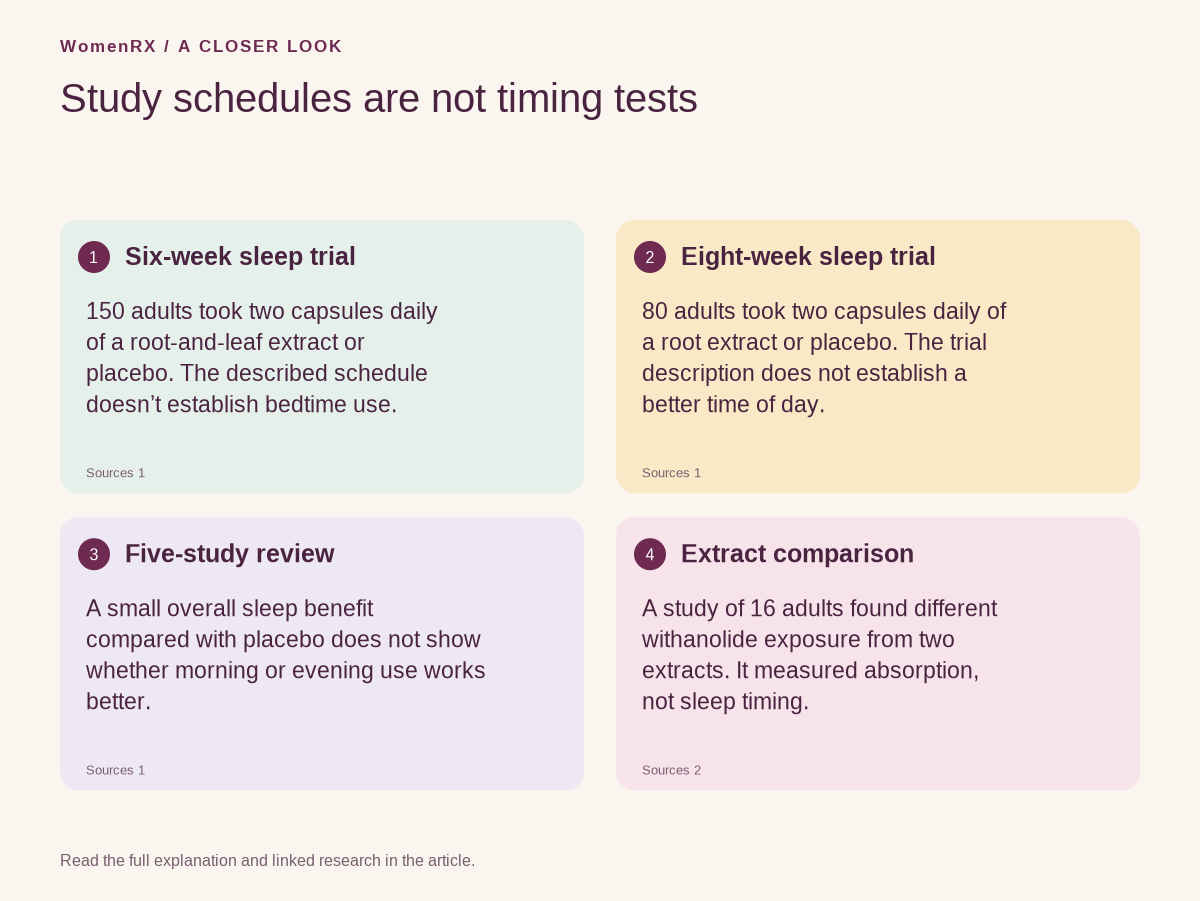
Six-week sleep trial: 150 adults took two capsules daily of a root-and-leaf extract or placebo. The described schedule doesn’t establish bedtime use.1
Eight-week sleep trial: 80 adults took two capsules daily of a root extract or placebo. The trial description does not establish a better time of day.1
Five-study review: A small overall sleep benefit compared with placebo does not show whether morning or evening use works better.1
Extract comparison: A study of 16 adults found different withanolide exposure from two extracts. It measured absorption, not sleep timing.2
Read the figure as text
Compare what researchers measured with the morning-versus-night question they did not answer.- Six-week sleep trial: 150 adults took two capsules daily of a root-and-leaf extract or placebo. The described schedule doesn’t establish bedtime use.1
- Eight-week sleep trial: 80 adults took two capsules daily of a root extract or placebo. The trial description does not establish a better time of day.1
- Five-study review: A small overall sleep benefit compared with placebo does not show whether morning or evening use works better.1
- Extract comparison: A study of 16 adults found different withanolide exposure from two extracts. It measured absorption, not sleep timing.2
Sources you can check
- Ashwagandha: Is it helpful for stress, anxiety, or sleep? - Health Professional Fact SheetAccessed 2026-09-25Return to first citation
- Pharmacokinetics and bioequivalence of Withania somnifera (Ashwagandha) extracts - A double blind, crossover study in healthy adults.Kim SK, Venkatesan J, Rathi P, Antony B. · Heliyon · 2023Return to first citation