Should You Take Saffron in the Morning or at Night?
Saffron has been studied before bed for sleep, but that study didn’t test whether bedtime works better than morning.
There’s no proven best time to take saffron based on these studies. In one trial, adults with unsatisfactory sleep took a saffron extract before bed and reported improvements in some sleep measures, but there was no morning-saffron group. If you’re considering a product, use its own directions rather than copying a trial schedule. 2
Bedtime was tested, but timing wasn’t compared
In a 28-day randomized trial, 120 adults with unsatisfactory sleep took either a placebo or a standardized saffron extract one hour before bed. Compared with placebo, the saffron groups improved on the study’s main sleep-quality rating and some insomnia measures. Other sleep-diary and questionnaire measures did not differ significantly. Everyone assigned saffron took it at the same time, so the trial cannot tell you whether morning use would have worked differently. 2
A review of saffron studies for insomnia found possible benefits for sleep quality and duration, but rated the sleep-quality evidence very low quality. It also found no clear difference from placebo in the pooled result for insomnia severity. The studies used different preparations and amounts; the review did not establish a best time of day. 4
The useful distinction is between a time that was used in a study and a time shown to be better. Before bed is the first. These findings don’t establish the second. 24
Why another study’s schedule may look different
A trial in women of reproductive age used one saffron-containing capsule in the morning and another in the evening. That trial studied sexual function in women without comorbid sleep disorders. It did not assign one group to morning saffron and another to evening saffron to compare sleep. Its twice-daily routine isn’t evidence that splitting saffron across the day is better for sleep. 1
Products can also differ from the extracts studied in trials. One study of sleep and other outcomes in women tested an oral product containing saffron alongside ashwagandha and L-theanine. Results from a combination product cannot isolate what saffron alone did. 3
If two labels give different directions, check whether they’re describing the same product, serving and ingredients. Follow the directions for the product you actually have, not a schedule borrowed from a different supplement or study. If its own directions are unclear or contradictory, ask the seller or a pharmacist to clarify them before you use it.
Keep a note that answers your question
If your product’s directions allow flexibility and you want to notice how its timing fits your day, keep the note simple: record the product and its stated serving, when you took it, how you slept, and how you felt the next day. Note a missed serving or a change in your usual sleep routine too. That can make your own observations easier to interpret; it won’t prove that saffron or a particular time caused a change.
You might also note whether sleep changes around your period or during perimenopause if that’s relevant to you. The bedtime sleep trial reported results for adults, not a women-specific timing comparison, and the reproductive-age women’s trial addressed a different question. Neither provides a reason to recommend one time of day for cycling years, perimenopause or postmenopause. 12
For sleep, bedtime saffron has been studied against placebo. The cited studies do not show whether it works better than taking saffron in the morning. 24
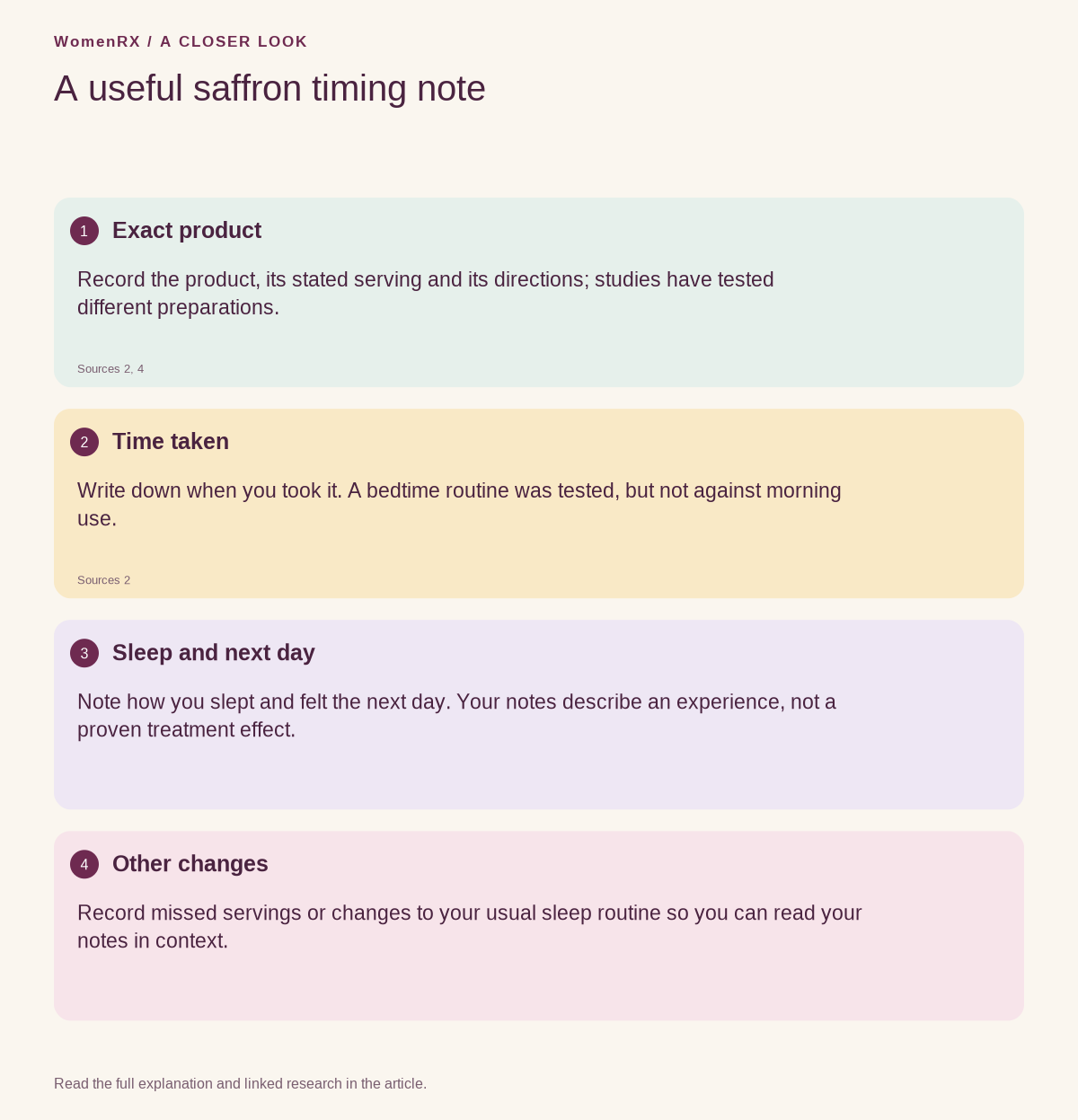
A useful saffron timing note
Exact product: Record the product, its stated serving and its directions; studies have tested different preparations.24
Time taken: Write down when you took it. A bedtime routine was tested, but not against morning use.2
Sleep and next day: Note how you slept and felt the next day. Your notes describe an experience, not a proven treatment effect.
Other changes: Record missed servings or changes to your usual sleep routine so you can read your notes in context.
Read the figure as text
These details can help you describe your routine without treating a trial schedule as a proven best time.- Exact product: Record the product, its stated serving and its directions; studies have tested different preparations.24
- Time taken: Write down when you took it. A bedtime routine was tested, but not against morning use.2
- Sleep and next day: Note how you slept and felt the next day. Your notes describe an experience, not a proven treatment effect.
- Other changes: Record missed servings or changes to your usual sleep routine so you can read your notes in context.
More questions, answered
Does taking saffron before bed mean it will help me fall asleep faster?
Not necessarily. The bedtime trial found improvements in some reported sleep outcomes, but not every measure it assessed. A review of insomnia studies found no clear difference from placebo for sleep latency, the time it takes to fall asleep. 24
Sources you can check
- Effect of vitamin E with and without saffron on the sexual function in women of reproductive age with sexual dysfunction: a randomized controlled trial.Izadi S, Mohammad-Alizadeh-Charandabi S, Yadollahi P, Mirghafourvand M. · BMC women's health · 2024Return to first citation
- An investigation into an evening intake of a saffron extract (affron®) on sleep quality, cortisol, and melatonin concentrations in adults with poor sleep: a randomised, double-blind, placebo-controlled, multi-dose study.Lopresti AL, Smith SJ, Drummond PD. · Sleep medicine · 2021Return to first citation
- Combining Topical and Oral Botanicals for Skin Redness, Pigmentation, Sleep, and Mood: A Randomized Controlled Study.Maloh J, Chakkalakal M, Sulaiman F, Burney W, Chambers CJ, Sivamani RK. · Journal of clinical medicine · 2022Return to first citation
- Crocus Sativus for Insomnia: A Systematic Review and Meta-Analysis.Munirah MP, Norhayati MN, Noraini M. · International journal of environmental research and public health · 2022Return to first citation