How to Decide Which Supplements You Actually Need
Start with the reason you’re considering a supplement, then check whether it matches a real need, evidence for your situation, and what’s already in your cabinet.
There’s no universal supplement stack for women. A product makes more sense when it addresses a specific need, such as a diagnosed deficiency, a dietary gap, or guidance tied to a life stage. Before buying, check the evidence for your goal, compare ingredients across products, and have a pharmacist or clinician review possible medicine interactions. Pregnancy, breastfeeding, and menopause call for different questions.
Begin with the reason, not the bottle
Write down what you want the supplement to do. “I was told my iron is low” is a different starting point from “I feel tired” or “this product says it supports hormones.” A supplement might be relevant to an identified deficiency, a diet that consistently leaves a nutrient gap, or a specific life-stage recommendation. A broad wellness claim, on its own, doesn’t tell you that you need the ingredient.
Then ask what would change your decision: a test result, a review of what you eat, a particular pregnancy recommendation, or better evidence for the health outcome you care about. That keeps the question focused on your need rather than a long list of nutrients marketed to women.
Match the next step to the kind of need
A diagnosed deficiency: Find out which nutrient is low and what may have contributed. Iron, for example, is needed to make hemoglobin, which carries oxygen in red blood cells. Low iron can be linked to blood loss, diet, or trouble absorbing iron; fatigue and shortness of breath can occur as iron-deficiency anemia develops. Too much iron can also be harmful, so don’t treat a suspected deficiency as proof that you need an iron product. 4
A possible food gap: Look at your usual pattern of eating, not just one meal. Some nutrients are found in foods and added to fortified products; iron, for instance, is found in meat, seafood, poultry, nuts, some dried fruit, and fortified foods. A food gap is a useful question to investigate, not automatic proof that a pill is the answer. 4
A life-stage recommendation: Some guidance is specific to timing. Getting enough folic acid before and during pregnancy can help prevent major birth defects of the brain or spine. If you’re pregnant, MedlinePlus advises against taking regular vitamins because they may contain too much or too little of what you need; prenatal vitamins are a distinct option to discuss in prenatal care. 2 3
A condition-specific claim: Ask whether the product has evidence for the outcome you want, in people like you, and whether that evidence shows a meaningful health benefit, not simply that an ingredient has a role in the body. Supplements can play a useful role, but they don’t all have the same evidence or purpose. 1
Life stage changes the question
If you’re trying to conceive, folic acid is a specific consideration because timing before pregnancy matters. During pregnancy, don’t assume a regular multivitamin is interchangeable with a prenatal vitamin; discuss the appropriate product in prenatal care. 2 3
Breastfeeding is a separate context. Don’t assume that a product chosen for pregnancy is automatically the right choice after birth; review what you’re taking and why in light of your current situation. The same goes for menopause: the word “menopause” alone doesn’t identify a deficiency or establish a personal need for a supplement. Calcium and vitamin D have roles in bone health, but that fact alone doesn’t show that every woman needs them as supplements. 1
Pregnancy research also shows why context matters. In a randomized trial in rural Bangladesh, the effect of multiple micronutrients compared with iron and folic acid varied with participants’ dietary diversity and was greatest among those with the least diverse diets. That result is specific to that study population and comparison; it isn’t a formula for choosing a supplement for an individual in the United States. 5
Do a two-minute label and safety check
Before adding a product, compare its ingredient list with every vitamin, mineral, powder, and fortified product you already use. Multiple products can contain the same nutrients, and formulations can vary. In an online survey of 254 women seeking fertility treatment or who were pregnant in Germany, participants reported using an average of two supplements at once; the researchers noted variability in multiple-micronutrient formulations that could lead to too much or too little of some nutrients. The survey doesn’t establish what any individual needs, but it’s a good reason to check for overlap. 6
Make a simple list of product names and ingredients. Ask a pharmacist or clinician to review it for possible interactions with medicines, and share your supplement use before surgery. MedlinePlus advises telling your health care provider about supplements and cautions that taking more than the label recommends can be unsafe. 1
A practical decision rule: keep a supplement on your list only when you can finish this sentence: “I’m considering this because , and the reason it fits me is .” If the second blank is only a broad promise on a label, pause and look for a better-supported next step.
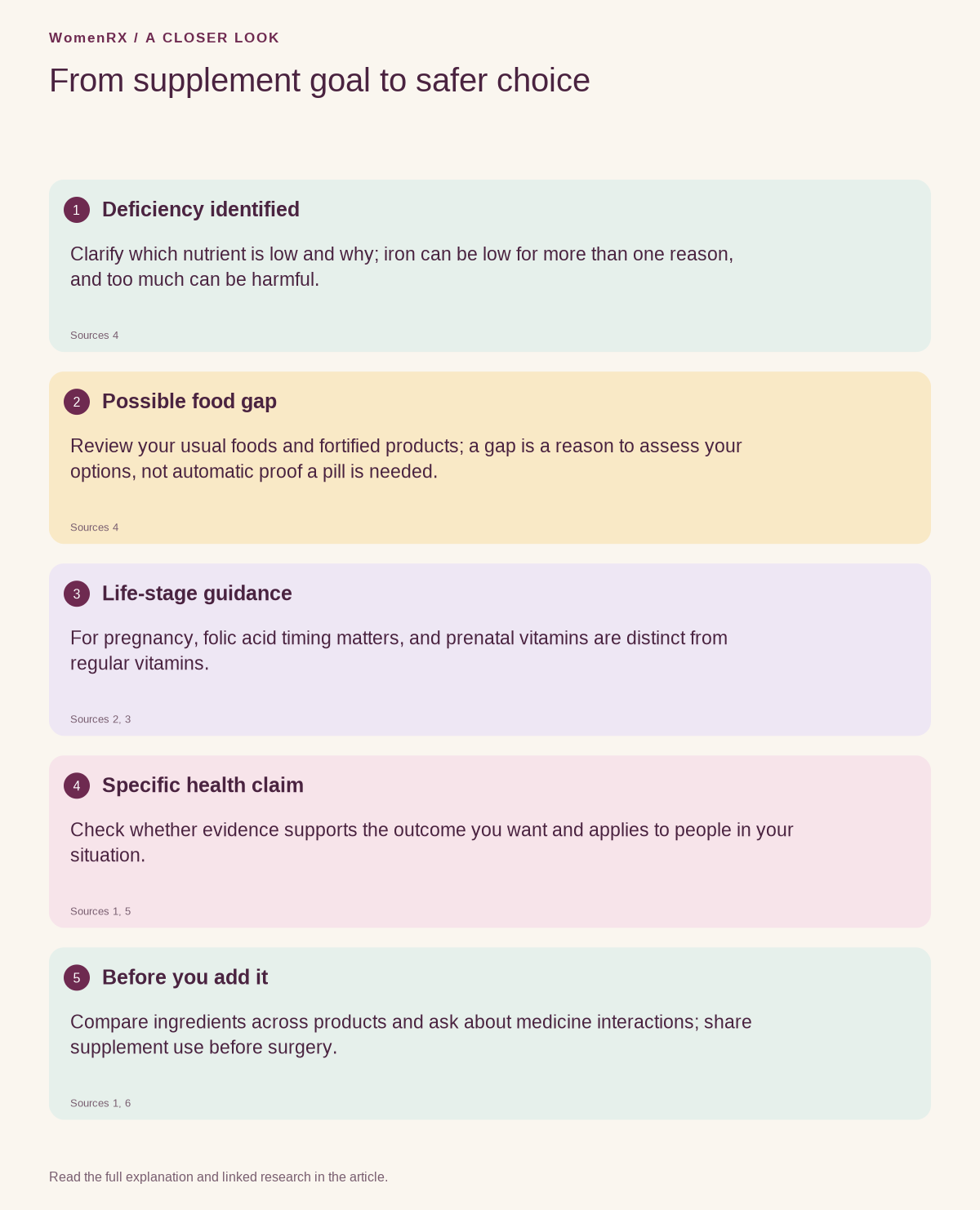
From supplement goal to safer choice
Deficiency identified: Clarify which nutrient is low and why; iron can be low for more than one reason, and too much can be harmful.4
Possible food gap: Review your usual foods and fortified products; a gap is a reason to assess your options, not automatic proof a pill is needed.4
Life-stage guidance: For pregnancy, folic acid timing matters, and prenatal vitamins are distinct from regular vitamins.23
Specific health claim: Check whether evidence supports the outcome you want and applies to people in your situation.15
Before you add it: Compare ingredients across products and ask about medicine interactions; share supplement use before surgery.16
Read the figure as text
Use the reason for considering a product to decide what to check next, before adding another bottle.- Deficiency identified: Clarify which nutrient is low and why; iron can be low for more than one reason, and too much can be harmful.4
- Possible food gap: Review your usual foods and fortified products; a gap is a reason to assess your options, not automatic proof a pill is needed.4
- Life-stage guidance: For pregnancy, folic acid timing matters, and prenatal vitamins are distinct from regular vitamins.23
- Specific health claim: Check whether evidence supports the outcome you want and applies to people in your situation.15
- Before you add it: Compare ingredients across products and ask about medicine interactions; share supplement use before surgery.16
More questions, answered
Does feeling tired mean I should try iron?
Not by itself. Iron-deficiency anemia can cause fatigue, but low iron can have several causes, and too much iron can be harmful. A symptom is a reason to clarify what’s going on, not enough to establish that you need an iron supplement. 4
Should I take a supplement before surgery?
Tell your health care provider about every supplement you use before surgery. MedlinePlus specifically recommends checking with your provider about supplements when you’re going to have surgery. 1
Sources you can check
- Dietary Supplements: MedlinePlusAccessed 2026-09-25Return to first citation
- Folic Acid: MedlinePlusAccessed 2026-09-25Return to first citation
- Pregnancy and Medicines | MedlinePlusAccessed 2026-09-25Return to first citation
- Iron: MedlinePlusAccessed 2026-09-25Return to first citation
- Dietary diversity as a modifier of the effect of supplementation with multiple micronutrients during pregnancy on low birth weight in a randomized controlled trial in Bangladesh.de Boer M, Thorne-Lyman AL, Shamim AA, Wu LS, Shaikh S, Ali H, West KP, Christian P. · The American journal of clinical nutrition · 2025Return to first citation
- Adherence to vitamin and dietary supplement intake in fertility and pregnancy care: insights into knowledge, information satisfaction, and formulation variability.Breuste NJ, Schippert C, von Versen-Höynck F. · Archives of gynecology and obstetrics · 2026Return to first citation