Which Supplements Make Sense at Different Life Stages?
Your best guide to supplements is your current situation: pregnancy plans, heavy periods, breastfeeding, diet, and health conditions can all change what’s worth considering.
There isn’t one supplement list every woman needs. Folic acid matters if you could become pregnant, while iron is more relevant when low iron is a concern, including with heavy periods. Pregnancy, breastfeeding, later-life bone health, diet, and conditions that affect absorption can shift the picture. Use those details to guide a conversation about what you need, rather than adding supplements by default. 2 3
Start with the reason, not the bottle
A supplement makes sense when it addresses a particular need or risk. That could be a nutrient with a clear role before pregnancy, low iron, difficulty absorbing nutrients, or a higher risk of vitamin D deficiency. Food and fortified foods can contribute too. A multivitamin isn’t automatically a better fit just because it covers more nutrients.
One useful first question is: What need am I trying to meet? Your answer may depend on life stage, menstrual bleeding, what you eat, a health condition, or a medicine that affects absorption or nutrient levels.
If pregnancy is possible or planned
Folic acid is the clearest example of a supplement that can matter before a life-stage change is obvious. Getting enough before and during pregnancy can help prevent major birth defects of a baby’s brain or spine. It’s relevant for women who may become pregnant, not only those already trying to conceive. 3
If you’re pregnant, don’t assume a regular multivitamin is interchangeable with a prenatal vitamin. MedlinePlus advises against regular vitamins during pregnancy because they may contain too much or too little of what’s needed; prenatal vitamins are discussed during prenatal care. Check with your care team before starting supplements, herbs, or other medicines. 4
Pregnancy also increases iron needs, but that doesn’t mean every person should add iron on their own. Low iron can be related to blood loss, diet, or absorption problems, and too much iron can cause problems. A review of iron deficiency in pregnancy describes ferritin-based assessment; ask your care team how your individual iron status should be evaluated. 2 5
Heavy periods and iron
Heavy periods are one reason a woman may be more likely to have low iron. Iron helps your body make hemoglobin, which carries oxygen in red blood cells. Low iron can develop into iron-deficiency anemia; symptoms can include fatigue, shortness of breath, or difficulty with memory and concentration. Those symptoms have other possible causes, so they don’t confirm low iron by themselves. 2
Iron is found in foods and fortified products, and supplements are used to treat low iron and iron-deficiency anemia. But taking extra iron without knowing it’s needed can cause nausea, constipation, abdominal pain, or diarrhea; very high levels can cause serious harm. If heavy bleeding or symptoms raise concern, ask about an evaluation before adding iron. 2
Breastfeeding and vitamin D
Vitamin D supports calcium absorption, which is relevant to bone health. MedlinePlus lists a daily recommended amount of 600 IU for pregnant and breastfeeding women. That is a general recommended amount, not a personalized treatment plan for a diagnosed deficiency. 1
There’s also a separate infant consideration: MedlinePlus says breastfed infants should receive a vitamin D supplement. That recommendation concerns the baby’s needs, not proof that the breastfeeding parent needs extra vitamin D beyond her own circumstances. 1
Later life, bones, and changing risks
Vitamin D deficiency can contribute to loss of bone density. Older adults are among the groups at higher risk because the skin makes vitamin D less efficiently with age and the kidneys are less able to convert it to its active form. Other risk factors include conditions that interfere with absorption, kidney or liver disease, and some medicines. 1
This is a reason to consider personal risk, not a rule that everyone needs a vitamin D pill after menopause. Vitamin D can come from food, fortified foods, sunlight, and supplements; a blood test can measure vitamin D, and people at higher risk can ask whether testing is appropriate. Very high supplement levels can be harmful, including to the kidneys. 1
When health conditions change the calculation
Some people need a closer look because their bodies may not absorb or use nutrients normally. Digestive conditions and weight-loss surgery can affect iron absorption; conditions such as celiac disease, inflammatory bowel disease, or gastric bypass can also raise vitamin D deficiency risk. Kidney or liver disease and certain medicines may affect vitamin D levels or use. 1 2
Pregnancy after bariatric surgery is a particularly specific situation: in one prospective study of 69 pregnant women after bariatric surgery, deficiencies in several nutrients were common. The study was small and does not establish what every person in that situation needs, but it supports individualized monitoring rather than relying on a generic multivitamin list. 6
Connect each supplement to a specific need
Before adding something, connect it to a reason: pregnancy possibility, a diagnosed deficiency, heavy bleeding, a restrictive diet, a condition affecting absorption, or a known risk for low vitamin D. Bring your current supplement labels and a list of medicines to a clinician or dietitian if the picture is complicated. The useful outcome isn’t the longest routine; it’s knowing which need you’re addressing and whether the amount and product fit that need.
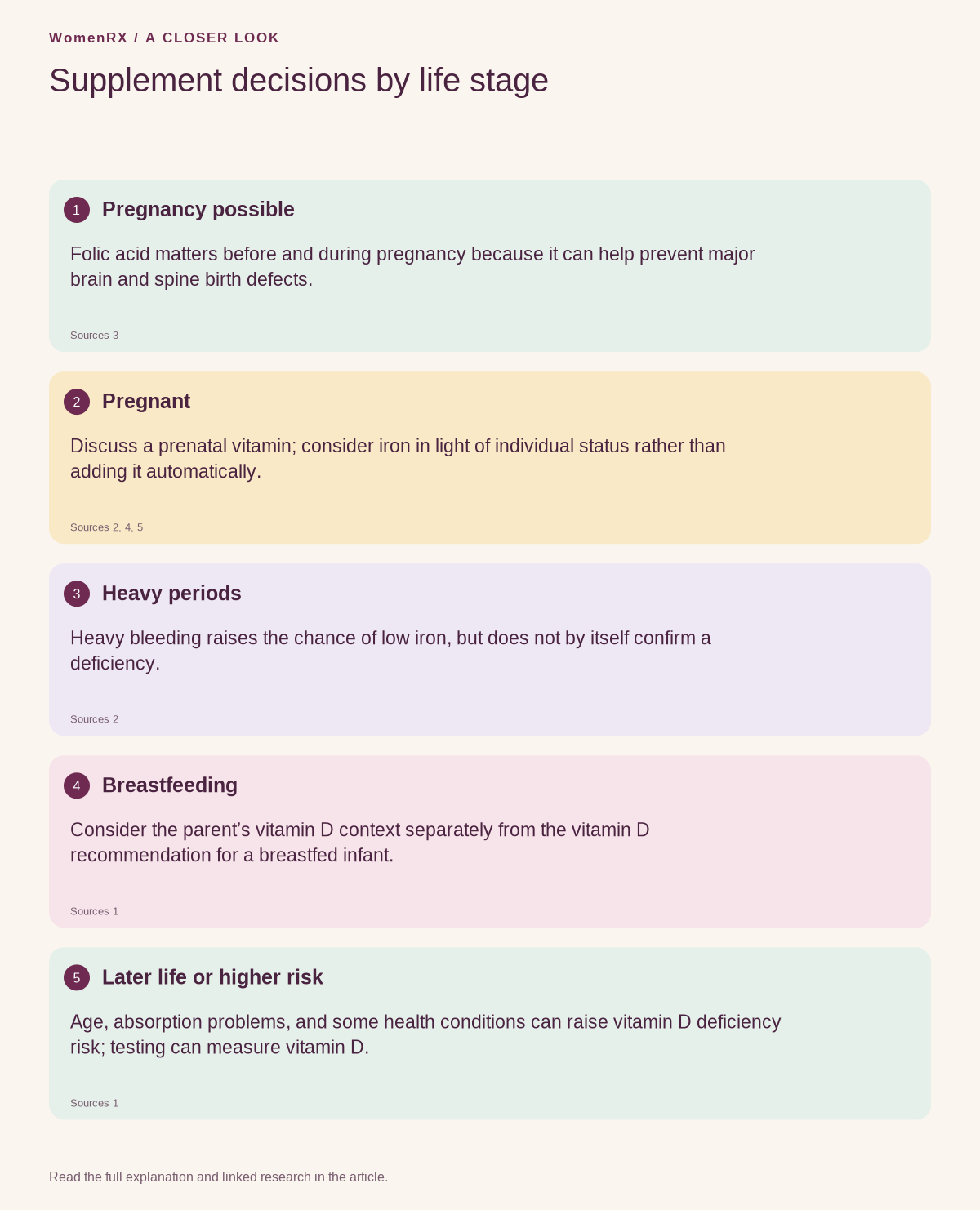
Supplement decisions by life stage
Pregnancy possible: Folic acid matters before and during pregnancy because it can help prevent major brain and spine birth defects.3
Pregnant: Discuss a prenatal vitamin; consider iron in light of individual status rather than adding it automatically.245
Heavy periods: Heavy bleeding raises the chance of low iron, but does not by itself confirm a deficiency.2
Breastfeeding: Consider the parent’s vitamin D context separately from the vitamin D recommendation for a breastfed infant.1
Later life or higher risk: Age, absorption problems, and some health conditions can raise vitamin D deficiency risk; testing can measure vitamin D.1
Read the figure as text
Life stages can change which nutrient questions are relevant. This is a decision map, not a schedule or a list everyone needs to follow.- Pregnancy possible: Folic acid matters before and during pregnancy because it can help prevent major brain and spine birth defects.3
- Pregnant: Discuss a prenatal vitamin; consider iron in light of individual status rather than adding it automatically.245
- Heavy periods: Heavy bleeding raises the chance of low iron, but does not by itself confirm a deficiency.2
- Breastfeeding: Consider the parent’s vitamin D context separately from the vitamin D recommendation for a breastfed infant.1
- Later life or higher risk: Age, absorption problems, and some health conditions can raise vitamin D deficiency risk; testing can measure vitamin D.1
More questions, answered
Does everyone with heavy periods need iron?
No. Heavy periods raise the chance of low iron, but they don’t establish that you have a deficiency. Iron supplements are used to treat low iron, and excess can cause harm, so ask about an evaluation rather than assuming you need iron. 2
Is a prenatal vitamin the same as a regular multivitamin?
Not necessarily. MedlinePlus says regular vitamins may contain too much or too little of what’s needed during pregnancy and describes prenatal vitamins as a separate option to discuss during prenatal care. 4
Sources you can check
- Vitamin D Deficiency: MedlinePlusAccessed 2026-09-25Return to first citation
- Iron: MedlinePlusAccessed 2026-09-25Return to first citation
- Folic Acid: MedlinePlusAccessed 2026-09-25Return to first citation
- Pregnancy and Medicines | MedlinePlusAccessed 2026-09-25Return to first citation
- Iron deficiency during pregnancy and lactation.Wasserfallen L, Moretti D. · Current opinion in clinical nutrition and metabolic care · 2026Return to first citation
- Micronutrient Deficiency During Pregnancy After Bariatric Surgery: The Role of Micronutrient Supplements and Dietary Intake.Guthrie T, Eccles-Smith J, Lee S, Kothari A, Pinzon Perez W, Truby H, de Jersey S. · Obesity surgery · 2026Return to first citation