Could You Have Iron Deficiency? Symptoms, Testing, and Causes
A blood test can show whether iron stores are low before anemia develops, while follow-up helps uncover why.
Iron deficiency means your iron stores are low; iron-deficiency anemia develops when low iron also reduces hemoglobin. Anemia can cause fatigue, weakness, dizziness, or shortness of breath, but early iron deficiency may have no symptoms. Heavy periods, pregnancy, or trouble absorbing iron can raise the chance of deficiency. A CBC and ferritin help answer different questions, and symptoms alone can’t diagnose it. 1 3 4
Low iron and anemia aren’t the same thing
Your body uses iron to make hemoglobin, the protein in red blood cells that carries oxygen. Iron deficiency can start with depleted iron stores while hemoglobin is still in the normal range. If low iron progresses far enough to lower hemoglobin, it becomes iron-deficiency anemia. 1 3
Anemia can cause fatigue, weakness, feeling cold, dizziness, headaches, or shortness of breath. Iron-deficiency anemia may also come with difficulty concentrating. Early iron deficiency may not cause symptoms, and these symptoms can have other causes, too. They may be a reason to ask about testing, but they can’t confirm that your iron is low. 1 3 4
When it’s reasonable to ask about testing
Consider bringing up testing if fatigue or other symptoms persist, or if you have a possible source of blood loss or trouble absorbing iron. Heavy menstrual bleeding is one risk context: people with abnormally heavy periods are more likely to have iron deficiency. Digestive conditions such as celiac disease, Crohn’s disease, or ulcerative colitis can also make it harder to absorb iron. A risk factor raises the question; it doesn’t establish a diagnosis. 3 4
Pregnancy also raises the risk of iron deficiency, so mention it when discussing symptoms or testing. If you’ve recently given birth, share that context as well; periods can change after childbirth, but that change alone doesn’t show whether your iron is low. 2 3
You might ask, “Could we check whether I’m anemic and whether my iron stores are low?” It can also help to describe when symptoms began and mention heavy bleeding, pregnancy, or digestive conditions. There isn’t a single symptom that proves low iron or determines when testing is needed.
What a blood count and ferritin can show
A complete blood count (CBC) includes hemoglobin, which helps show whether anemia is present. But anemia has several possible causes, including blood loss, problems making or maintaining red blood cells, and deficiencies other than iron. A low hemoglobin result by itself doesn’t establish that iron deficiency is the cause. 1 3
Ferritin is a measure of stored iron. Because iron stores can fall before hemoglobin does, ferritin can help identify iron deficiency before anemia develops. The NIH Office of Dietary Supplements says a ferritin result below 30 micrograms per liter suggests iron deficiency. That value should be interpreted in context rather than treated as a stand-alone answer. 3
Inflammation can complicate the picture: ferritin may not reflect iron stores as clearly in someone with inflammation, and transferrin saturation can add information in some forms of anemia. If the results don’t seem to fit your symptoms or circumstances, ask how the different measures fit together. 5
Iron measures also don’t all change the same way across the menstrual cycle. In an analysis of 1,484 nonpregnant women ages 18 to 44, serum iron and transferrin saturation were lowest during menstruation, while ferritin and hemoglobin remained stable. The study found no consistent cycle-related difference in iron-deficiency prevalence across the diagnostic models it used. This is context for interpreting results, not a reason by itself to schedule testing on a particular cycle day. 6
If iron is low, look for the reason
Possible causes include blood loss, not getting enough iron, and difficulty absorbing it. Heavy periods can contribute to blood loss, while some digestive conditions can interfere with absorption. Anemia can also result from causes unrelated to iron, so it’s useful to ask whether the test results point to iron deficiency and what might explain them. 1 3 4
If your periods are very heavy or have changed significantly, mention that even if iron tests are normal. Very heavy bleeding and major menstrual changes can deserve attention in their own right. 2
Ask what the results show about both hemoglobin and iron stores, and what might account for the pattern. Don’t assume fatigue needs an iron supplement: treatment depends on what the tests show and why your iron is low. Taking more iron than your body needs can cause nausea, constipation, vomiting, abdominal pain, or diarrhea. 1 4
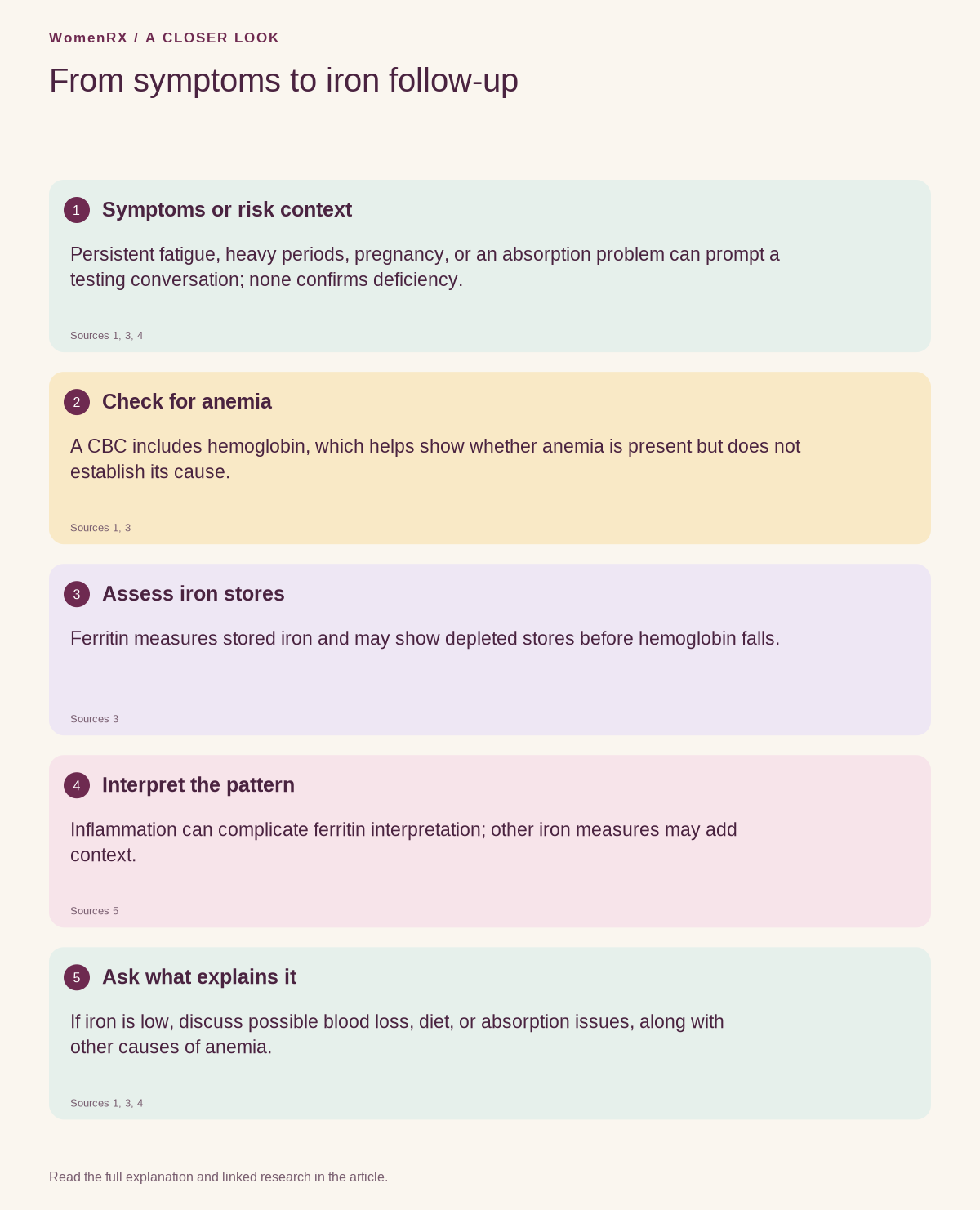
From symptoms to iron follow-up
Symptoms or risk context: Persistent fatigue, heavy periods, pregnancy, or an absorption problem can prompt a testing conversation; none confirms deficiency.134
Check for anemia: A CBC includes hemoglobin, which helps show whether anemia is present but does not establish its cause.13
Assess iron stores: Ferritin measures stored iron and may show depleted stores before hemoglobin falls.3
Interpret the pattern: Inflammation can complicate ferritin interpretation; other iron measures may add context.5
Ask what explains it: If iron is low, discuss possible blood loss, diet, or absorption issues, along with other causes of anemia.134
Read the figure as text
This flow separates reasons to ask about testing from what the tests and follow-up can clarify.- Symptoms or risk context: Persistent fatigue, heavy periods, pregnancy, or an absorption problem can prompt a testing conversation; none confirms deficiency.134
- Check for anemia: A CBC includes hemoglobin, which helps show whether anemia is present but does not establish its cause.13
- Assess iron stores: Ferritin measures stored iron and may show depleted stores before hemoglobin falls.3
- Interpret the pattern: Inflammation can complicate ferritin interpretation; other iron measures may add context.5
- Ask what explains it: If iron is low, discuss possible blood loss, diet, or absorption issues, along with other causes of anemia.134
More questions, answered
Can iron deficiency happen without anemia?
Yes. Iron stores can become depleted before hemoglobin falls. Ferritin can help assess those stores, while a CBC helps show whether anemia has developed. 3
Does a low hemoglobin result mean I need iron?
Not necessarily. Low hemoglobin indicates anemia, but anemia can have causes besides iron deficiency, including other nutrient deficiencies and inflammation. Ferritin and the rest of the test results help clarify whether low iron is involved. 1 3 5
Sources you can check
- Anemia | MedlinePlusAccessed 2026-09-25Return to first citation
- Menstruation | Period | MedlinePlusAccessed 2026-09-25Return to first citation
- Iron - Health Professional Fact SheetAccessed 2026-09-25Return to first citation
- Iron: MedlinePlusAccessed 2026-09-25Return to first citation
- A genome-wide meta-analysis yields 46 new loci associating with biomarkers of iron homeostasis.Bell S, Rigas AS, Magnusson MK, Ferkingstad E, Allara E, Bjornsdottir G, Ramond A, Sørensen E, Halldorsson GH, Paul DS, Burgdorf KS, Eggertsson HP, Howson JMM, Thørner LW, Kristmun... · Communications biology · 2021Return to first citation
- Cyclical fluctuations of iron biomarkers in women: Diagnostic implications for iron deficiency.Aguree S, Owora A, Silveyra P. · Practical laboratory medicine · 2025Return to first citation