How to Spot Iron Deficiency Before Anemia
Iron stores can run low before a blood count shows anemia, so ferritin and a CBC answer different questions.
Fatigue or reduced stamina can be a reason to ask about iron testing, but symptoms alone can’t confirm a deficiency. A ferritin blood test estimates stored iron and may show low stores before anemia develops; a CBC checks for effects on red blood cells, including low hemoglobin. Ferritin needs careful interpretation because inflammation can raise it. 3
Low iron and anemia aren’t the same thing
Iron deficiency can develop in stages. First, stored iron falls. Later, the supply available for making red blood cells can decline. Only after that may hemoglobin fall enough to meet the definition of anemia. That means a normal hemoglobin result does not necessarily rule out depleted iron stores. 3
Iron is needed to make hemoglobin, the protein in red blood cells that carries oxygen. Anemia can have several causes, though, including blood loss, reduced red blood cell production, and increased red blood cell breakdown. So finding anemia on a blood count doesn’t, by itself, prove that iron is the cause. 13
What the tests can, and can’t, show
Ferritin is a measure of the body’s iron stores. It can fall early in iron depletion, before hemoglobin drops. The NIH Office of Dietary Supplements says a ferritin result below 30 micrograms per liter suggests iron deficiency. That figure is a guide, not a stand-alone diagnosis: the full result and a person’s health context matter. 3
Ferritin has a key limitation: inflammation can push the result upward. In that situation, a result that doesn’t look low may not tell the whole story. A clinician may interpret ferritin alongside other iron measures, such as transferrin saturation, which reflects how much iron is available in the blood for making red blood cells. 36
A complete blood count (CBC) includes hemoglobin and other red blood cell measures. Low hemoglobin can indicate anemia, while measures such as hematocrit and cell size can help describe its pattern. But hemoglobin and hematocrit are not sensitive or specific tests for early iron depletion. The practical distinction is simple: ferritin looks at stores; a CBC looks for blood-count changes. 13
A single iron-related result may not settle the question. For example, a clinician may look at ferritin and the CBC together, then add other tests if the results or symptoms call for them. Inflammation is one reason a fuller interpretation can matter. 36
Symptoms are a prompt to check, not a diagnosis
Fatigue, weakness, shortness of breath, and trouble concentrating can occur with iron-deficiency anemia. But those symptoms can have other causes, and symptoms alone can’t tell whether iron stores are low or whether anemia is present. The signs of iron deficiency can also be hard to separate from other nutrient deficiencies. 34
If fatigue or reduced exercise tolerance persists, it’s reasonable to ask whether blood tests are appropriate, especially if you have a possible source of iron loss or a condition that affects absorption. A study of female runners tested a food-based intervention, but found no statistically significant difference in ferritin changes between groups and no differences in its other measured outcomes. It doesn’t establish that reduced exercise performance is a reliable sign of iron deficiency. 5
Your life stage can change the context
Heavy menstrual bleeding can increase the risk of iron deficiency because blood loss carries iron with it. Periods that regularly last longer than eight days, very heavy bleeding, or a major change in your usual cycle are reasons to bring the bleeding pattern into a conversation about testing. 23
Iron needs rise during pregnancy as the body makes more red blood cells and supports the pregnancy. If you’re pregnant and have symptoms or concerns about iron, raise testing with your prenatal care team; the right interpretation depends on your situation. 3
After childbirth, menstrual patterns may change. A change in bleeding doesn’t reveal your iron stores, so ongoing concerns are better assessed with the relevant blood tests than with symptoms or cycle changes alone. 23
One analysis of U.S. health survey data in nonpregnant women ages 18 to 44 found that serum iron and transferrin saturation varied across menstrual-cycle phases, while ferritin and hemoglobin were stable. The study’s estimates of iron deficiency also varied depending on which diagnostic model was used. This is a reason to interpret a panel in context, not a reason to delay testing until a particular cycle day. 7
If a test shows low iron, ask why
The next useful step is not just to identify low iron, but to consider its cause. Heavy periods, low dietary intake, and problems absorbing iron are among the possible contributors. Gastrointestinal conditions such as celiac disease or inflammatory bowel disease can affect absorption or involve blood loss. The likely explanation depends on your history and results. 34
Don’t assume that fatigue means you need an iron supplement. Anemia can have causes other than iron deficiency, and excessive iron can be harmful. Testing can help distinguish low stores from anemia and guide whether further evaluation or treatment is appropriate. 134
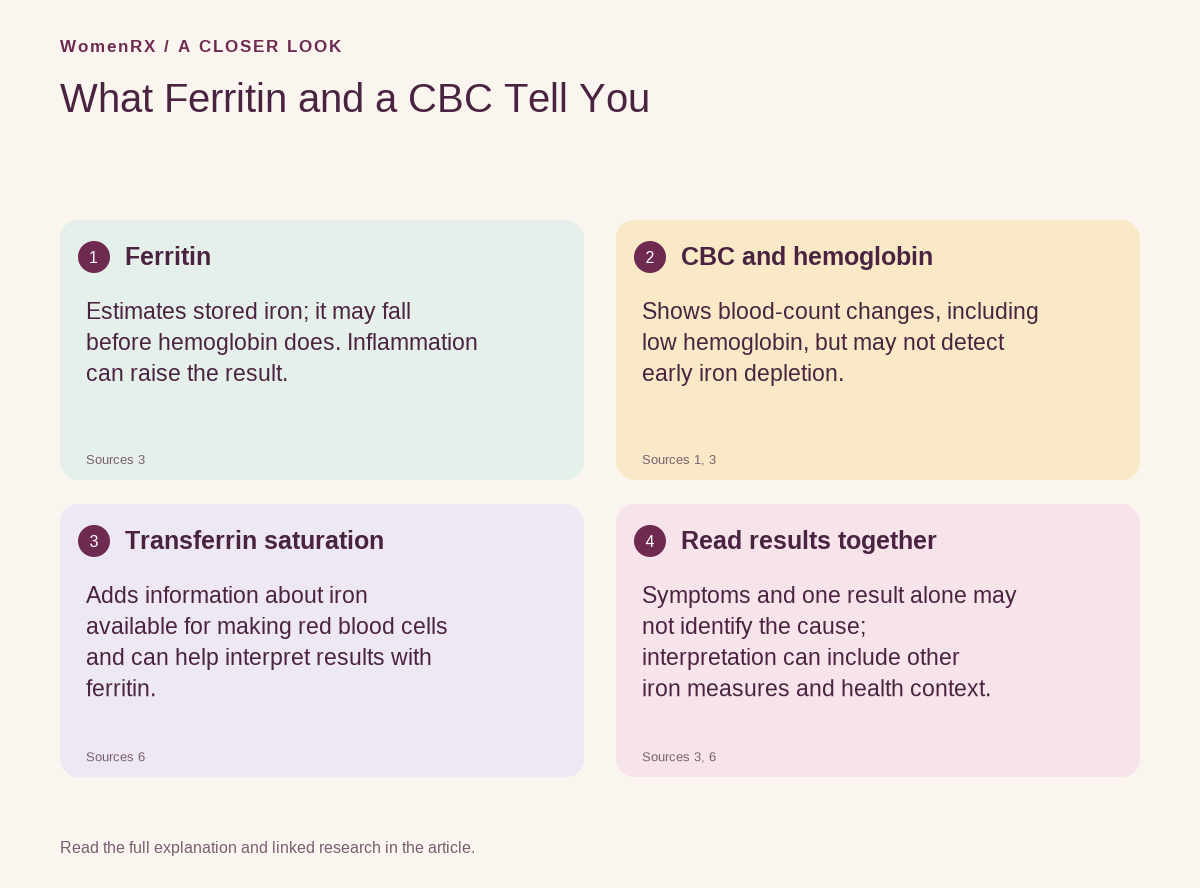
What Ferritin and a CBC Tell You
Ferritin: Estimates stored iron; it may fall before hemoglobin does. Inflammation can raise the result.3
CBC and hemoglobin: Shows blood-count changes, including low hemoglobin, but may not detect early iron depletion.13
Transferrin saturation: Adds information about iron available for making red blood cells and can help interpret results with ferritin.6
Read results together: Symptoms and one result alone may not identify the cause; interpretation can include other iron measures and health context.36
Read the figure as text
These tests look at different parts of iron status: stored iron and the effect of iron supply on red blood cells.- Ferritin: Estimates stored iron; it may fall before hemoglobin does. Inflammation can raise the result.3
- CBC and hemoglobin: Shows blood-count changes, including low hemoglobin, but may not detect early iron depletion.13
- Transferrin saturation: Adds information about iron available for making red blood cells and can help interpret results with ferritin.6
- Read results together: Symptoms and one result alone may not identify the cause; interpretation can include other iron measures and health context.36
More questions, answered
Can a normal CBC rule out low iron stores?
No. Iron stores can be depleted before hemoglobin falls, so a CBC may not show anemia at that earlier stage. Ferritin is used to assess iron stores, although inflammation can raise ferritin and complicate interpretation. 3
Does fatigue mean I should start taking iron?
Not by itself. Fatigue has many possible causes, and anemia can result from conditions other than iron deficiency. Blood tests help clarify whether iron stores are low and whether anemia is present; excessive iron can be harmful. 134
Sources you can check
- Anemia | MedlinePlusAccessed 2026-09-25Return to first citation
- Menstruation | Period | MedlinePlusAccessed 2026-09-25Return to first citation
- Iron - Health Professional Fact SheetAccessed 2026-09-25Return to first citation
- Iron: MedlinePlusAccessed 2026-09-25Return to first citation
- Low phytic acid pea supplementation as an approach to combating iron deficiency in female runners: A randomized control trial.Shaw KA, Chilibeck PD, Lindsay DL, Warkentin TD, Ko J, Zello GA. · Nutrition and health · 2025Return to first citation
- A genome-wide meta-analysis yields 46 new loci associating with biomarkers of iron homeostasis.Bell S, Rigas AS, Magnusson MK, Ferkingstad E, Allara E, Bjornsdottir G, Ramond A, Sørensen E, Halldorsson GH, Paul DS, Burgdorf KS, Eggertsson HP, Howson JMM, Thørner LW, Kristmun... · Communications biology · 2021Return to first citation
- Cyclical fluctuations of iron biomarkers in women: Diagnostic implications for iron deficiency.Aguree S, Owora A, Silveyra P. · Practical laboratory medicine · 2025Return to first citation