Can Fibroids Cause Heavy Bleeding or Pelvic Pressure?
Fibroids can contribute to heavy periods or a feeling of fullness, but symptoms alone can’t confirm the cause.
Yes. Fibroids can cause heavy or prolonged periods, and larger growths may create lower-abdominal fullness or pressure on nearby organs. The connection depends partly on where a fibroid sits, but symptoms don’t reliably show whether fibroids are present or how large they are. Ultrasound is central to diagnosis, and blood tests may check for iron-deficiency anemia when bleeding is heavy. Bleeding after menopause needs assessment rather than being assumed to come from fibroids. 2 4 5 1
How fibroid location can matter
Fibroids are benign growths in or around the uterus. Many cause no symptoms, and having heavy bleeding or pelvic pressure doesn’t prove you have one. When symptoms do occur, their pattern can relate to a fibroid’s size, number, and location. 2
Fibroids that extend toward the uterine cavity are the ones most directly linked with heavy menstrual bleeding. Bleeding may be heavier or last longer than usual. Fibroids can also occur within the uterine wall or toward its outer surface, but their presence alone doesn’t establish that they are causing a particular symptom. 5
Larger fibroids may make the lower abdomen feel full or press on nearby organs. For example, pressure on the bladder can contribute to urinary problems. These are possible patterns, not a way to estimate a fibroid’s size from how you feel. 2 4
Ultrasound helps connect the dots
A pelvic exam may prompt further evaluation, but fibroids aren’t reliably identified or characterized by examination alone. Ultrasound is the usual first imaging step: it can show whether fibroids are present and describe their number, location, and size. That information helps a clinician consider whether a fibroid fits your symptoms. MRI may be used for complex cases or surgical planning. 5 4
The fit is not always straightforward. Heavy bleeding can have causes other than fibroids, including polyps, hormone or thyroid problems, adenomyosis, and conditions that affect clotting. More than one cause can also be present. So an ultrasound finding is useful context, not automatic proof that a fibroid explains every change in bleeding. 1 3 5
Heavy bleeding can affect iron levels
If bleeding is heavy or prolonged, blood tests may be used to check for iron deficiency or anemia. This matters because anemia can develop with ongoing blood loss; feeling unusually tired or short of breath can be clues worth mentioning alongside your bleeding pattern. Blood tests and imaging answer different questions: one can assess for anemia, while the other looks at the uterus and fibroids. 3
A useful description includes whether bleeding is heavier, longer, irregular, between periods, or after sex. Those details help distinguish bleeding patterns, but they don’t identify the cause by themselves. 1 5
Bleeding after menopause is a different situation
Fibroids mainly affect people who haven’t been through menopause, but bleeding after menopause is still abnormal bleeding and should be assessed. Don’t assume a new bleed is simply a fibroid symptom. Fibroids are one possible cause of abnormal bleeding, but other causes need consideration too. 4 1
The practical takeaway: bleeding and pressure can fit with fibroids, but neither symptom pattern nor severity can diagnose them. Imaging helps establish what is present, while the full evaluation considers other explanations and checks for effects such as anemia.
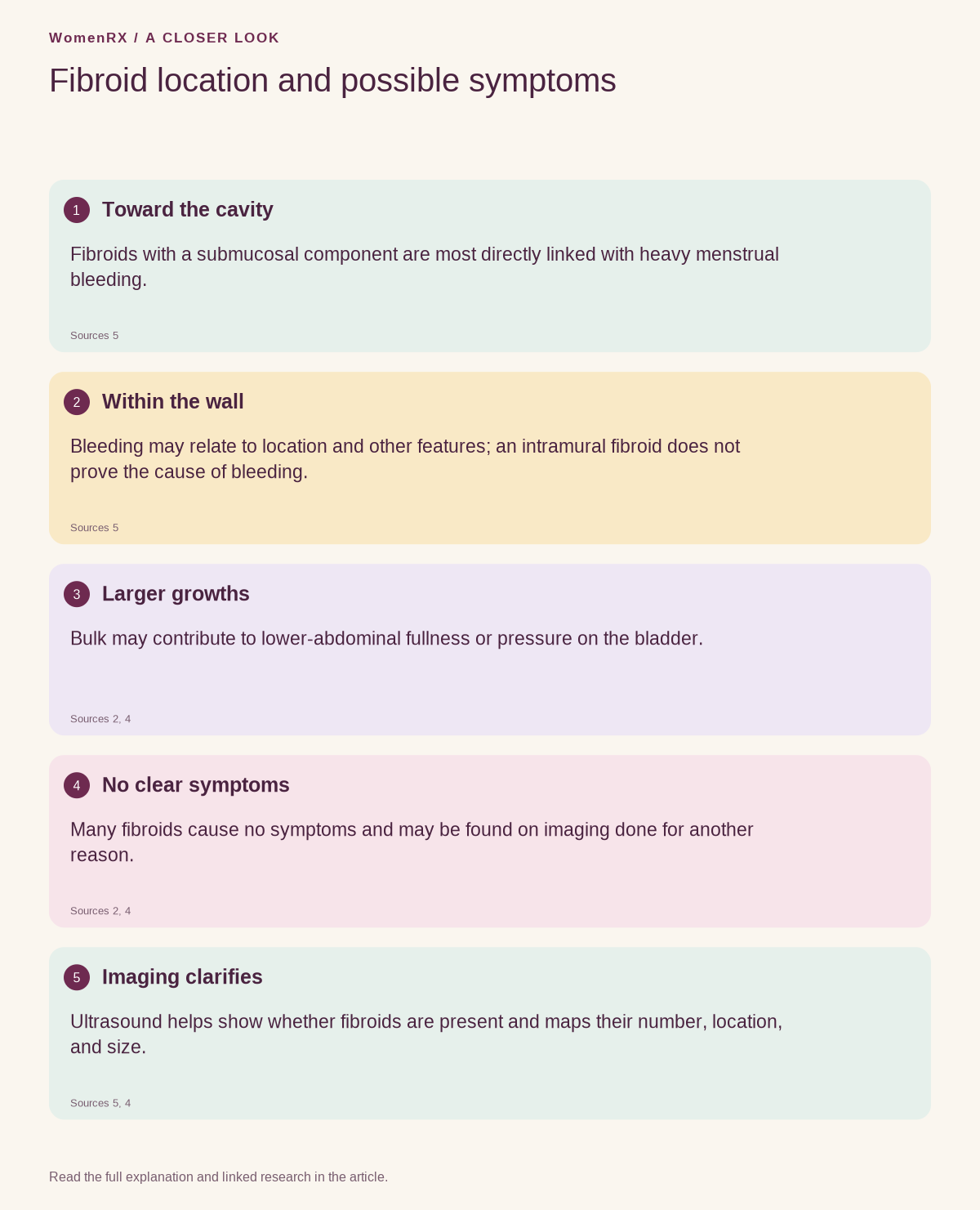
Fibroid location and possible symptoms
Toward the cavity: Fibroids with a submucosal component are most directly linked with heavy menstrual bleeding.5
Within the wall: Bleeding may relate to location and other features; an intramural fibroid does not prove the cause of bleeding.5
Larger growths: Bulk may contribute to lower-abdominal fullness or pressure on the bladder.24
No clear symptoms: Many fibroids cause no symptoms and may be found on imaging done for another reason.24
Imaging clarifies: Ultrasound helps show whether fibroids are present and maps their number, location, and size.54
Read the figure as text
Where a fibroid sits can help explain a symptom pattern, but imaging, not symptoms alone, establishes its location and size.- Toward the cavity: Fibroids with a submucosal component are most directly linked with heavy menstrual bleeding.5
- Within the wall: Bleeding may relate to location and other features; an intramural fibroid does not prove the cause of bleeding.5
- Larger growths: Bulk may contribute to lower-abdominal fullness or pressure on the bladder.24
- No clear symptoms: Many fibroids cause no symptoms and may be found on imaging done for another reason.24
- Imaging clarifies: Ultrasound helps show whether fibroids are present and maps their number, location, and size.54
More questions, answered
Can a fibroid be present without causing symptoms?
Yes. Many fibroids cause no symptoms and may be found during an exam or on imaging, including scans done for other reasons. 2 4
Does a larger fibroid always cause heavier bleeding?
No. Bleeding and pressure relate in part to fibroid location as well as size and number, and symptoms alone don’t reliably show the fibroid’s dimensions. Ultrasound provides that information. 2 5
Sources you can check
- Vaginal Bleeding | Uterine Fibroids | MedlinePlusAccessed 2026-09-25Return to first citation
- Uterine Fibroids | Fibroids | MedlinePlusAccessed 2026-09-25Return to first citation
- Heavy periods - NHSAccessed 2026-09-25Return to first citation
- Fibroids - NHSAccessed 2026-09-25Return to first citation
- Diagnosis and classification of uterine fibroids.Lakabi R, Harth S, Meinhold-Heerlein I, Olsthoorn AV, Munro MG, Murji A. · International journal of gynaecology and obstetrics: the official organ of the International Federation of Gynaecology and Obstetrics · 2025Return to first citation