How Uterine Fibroids Are Diagnosed
A pelvic exam can raise suspicion, but ultrasound usually shows whether fibroids are present and where they sit.
Fibroids may be found during a pelvic exam or an imaging test. Pelvic ultrasound is commonly used to show their number, size, and location; it may be abdominal or transvaginal. Those details help explain whether a fibroid could relate to bleeding or pressure, but the scan alone doesn’t establish that it caused your symptoms or determine treatment. 2 4
The exam can start the search; imaging maps the uterus
If you’re being evaluated for heavy bleeding, pelvic pressure, or pain, the first step is usually a conversation about your symptoms and a physical examination that may include a pelvic exam. Fibroids can also be found unexpectedly on imaging done for another reason. An exam may raise the possibility of fibroids, but imaging is what can show how many there are, how large they are, and where they’re located. 2 4
A fibroid on a scan isn’t automatically the explanation for a symptom. Many cause no symptoms at all, and symptoms can vary with a fibroid’s size, number, and location. Pelvic pain has other possible causes, including conditions affecting the bowel, bladder, or reproductive organs. So the useful question isn’t only “Are there fibroids?” It’s whether their position and size fit what you’re experiencing. 2 3
What ultrasound can tell you
Pelvic ultrasound, which may be abdominal or transvaginal, is a central imaging test for identifying fibroids. A report may describe the number, size, and location of the growths. Those details help distinguish a single small finding from several fibroids or a larger one, and give your clinician a clearer picture of the uterus. 1 2 4
Reports may use terms such as submucosal, intramural, and subserosal for different fibroid locations. Location can matter: submucosal fibroids are associated with heavy or prolonged bleeding. The labels are useful descriptions, not a diagnosis of why you’re bleeding. 5 6
A scan also doesn’t decide what should happen next. Treatment depends on symptoms and other considerations, including whether you’re pregnant or want to become pregnant in the future. Some people with fibroids have no symptoms and need no treatment; many can become pregnant without problems, while some fibroids may be associated with fertility or pregnancy difficulties. 2 4
When another imaging test may enter the picture
MRI is another way to image the uterus. In a selected group undergoing uterine artery embolization, researchers used pelvic MRI to assess fibroid location and T2 signal characteristics in relation to treatment response. A review also discusses MRI and ultrasound for evaluating uterine growths. These sources do not establish that everyone needs MRI after ultrasound. 5 6
If MRI is suggested, it’s reasonable to ask what question it is meant to answer: for example, whether it will add useful detail about the fibroids or help with planning a procedure. What happens next depends on what the exam and initial imaging show.
Pregnancy plans and the menopausal transition matter
If you hope to become pregnant, say so when discussing the results. Fibroids don’t prevent pregnancy for everyone, but some can be associated with difficulty conceiving, pregnancy loss, or pregnancy complications. The number, size, and location on imaging give useful context for a discussion about whether a fibroid might matter in your situation. They don’t, by themselves, predict your individual outcome. 2
Fibroids mainly affect people who have not been through menopause, and being near or past menopause can matter in treatment discussions. Bleeding after menopause is considered abnormal vaginal bleeding and deserves evaluation rather than being assumed to come from a known fibroid. 1 2 4
What to take from the report
The most useful takeaway is a map, not simply a yes-or-no result. Note how many fibroids are described, their sizes and locations, and whether the findings seem to fit your symptoms or pregnancy plans. If bleeding, pressure, or pain continues, those details can help frame what further evaluation may be useful. A fibroid can be present and still be incidental; the scan needs to be interpreted alongside your symptoms and life stage. 2 4
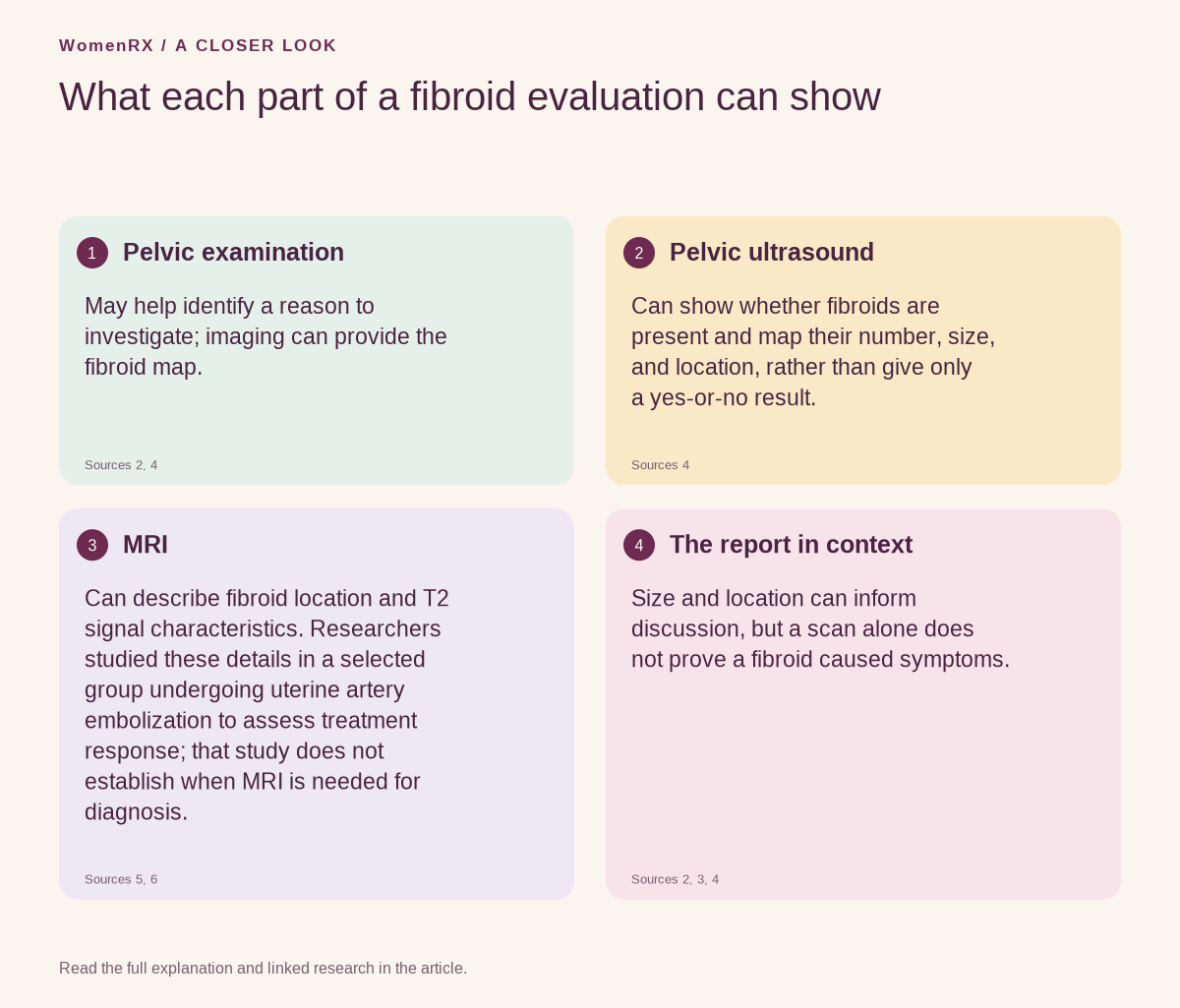
What each part of a fibroid evaluation can show
Pelvic examination: May help identify a reason to investigate; imaging can provide the fibroid map.24
Pelvic ultrasound: Can show whether fibroids are present and map their number, size, and location, rather than give only a yes-or-no result.4
MRI: Can describe fibroid location and T2 signal characteristics. Researchers studied these details in a selected group undergoing uterine artery embolization to assess treatment response; that study does not establish when MRI is needed for diagnosis.56
The report in context: Size and location can inform discussion, but a scan alone does not prove a fibroid caused symptoms.234
Read the figure as text
A pelvic exam may prompt imaging. Ultrasound maps fibroid number, size, and location; MRI can describe location and T2 signal characteristics in selected procedure-related evaluations. Neither scan alone establishes whether a fibroid caused symptoms. 2 4 5- Pelvic examination: May help identify a reason to investigate; imaging can provide the fibroid map.24
- Pelvic ultrasound: Can show whether fibroids are present and map their number, size, and location, rather than give only a yes-or-no result.4
- MRI: Can describe fibroid location and T2 signal characteristics. Researchers studied these details in a selected group undergoing uterine artery embolization to assess treatment response; that study does not establish when MRI is needed for diagnosis.56
- The report in context: Size and location can inform discussion, but a scan alone does not prove a fibroid caused symptoms.234
More questions, answered
Can fibroids be found when I have no symptoms?
Yes. Fibroids may be discovered during a pelvic exam or on imaging done for another reason, and many don’t cause symptoms or need treatment. 2 4
Does finding a fibroid prove it caused my pelvic pain?
No. Fibroids can be associated with symptoms, but pelvic pain has other possible causes too. Whether a fibroid fits your symptoms depends on the whole picture, not the scan alone. 2 3
Sources you can check
- Vaginal Bleeding | Uterine Fibroids | MedlinePlusAccessed 2026-09-25Return to first citation
- Uterine Fibroids | Fibroids | MedlinePlusAccessed 2026-09-25Return to first citation
- Pelvic pain - NHSAccessed 2026-09-25Return to first citation
- Fibroids - NHSAccessed 2026-09-25Return to first citation
- Development of a Model for the Prediction of Treatment Response of Uterine Leiomyomas after Uterine Artery Embolization.Chung YJ, Kang SY, Chun HJ, Rha SE, Cho HH, Kim JH, Kim MR. · International journal of medical sciences · 2018Return to first citation
- Benign Disease of the UterusKinkel K, Ascher SM, Reinhold C. · 2018Return to first citation