Period Cramps: What to Try and When to Get Help
Heat and pain medicines can ease familiar cramps, but pain that disrupts life, worsens, or changes deserves a closer look.
For familiar cramps around the start of your period, try heat, gentle movement, or a pain reliever such as ibuprofen if it’s safe for you and you follow the label. If cramps regularly keep you from school, work, or daily activities, are getting worse, or come with heavier or irregular periods, arrange a medical review. Pain starting in adolescence can also merit evaluation when it’s severe or persistent. 1 2 3
Start with relief for familiar cramps
Period cramps often happen as the uterus tightens during menstruation. They commonly begin just before or around the start of bleeding and may spread into the back or thighs. A warm bath, a heat pad or wrapped hot-water bottle, gentle massage, or light movement such as walking or yoga may help. 3
An anti-inflammatory pain reliever such as ibuprofen is another option for period pain. These medicines can cause side effects, including indigestion and stomach ache. Read the product label, and ask a pharmacist or clinician if you’re unsure whether an NSAID is appropriate for you. If you’re pregnant or breastfeeding, get advice about pain medicine that’s suitable for you. 1 3
If one cycle’s cramps are manageable, it may be useful to notice whether these measures help. Relief matters, but it doesn’t explain the cause of pain, and needing more support isn’t a personal failure.
Let the pattern guide the next step
A familiar pattern is not the only one worth treating. Make an appointment for evaluation if pain is stopping you from doing usual activities, becoming more painful, or occurring alongside periods that have become heavier or irregular. If pain is severe or worse than usual and pain medicine hasn’t helped, seek medical help promptly. 3
There are several possible explanations for painful periods. Some pain occurs without an identified pelvic condition; other menstrual pain is related to conditions such as endometriosis, adenomyosis, or fibroids. Symptoms alone can’t tell you which explanation applies. 3 4
Endometriosis is worth discussing when pain is severe or persistent, including when it begins in adolescence. It can affect girls and women from puberty through menopause, and its symptoms can overlap with other conditions. That overlap can make diagnosis take time; a clinician may ask about symptoms and consider further assessment, such as an ultrasound or referral. 2 3
If your periods become more painful, heavier, or irregular after years of a familiar pattern, don’t dismiss the change. These changes don’t prove a particular condition, but they are reasons not to assume that the cramps are simply your usual cycle. Fibroids and other conditions can cause period pain. 3
Relief and investigation can happen together
A clinician may discuss treatments beyond at-home measures. Hormonal options, including the combined contraceptive pill or other hormone medicines, can help ease pain associated with endometriosis; anti-inflammatory medicines may also be considered. The right option depends on the likely cause, your circumstances, and the risks and possible side effects of treatment. 2 3
If a pain reliever doesn’t help enough, that’s a reason to revisit the plan, not proof that you have endometriosis. Inadequate relief can have different explanations, and a self-reported survey of adult women found considerable variation in NSAID response. The useful distinction is between treating this cycle’s pain and checking whether the pattern needs a different explanation or treatment. 5
You don’t need to wait until pain is unbearable to ask for help. In particular, pain that affects school, work, relationships, or everyday life deserves evaluation whether it started with your first periods or changed more recently. 2 3
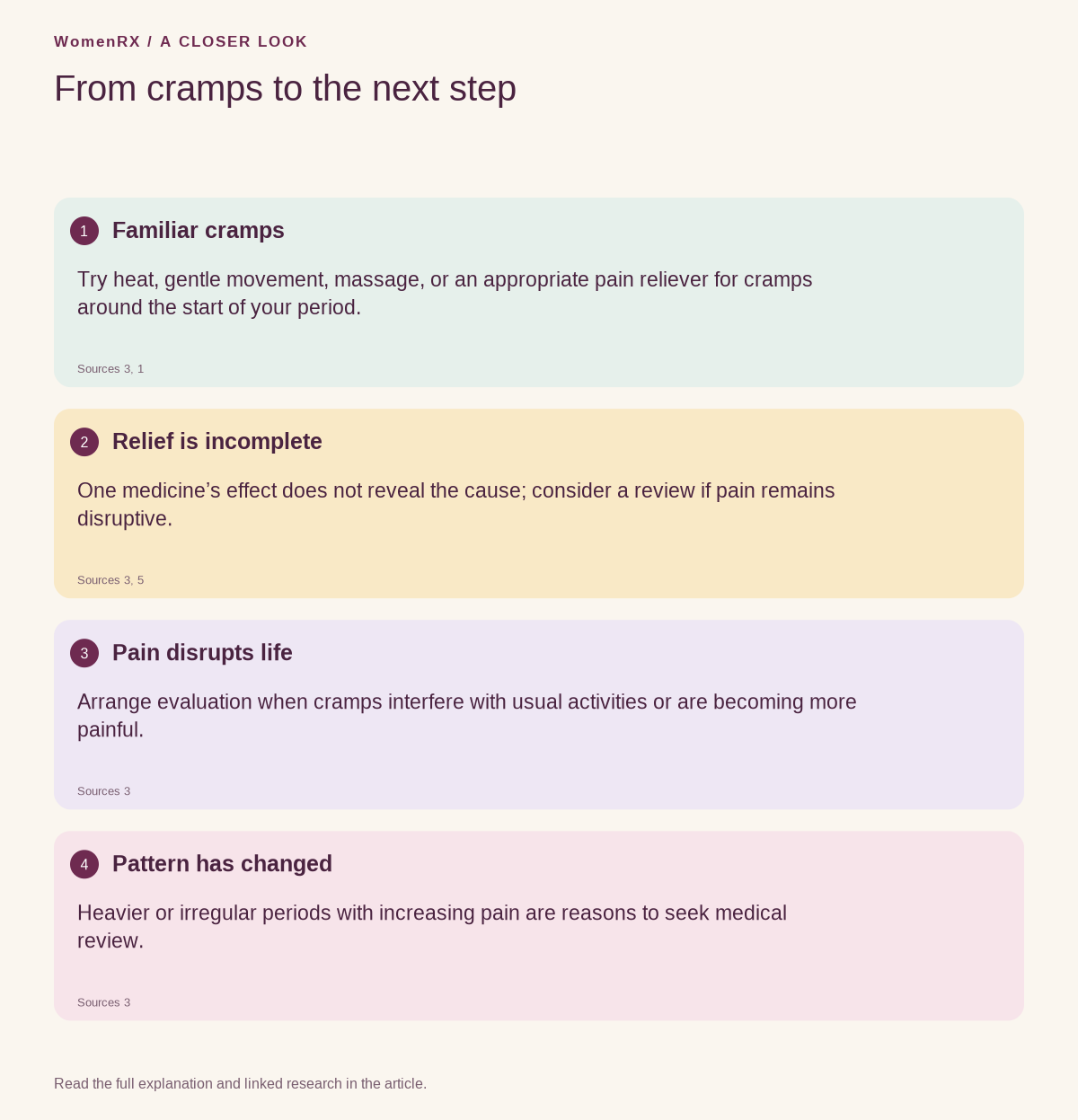
From cramps to the next step
Familiar cramps: Try heat, gentle movement, massage, or an appropriate pain reliever for cramps around the start of your period.31
Relief is incomplete: One medicine’s effect does not reveal the cause; consider a review if pain remains disruptive.35
Pain disrupts life: Arrange evaluation when cramps interfere with usual activities or are becoming more painful.3
Pattern has changed: Heavier or irregular periods with increasing pain are reasons to seek medical review.3
Read the figure as text
Use the pattern and impact of pain to distinguish at-home relief from reasons to seek evaluation.- Familiar cramps: Try heat, gentle movement, massage, or an appropriate pain reliever for cramps around the start of your period.31
- Relief is incomplete: One medicine’s effect does not reveal the cause; consider a review if pain remains disruptive.35
- Pain disrupts life: Arrange evaluation when cramps interfere with usual activities or are becoming more painful.3
- Pattern has changed: Heavier or irregular periods with increasing pain are reasons to seek medical review.3
More questions, answered
Can severe cramps starting with my first periods be endometriosis?
It’s possible, but cramps alone can’t diagnose endometriosis. The condition can affect people from puberty onward. If pain disrupts daily life or doesn’t improve with initial treatment, ask for an evaluation. 2 3
Does ibuprofen not helping mean I have endometriosis?
No. Poor relief can happen for more than one reason and doesn’t identify a specific condition. If pain remains disruptive or is worsening, get the pattern reviewed rather than treating response to one medicine as a diagnosis. 3 5
Sources you can check
- NSAIDs - NHSAccessed 2026-09-25Return to first citation
- Endometriosis - NHSAccessed 2026-09-25Return to first citation
- Period pain - NHSAccessed 2026-09-25Return to first citation
- Efficacy of probiotic supplementation in reducing primary dysmenorrhea: a double-blinded randomized controlled trial.Vallibhakara O, Tosiri W, Vallibhakara SA, Sophonsritsuk A, Lekpittaya N. · Scientific reports · 2026Return to first citation
- Exploring predictors of analgesic response in adult women regularly using NSAIDs: insights from a machine learning approach.Huong C, Seidman LC, Hellman KM, Payne LA. · Frontiers in pain research (Lausanne, Switzerland) · 2026Return to first citation