Cycle Syncing: What Research Supports
Your symptoms may change across your cycle, but research doesn’t support a one-size-fits-all workout or diet calendar.
Hormone levels and symptoms can vary across a menstrual cycle, and some metabolic shifts are plausible. But performance findings are inconsistent, and research hasn’t established a universal phase-based workout or nutrition plan. These exercise and nutrition findings don’t establish whether scheduling work by cycle phase helps. If you suspect a personal pattern, tracking symptoms and how activity feels may be more useful than following a fixed calendar. 3 4 6 7
Cycle syncing usually means changing workouts, meals, or work plans according to a menstrual-cycle phase. The idea has a biological rationale: ovarian hormones fluctuate, and research reviews describe possible changes in metabolism and exercise responses. But that doesn’t establish that everyone benefits from the same phase-by-phase routine. Current evidence supports paying attention to your own symptoms and training tolerance, not treating a calendar template as a prescription. 3 4 7
Plausible biology isn’t a universal schedule
In studies of athletes, menstrual-cycle phase has been associated with differences in some measures, such as strength, endurance strain, or coordination. Other studies have found little or no meaningful difference. A 2026 review describes the overall performance findings as weak, variable, and specific to the task and individual. It concludes that no phase can be called universally advantageous or disadvantageous. 3
Hormones may also influence how the body uses energy and nutrients. A 2026 narrative review describes tendencies toward changes in energy intake, resting energy expenditure, and fuel use across phases, while also emphasizing that responses vary among people and that the evidence is fragmented. These possible shifts don’t show that you need a particular menu or a different training plan in each phase. 7
That distinction matters: a proposed mechanism or average group difference isn’t the same as evidence that a phase-based routine improves your health or performance. Research on nutrition interventions during the cycle is also limited. In a review of 23 studies, most performance trials tested an intervention in just one phase, making it difficult to tell whether the findings apply throughout the cycle. 6
The exercise and nutrition research discussed here doesn’t test whether scheduling work tasks by cycle phase improves focus or output. It can’t establish a universal work calendar. Noticing that symptoms affect your own workday is personal observation, not evidence that everyone should schedule work around cycle phases.
Symptoms can matter more than phase labels
Pain, fatigue, sleep disruption, stomach discomfort, or fluid retention can affect how a workout feels on a particular day. A 2026 review identifies symptom burden as a practical influence on training tolerance, while treating hormones as context rather than a deterministic performance switch. 4
That gives you a more useful question than “What workout belongs in this phase?”: “What’s affecting how I feel today, and what kind of movement feels manageable?” For example, if cramps or poor sleep leave you feeling less up for a hard session, you might choose an easier version or rest. That’s an individual adjustment to how you feel, not proof that everyone should avoid intense exercise during that phase.
Survey findings can help explain why some women want flexibility, but they don’t demonstrate that a phase-based plan improves performance. In an online survey of 150 professional rugby players in two UK leagues, many participants said they perceived menstrual symptoms as affecting physical or psychological performance. The survey measured athletes’ reported experiences, not the effect of assigning workouts by cycle phase. 5
A practical way to test your own pattern
If you’re curious whether your cycle affects your exercise experience, keep a simple record alongside your usual routine. Note bleeding or cycle timing if useful, symptoms, sleep, energy, and how the workout felt. The goal isn’t to prove that a particular phase caused a good or bad session. It’s to notice whether a pattern repeats for you and whether a small, flexible adjustment helps.
Keep the comparison grounded: consider the type and intensity of activity, stress, sleep, and other day-to-day factors too. Research reviews point to substantial variation between people and within the same person, as well as study limitations such as small samples, inconsistent phase classification, and incomplete hormone verification. A cycle-day estimate alone may not identify the hormonal phase precisely. 3 4
You don’t need to replace a routine that works for you with a cycle calendar. Regular activity has health benefits, and a healthy eating plan is meant to provide energy and nutrients day to day, not require a strict phase-specific menu. 1 2
When a standard cycle template doesn’t fit
A phase-by-phase calendar depends on correctly identifying cycle phase. Reviews identify inaccurate phase classification and limited hormone verification as problems in this research. That’s a reason not to treat a day-number calendar as a precise predictor of how you’ll perform. 3 6
Hormonal contraception also changes how a template should be interpreted. A review reports that hormonal contraceptives suppress endogenous hormonal variability, but current findings don’t show consistent effects on performance, injury prevention, or metabolism. A natural-cycle phase schedule shouldn’t automatically be applied to someone using hormonal contraception. 4
The exercise and nutrition reviews discussed here don’t establish a separate cycle-syncing plan for irregular cycles or perimenopause. Their findings shouldn’t be treated as validation of a standard phase template for those situations. If phase labels don’t fit your experience, pay attention to what you notice about symptoms, energy, and activity rather than forcing yourself into a standard phase. 3 4
cycle syncing is a reasonable idea to explore as personal observation, not a proven universal formula. Keep what feels useful, adjust based on how you’re actually doing, and don’t assume a phase label tells you what your body can or should do.
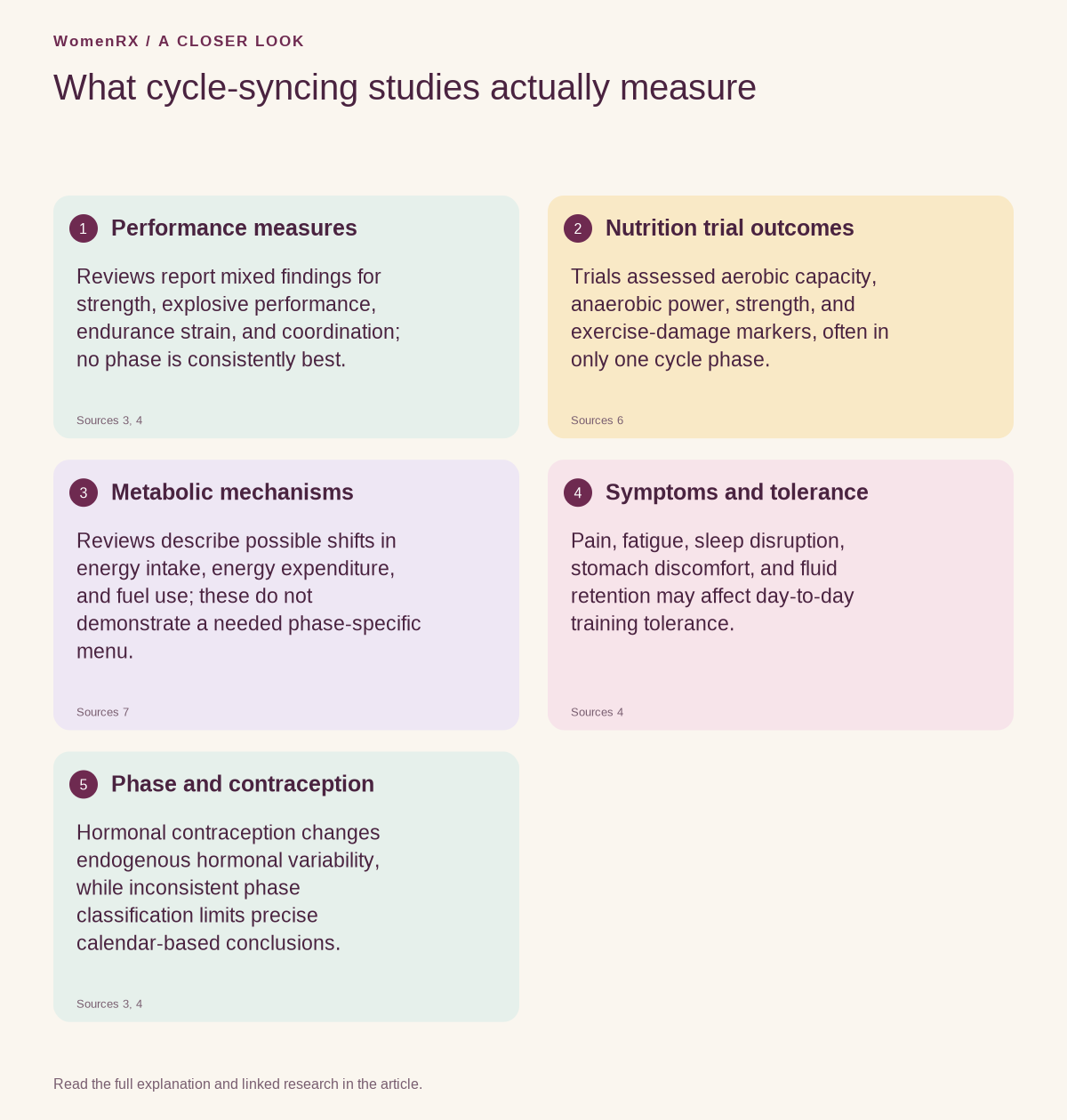
What cycle-syncing studies actually measure
Performance measures: Reviews report mixed findings for strength, explosive performance, endurance strain, and coordination; no phase is consistently best.34
Nutrition trial outcomes: Trials assessed aerobic capacity, anaerobic power, strength, and exercise-damage markers, often in only one cycle phase.6
Metabolic mechanisms: Reviews describe possible shifts in energy intake, energy expenditure, and fuel use; these do not demonstrate a needed phase-specific menu.7
Symptoms and tolerance: Pain, fatigue, sleep disruption, stomach discomfort, and fluid retention may affect day-to-day training tolerance.4
Phase and contraception: Hormonal contraception changes endogenous hormonal variability, while inconsistent phase classification limits precise calendar-based conclusions.34
Read the figure as text
These examples separate measured outcomes from proposed mechanisms and show why the findings don’t translate into one routine for every cycle.- Performance measures: Reviews report mixed findings for strength, explosive performance, endurance strain, and coordination; no phase is consistently best.34
- Nutrition trial outcomes: Trials assessed aerobic capacity, anaerobic power, strength, and exercise-damage markers, often in only one cycle phase.6
- Metabolic mechanisms: Reviews describe possible shifts in energy intake, energy expenditure, and fuel use; these do not demonstrate a needed phase-specific menu.7
- Symptoms and tolerance: Pain, fatigue, sleep disruption, stomach discomfort, and fluid retention may affect day-to-day training tolerance.4
- Phase and contraception: Hormonal contraception changes endogenous hormonal variability, while inconsistent phase classification limits precise calendar-based conclusions.34
More questions, answered
Does cycle syncing mean you should avoid hard workouts during your period?
No universal phase-based rule is supported by the performance evidence. Research finds variable, task-specific results rather than one phase that is consistently worse for everyone. How symptoms affect you on a given day may be more useful when deciding how to adjust a workout. 3 4
Should you change what you eat in each cycle phase?
Research reviews describe possible average changes in energy use and metabolism, but they don’t establish a universal phase-by-phase diet. Nutrition-intervention studies have often tested just one phase, limiting what can be concluded about a full-cycle eating plan. 6 7
Sources you can check
- Nutrition: MedlinePlusAccessed 2026-09-25Return to first citation
- Benefits of Exercise: MedlinePlusAccessed 2026-09-25Return to first citation
- Menstrual cycle hormonal fluctuations and their associations with athletic performance and injury susceptibility in female athletes.Zou Y, Gao Y, Yuan R, Yang Q, Xin T, Wen Y, Xie F, Niu X, Du K, Cheng J. · Frontiers in sports and active living · 2026Return to first citation
- Menstrual Cycle and Hormonal Contraceptives in Female Athletes: Should Symptoms and Nutrition Matter More than Cycle Phase? A Narrative Review.Natalucci V, Spinello G, Moro T, Pavei G, Boccia G, La Torre A, Bonato M. · Nutrients · 2026Return to first citation
- Role of the Menstrual Cycle on Performance and Injury Risk: A Survey of Female Professional Rugby Players in the United Kingdom.Hayward E, Akam L, Hunter D, Mastana S. · International journal of environmental research and public health · 2024Return to first citation
- Impact of Nutrition-Based Interventions on Athletic Performance during Menstrual Cycle Phases: A Review.Helm MM, McGinnis GR, Basu A. · International journal of environmental research and public health · 2021Return to first citation
- An Overview of the Impact of the Menstrual Cycle on Nutrient Metabolism: An Integrative Perspective.García-Montero C, de Castro-Martínez P, Liviu Boaru D, Ortega MA, Fraile-Martínez Ó. · Nutrients · 2026Return to first citation