Choose a Period-Tracking App That Fits Your Goal
A useful tracker should match what you want to learn, while making its prediction limits and data practices easy to understand.
Start with your main reason for tracking: noticing cycle patterns, recording symptoms, keeping fertility-related notes, or sharing a record with a clinician. Then check whether the app handles your cycle and contraception situation, lets you export and delete data, and explains who can access it. Treat predicted period or ovulation dates as estimates, not proof of when you can or can’t get pregnant.
Choose the job before the app
A tracker can be a simple calendar, a symptom journal, or a place to organize fertility-related information. Those are different jobs. Decide which one matters most to you before comparing features; more predictions and prompts don’t necessarily make an app more useful.
If you want to recognize patterns, look for quick ways to log period dates and the symptoms you care about. If symptoms are your focus, check whether you can record their intensity and day-to-day changes without a long daily questionnaire. Ease of use matters when you’re logging consistently, particularly if symptoms themselves make it harder to use an app. A small user-centered design study with people with PMDD or severe premenstrual symptoms highlighted simplicity and the need to represent a broad range of symptoms. 4
If you want to share information at an appointment, look for a readable export or report, not just an attractive in-app calendar. Check whether it includes the dates and notes you’d want to discuss, and try exporting before you depend on it. An app is a record-keeping tool; its predictions aren’t a diagnosis.
Period dates are not fertility confirmation
A predicted period date is an estimate based on dates and, depending on the app, other information you enter. Cycle length can vary, and even people with regular cycles don’t all have 28-day cycles. The NHS notes that it can be difficult to pinpoint ovulation, and that the timing differs among people and cycles. 1
That matters if you’re trying to conceive: an app can help organize cycle dates, symptoms, or results you enter, but don’t treat its predicted ovulation day as confirmation that ovulation happened. In a small study of 25 participants with regular cycles, app phase estimates were compared with a method using ovulation tests and hormone measures; the authors’ findings apply to that study and its specific app and participants, not every tracker or user. 2
It matters even more if you’re trying to avoid pregnancy. A period-prediction feature is not the same as a fertility-awareness method, and a forecast shouldn’t be treated as a guaranteed “safe day.” The NHS explains that ovulation timing can be hard to pinpoint and that cycle timing varies. Choose contraception based on a method intended to prevent pregnancy, rather than relying on an app’s calendar forecast. 1
Match the tracker to your cycle and contraception
If your cycles are irregular or changing, prioritize flexible logging and a clear explanation of how the app makes predictions. A forecast based mainly on past dates may be less helpful when those dates vary. In one comparison study, participants had self-reported average cycle lengths of about 27 days and regular cycles; its results don’t establish how well that app’s phase estimates work for irregular cycles. 2
If you use hormonal contraception, first ask what you want the tracker to do. Recording bleeding, symptoms, or other notes may still be useful, but an ovulation forecast may not fit your situation. Some hormonal methods, including the combined pill, patch, and injection, work by stopping ovulation. 1 Check whether the app lets you record your method and whether it clearly distinguishes logged bleeding from a predicted natural-cycle phase.
For trying to conceive, consider whether you can enter information you collect outside the app, such as ovulation-test results. For symptom tracking, make sure the app has the specific categories you need and lets you add notes when its preset choices fall short.
Read the privacy details before entering sensitive data
Check the privacy policy and in-app settings for answers to practical questions: What information is collected? Is it shared with advertisers, analytics companies, or other third parties? Can you use the basic tracker without creating an account? How do you download your data or request deletion, and what happens to information already shared? Look for clear answers rather than relying on a broad promise that your data is “secure.”
This isn’t a theoretical concern, but app practices differ. A 2025 evaluation of 14 menstrual health apps found that 71.4% shared user data with third parties. That review covered a selected group of apps at the time it was conducted, so it isn’t a current rating of every app. 5 In interviews, users also described wanting clearer privacy information and more control over their data. 3
If reproductive privacy is a particular concern, choose the minimum information you need to enter. You can also use a paper calendar or a private note instead of an app; the right tool is the one whose tradeoffs you’re comfortable with.
A quick comparison before you install
Try the app’s basics before entering months of history. Can you use it in your preferred language? Is the text readable, and can you log without a reliable internet connection if that matters to you? Does it support cycles that aren’t exactly 28 days, and can you record your contraception or symptoms in a way that makes sense for you? One app evaluation considered access, inclusivity, privacy, tracking, and educational content separately, a useful reminder that a polished interface alone doesn’t tell you whether the app fits. 5
A good choice doesn’t have to predict everything. It should help you keep the information you want, let you control what happens to it, and be honest about what a calendar estimate can’t tell you.
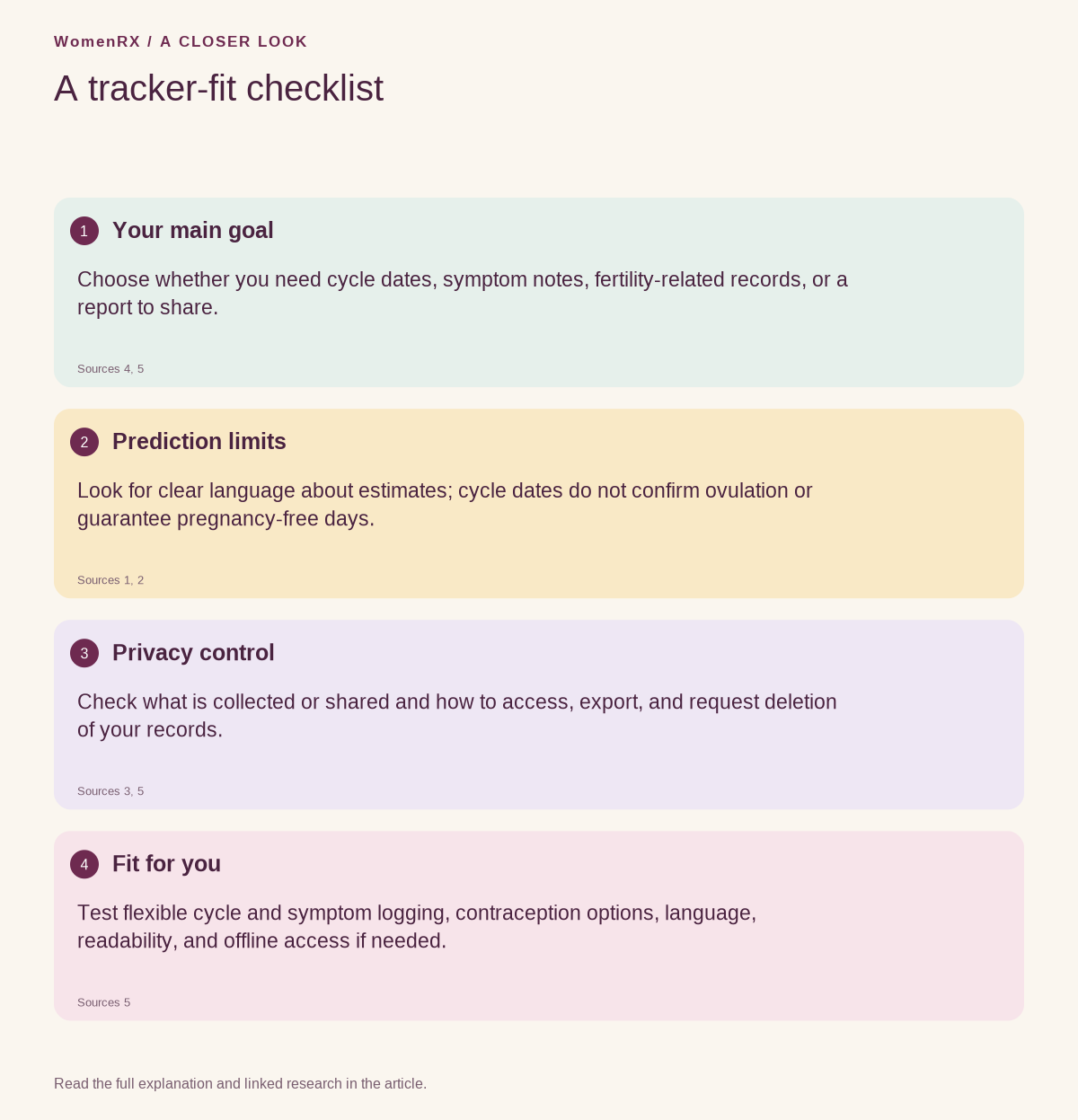
A tracker-fit checklist
Your main goal: Choose whether you need cycle dates, symptom notes, fertility-related records, or a report to share.45
Prediction limits: Look for clear language about estimates; cycle dates do not confirm ovulation or guarantee pregnancy-free days.12
Privacy control: Check what is collected or shared and how to access, export, and request deletion of your records.35
Fit for you: Test flexible cycle and symptom logging, contraception options, language, readability, and offline access if needed.5
Read the figure as text
Compare the app’s purpose and practical tradeoffs before entering sensitive information.- Your main goal: Choose whether you need cycle dates, symptom notes, fertility-related records, or a report to share.45
- Prediction limits: Look for clear language about estimates; cycle dates do not confirm ovulation or guarantee pregnancy-free days.12
- Privacy control: Check what is collected or shared and how to access, export, and request deletion of your records.35
- Fit for you: Test flexible cycle and symptom logging, contraception options, language, readability, and offline access if needed.5
More questions, answered
Can I use a period-tracking app with irregular cycles?
Yes, if your goal is recording dates or symptoms. Look for flexible logging and treat forecasts cautiously: cycle timing varies, and evidence from an app comparison in people with regular cycles doesn’t establish accuracy for irregular cycles. 1 2
Can an app tell me whether I ovulated?
A calendar forecast alone can’t confirm that ovulation occurred. If you’re trying to conceive, an app may help you organize information you enter, but its predicted day is still an estimate. 1 2
Sources you can check
- Periods and fertility in the menstrual cycle - NHSAccessed 2026-09-25Return to first citation
- Level of Agreement Between a Modified, Three-Step Menstrual Cycle Tracking Method and a Female-Health Menstrual Cycle Tracking App.Doroshuk ML, Lebrun CM, Doyle-Baker PK. · Women's health reports (New Rochelle, N.Y.) · 2025Return to first citation
- Flowing data: women's views and experiences on privacy and data security when using menstrual cycle tracking apps.Mohan S, Jenkins J. · Oxford open digital health · 2025Return to first citation
- Developing a Mood and Menstrual Tracking App for People With Premenstrual Dysphoric Disorder: User-Centered Design Study.Apsey C, Di Florio A, Stawarz K. · JMIR formative research · 2024Return to first citation
- An evaluation of menstrual health apps' functionality, inclusiveness, and health education information.Bucher E, Sharkey C, Henderson A, Basaran B, Meyer S, Chen CX. · BMC women's health · 2025Return to first citation