Menstrual Cycle Phases Without the Day-14 Rule
Your period gives you a date you can observe; ovulation and the phases around it don’t follow a fixed calendar.
Day 1 is the first day of your period. The follicular phase begins that same day and runs until ovulation, so menstruation overlaps with it. The luteal phase follows ovulation and ends when the next period begins. You can count the days between periods, but bleeding dates alone can’t tell you exactly when you ovulated.52
Start with the date you know
The first day of your period is day 1. Your cycle ends the day before your next period starts, so counting from one period’s start to the next gives you its length. A 28-day cycle is an average, not a schedule your body has to follow. Cycles shorter or longer than 28 days can still be normal.12
That distinction helps when you look at a cycle diagram. Period dates are events you can mark on a calendar. Follicular and luteal phases describe what happens around ovulation, which you usually can’t date precisely from a calendar alone.25
Menstruation overlaps with the follicular phase
The follicular phase starts on day 1, while you’re bleeding. During this phase, follicles in the ovary develop and estrogen helps the uterine lining grow. The phase ends at ovulation, when an ovary releases an egg. Menstruation isn’t a separate block that must finish before the follicular phase begins.5
Ovulation is the turning point, not a date fixed to the middle of every cycle. Day 14 is a rough illustration for a regular 28-day cycle; it doesn’t apply to everyone, particularly when cycles are shorter, longer, or irregular. Around ovulation, vaginal secretions may become thinner and stretchy, but a calendar date or a change in secretions alone doesn’t establish the exact day an egg was released.2
The luteal phase leads to the next period
After ovulation comes the luteal phase. Progesterone helps prepare the uterine lining for a possible pregnancy. If pregnancy doesn’t occur, estrogen and progesterone levels fall and the lining sheds as the next period. The time from ovulation to the start of a period is commonly around 10 to 16 days, rather than one identical length in every cycle.25
This is why counting backward from a period can put possible ovulation in better context than automatically circling day 14. It’s still an estimate, not confirmation: the next period tells you when bleeding began, not exactly what happened in the ovary beforehand.2
When a phase timeline may not fit
If your periods arrive at unpredictable intervals, a calendar-based ovulation prediction becomes less dependable. Irregular periods can occur when periods first start and as menopause approaches; cycles may also change after childbirth or during breastfeeding. Pregnancy, hormonal contraception, substantial weight change, excessive exercise, and some health conditions can affect period timing too.14
Hormonal contraception deserves its own distinction. Some methods, including the combined pill, patch, and contraceptive injection, work by stopping ovulation. Other hormonal methods may affect bleeding patterns. If you bleed while using hormonal contraception, don’t automatically assign that bleeding the follicular and luteal phases of a natural ovulatory cycle.21 If you’re using cycle dates to avoid pregnancy, a simple prediction based on past periods is not a dependable substitute for contraception; fertility-awareness methods may have higher pregnancy rates than other birth control methods.3
For a useful record, mark when each period starts and note whether bleeding occurs between periods. That shows your actual pattern without asking an app to know your hormone levels. If your usual pattern changes substantially, bleeding becomes very heavy, pain is severe, or you have bleeding between periods, bring that change to a healthcare provider.41
A cycle without fixed dates
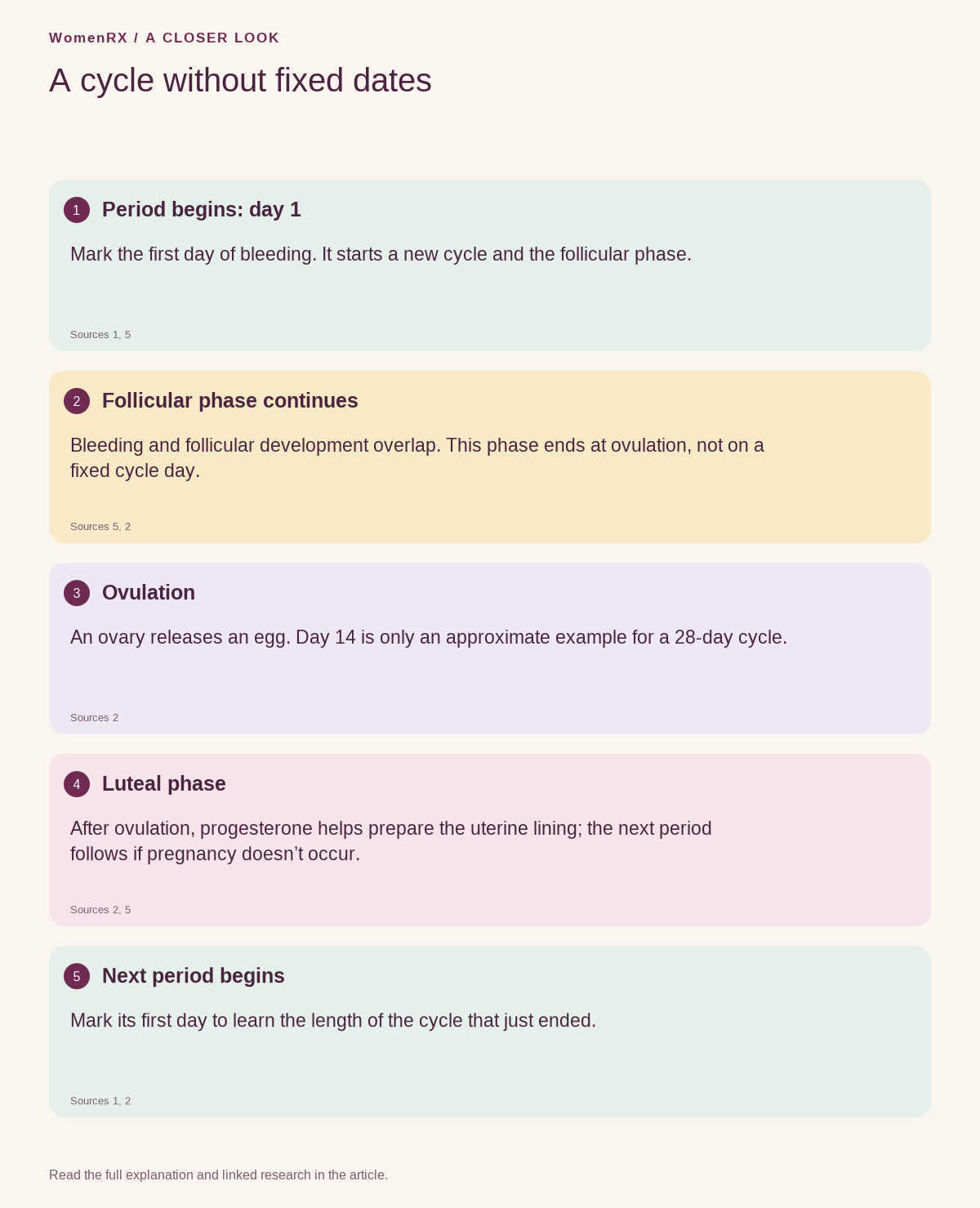
Period begins: day 1: Mark the first day of bleeding. It starts a new cycle and the follicular phase.15
Follicular phase continues: Bleeding and follicular development overlap. This phase ends at ovulation, not on a fixed cycle day.52
Ovulation: An ovary releases an egg. Day 14 is only an approximate example for a 28-day cycle.2
Luteal phase: After ovulation, progesterone helps prepare the uterine lining; the next period follows if pregnancy doesn’t occur.25
Next period begins: Mark its first day to learn the length of the cycle that just ended.12
Read the figure as text
Read the sequence from one period to the next. Only the bleeding dates can be placed on your calendar without estimating ovulation.- Period begins: day 1: Mark the first day of bleeding. It starts a new cycle and the follicular phase.15
- Follicular phase continues: Bleeding and follicular development overlap. This phase ends at ovulation, not on a fixed cycle day.52
- Ovulation: An ovary releases an egg. Day 14 is only an approximate example for a 28-day cycle.2
- Luteal phase: After ovulation, progesterone helps prepare the uterine lining; the next period follows if pregnancy doesn’t occur.25
- Next period begins: Mark its first day to learn the length of the cycle that just ended.12
More questions, answered
Is my period the follicular phase or a separate phase?
Both labels can describe the same days. Menstruation is the shedding of the uterine lining; the follicular phase begins on the first day of that bleeding and continues until ovulation.5
Can I tell when I ovulated by counting back from my next period?
You can estimate a possible window: ovulation often occurs around 10 to 16 days before the next period. That range doesn’t confirm ovulation or pinpoint its day, especially when your cycles vary.2
Sources you can check
- Irregular periods - NHSAccessed 2026-09-25Return to first citation
- Periods and fertility in the menstrual cycle - NHSAccessed 2026-09-25Return to first citation
- Birth Control | Contraception | Contraceptives | MedlinePlusAccessed 2026-09-25Return to first citation
- Menstruation | Period | MedlinePlusAccessed 2026-09-25Return to first citation
- Menstrual Cycle (Normal Menstruation): Overview & PhasesAccessed 2026-09-26Return to first citation