When Migraine Follows Your Menstrual Cycle
A recurring pattern around your period can suggest a menstrual link, but timing alone can’t show that estrogen caused an attack.
Menstrual migraine describes migraine attacks that happen just before or during a period. If attacks repeatedly cluster around that time, a cycle relationship is more plausible than after one nearby headache, but timing doesn’t prove estrogen caused it. Hormone changes may be one influence among several, and migraine patterns vary from person to person. 2 3
What a period-linked pattern looks like
Migraine attacks that happen just before or during a period are commonly described as menstrual migraines. These attacks are often longer and more severe than migraine attacks at other times. 2
One headache near a period doesn’t tell you much on its own. A recurring cluster around periods is more suggestive of a cycle relationship than a single nearby attack. That’s a practical way to notice a pattern, not proof of its cause.
Timing is only one clue. Migraine can involve throbbing pain, nausea, and sensitivity to light or sound, though symptoms vary. 1 A headache that happens near your period isn’t automatically a migraine, and a period-linked pattern doesn’t mean every attack you have is tied to your cycle.
How estrogen may fit in
Estrogen changes across the menstrual cycle. A decline in estrogen before menstruation has been proposed as one reason some people become more vulnerable to migraine around that time. 3
That explanation isn’t a simple rule that lower estrogen always means more migraine. The relationship is complex, and responses differ: the review describes estrogen withdrawal as a possible trigger for some people, while higher estrogen levels may be relevant for others. Those proposed patterns don’t establish what caused an individual attack. 3
Migraine is also influenced by more than one factor. A menstrual pattern can be part of someone’s migraine picture without explaining every attack or ruling out other triggers. A diary can help you look for possible patterns and triggers together. 1 2 3
Compare the pattern across your own cycles
To make the timing easier to judge, note the first day of bleeding and when each migraine attack begins. You can also record whether you had symptoms such as nausea or light sensitivity, and note major changes in sleep, stress, meals, or medication. A migraine log can help reveal recurring patterns and possible triggers. 1 2
When you look back, ask whether attacks repeatedly cluster around a similar point in your cycle, whether they also happen at other times, and whether the headache has features you recognize as migraine. If attacks occur throughout the month but sometimes worsen around your period, the cycle may be one part of a broader pattern.
If your periods become irregular, it may be harder to compare attacks by cycle timing. During perimenopause, migraine symptoms that were already present may stay the same, improve, or worsen. 3 A familiar pattern from earlier years may not predict exactly what happens as cycles change.
What timing can, and can’t, tell you
A recurring pattern can help you describe when attacks happen and explore whether your period is a consistent context for them. It can’t measure your estrogen level or establish that an estrogen change caused a particular migraine. Hormonal changes are one recognized context for migraine, not a complete explanation for every person’s attacks. 3 4
The useful distinction is between a narrow timing description and a broader possible association. “Menstrual migraine” describes migraine attacks that happen just before or during menstruation. A broader hormone-associated pattern might include changes in migraine at other times when reproductive hormones fluctuate. Neither observation, by itself, proves the mechanism behind an attack. 2 3
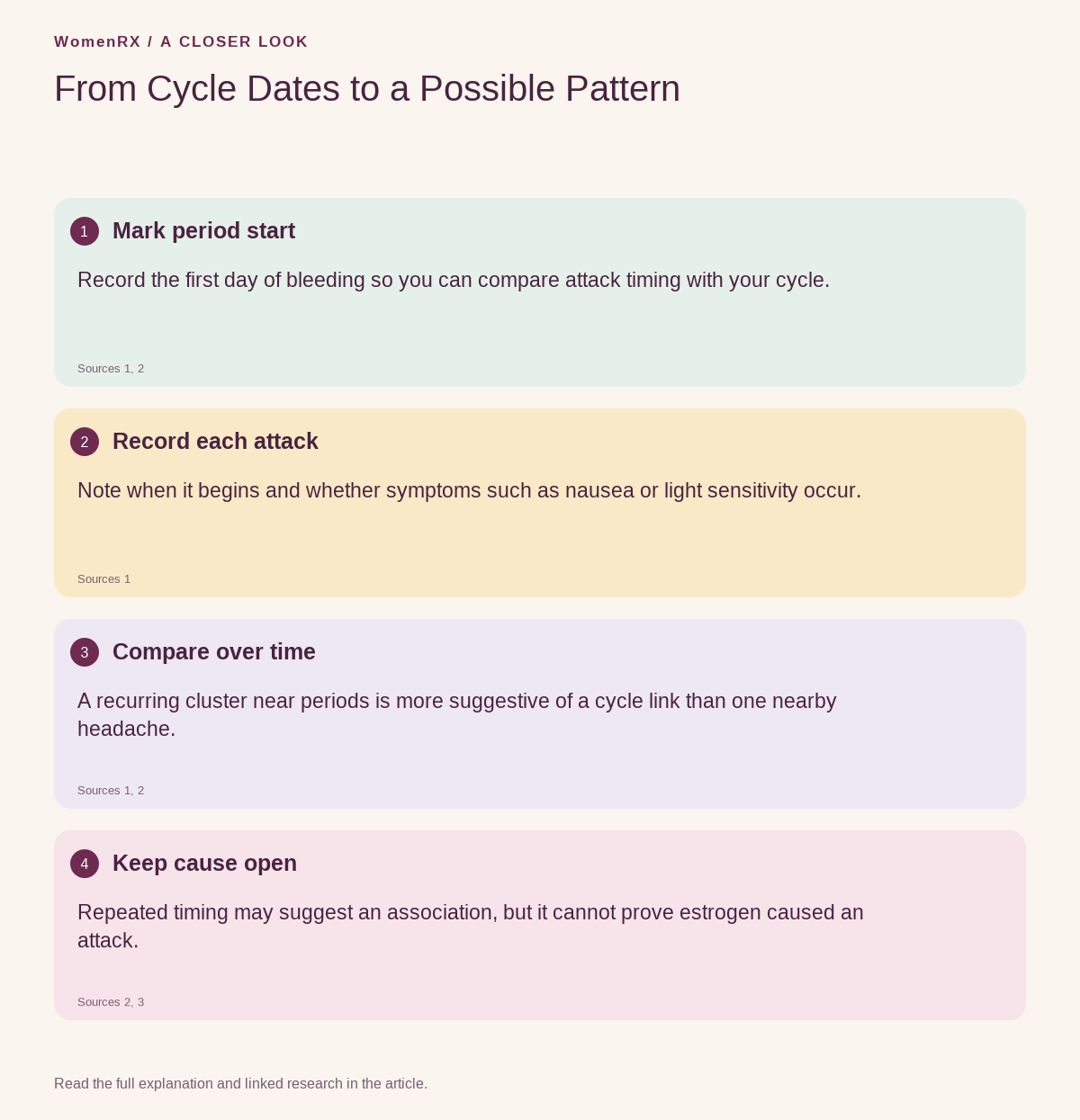
From Cycle Dates to a Possible Pattern
Mark period start: Record the first day of bleeding so you can compare attack timing with your cycle.12
Record each attack: Note when it begins and whether symptoms such as nausea or light sensitivity occur.1
Compare over time: A recurring cluster near periods is more suggestive of a cycle link than one nearby headache.12
Keep cause open: Repeated timing may suggest an association, but it cannot prove estrogen caused an attack.23
Read the figure as text
Compare period timing with migraine attacks to notice recurrence while keeping an observed pattern separate from a proven cause.- Mark period start: Record the first day of bleeding so you can compare attack timing with your cycle.12
- Record each attack: Note when it begins and whether symptoms such as nausea or light sensitivity occur.1
- Compare over time: A recurring cluster near periods is more suggestive of a cycle link than one nearby headache.12
- Keep cause open: Repeated timing may suggest an association, but it cannot prove estrogen caused an attack.23
Sources you can check
- Migraine | MedlinePlusAccessed 2026-09-25Return to first citation
- Migraine - NHSAccessed 2026-09-25Return to first citation
- How Sex Hormones Affect Migraine: An Interdisciplinary Preclinical Research Panel Review.Godley F, Meitzen J, Nahman-Averbuch H, O'Neal MA, Yeomans D, Santoro N, Riggins N, Edvinsson L. · Journal of personalized medicine · 2024Return to first citation
- Migraine and Other Headache Disorders: ACOG Clinical Updates In Women's Health Care Primary and Preventive Care Review Summary Volume XVIII, Number 4.Lucas S. · Obstetrics and gynecology · 2019Return to first citation