How to Identify and Treat Menstrual Migraine
A repeated timing pattern can point to menstrual migraine, while a headache diary helps make treatment choices more specific.
Menstrual migraine is identified by migraine attacks that repeatedly occur from two days before bleeding through the third day of menstruation. The pattern should appear in at least two of three cycles; attacks at other times can still fit menstrually related migraine. A diary can show the pattern and help you discuss acute treatment or whether prevention is worth considering. 5
The calendar pattern matters
A headache near your period isn't automatically menstrual migraine. The timing pattern applies to migraine attacks: attacks begin from two days before menstruation through the third day of bleeding, and that window recurs in at least two of three cycles. If attacks happen only in that window, the pattern is called pure menstrual migraine. If you also have migraine at other points in your cycle, it is called menstrually related migraine. 5
Migraine often involves throbbing pain and may bring nausea or sensitivity to light and sound. Those features help distinguish a migraine attack from a headache that simply happens to occur around bleeding, but diagnosis also involves considering other possible causes. 1
Use a diary to test the pattern
Record headache days alongside the start of bleeding for several cycles. Note which attacks feel like migraine, how long they last, symptoms such as nausea or light sensitivity, and what treatment you used. The aim isn't to diagnose yourself from a calendar. It's to make it easier to see whether attacks repeatedly fall in the same window and to give a clinician useful details when discussing treatment. Migraine diaries are also recommended as a way to identify patterns and possible triggers. 125
If your cycles are irregular, the dates may be harder to interpret. Keep recording both bleeding and headaches rather than guessing when a period-related window will begin. Hormonal contraception can also be part of the picture, but a cross-sectional study of people with migraine did not find clear differences in migraine features between stable hormone-treatment users and nonusers. That result does not establish how a specific contraceptive affects your own attacks. 7
Match the treatment discussion to the pattern
For an attack that's underway: Triptans and pain relievers, including nonsteroidal anti-inflammatory drugs (NSAIDs), are among the acute treatments used for migraine. Which option is appropriate depends on your health and the details of your attacks. In one clinic-based questionnaire study, NSAID responses differed between the pure and menstrually related groups, but the comparison involved relatively few people with usable medication-response data and the difference weakened after accounting for attack frequency. It isn't a basis for choosing a drug on your own. 15
For attacks that recur around menstruation: If the window is predictable and attacks are difficult to manage, ask whether a planned short-term prevention strategy is appropriate, or whether a broader preventive approach makes more sense. Frequent or severe migraine may call for preventive treatment, but menstrual-specific options need careful discussion. A review of CGRP-targeted treatments found that their role for menstrual migraine is not fully defined and that dedicated trials are lacking. One retrospective study of 43 Chinese women with pure menstrual migraine reported improvements with short-term rimegepant use, but without a comparison group it cannot establish that the treatment caused the improvement or define routine care. 146
A useful discussion can be concrete: “My attacks fell in this window in these cycles. What should I use when one starts, and is prevention worth considering?” Bring your diary if you have one. You don't need to wait to complete several cycles if your headaches are severe, getting worse, lasting longer than usual, or becoming difficult to control. 2
Keep the pattern in perspective
Hormone changes are thought to be involved in menstrual migraine, but the exact biology is not fully understood. The timing pattern is useful because it separates recurring cycle-linked attacks from migraine at other points in the month; it doesn't mean every headache near bleeding has the same cause or needs the same treatment. 36
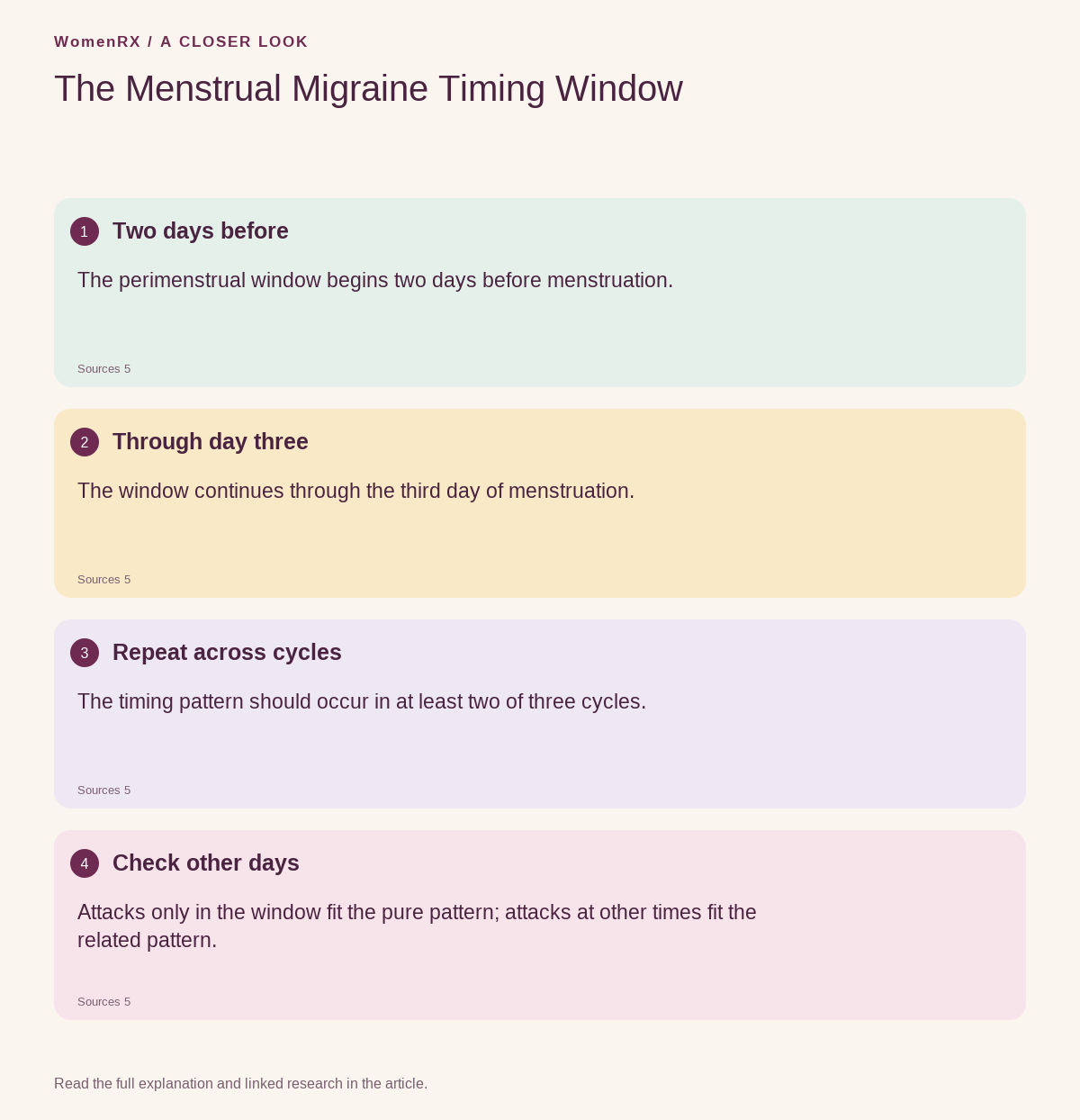
The Menstrual Migraine Timing Window
Two days before: The perimenstrual window begins two days before menstruation.5
Through day three: The window continues through the third day of menstruation.5
Repeat across cycles: The timing pattern should occur in at least two of three cycles.5
Check other days: Attacks only in the window fit the pure pattern; attacks at other times fit the related pattern.5
Read the figure as text
This timeline shows the recurring attack window used to identify a menstrual pattern and how attacks outside it change the classification.- Two days before: The perimenstrual window begins two days before menstruation.5
- Through day three: The window continues through the third day of menstruation.5
- Repeat across cycles: The timing pattern should occur in at least two of three cycles.5
- Check other days: Attacks only in the window fit the pure pattern; attacks at other times fit the related pattern.5
More questions, answered
What if I get migraine outside my period too?
Attacks outside the menstrual window don't rule out menstrually related migraine. The distinction is that pure menstrual migraine occurs only in the perimenstrual window, while menstrually related migraine also occurs at other times. 5
Sources you can check
- Migraine | MedlinePlusAccessed 2026-09-25Return to first citation
- Migraine - NHSAccessed 2026-09-25Return to first citation
- The progress and evolutionary direction of menstrual migraine research: a bibliometric analysis from 1994 to 2026.Li Y, Fu Z, Zhang X, He F, Duan C, Yuan S. · Frontiers in medicine · 2026Return to first citation
- Beyond triptans in menstrual migraine: the emerging role of CGRP-targeted therapies.Pellesi L, Scuteri D, Burgalassi A, Chiarugi A, Martelletti P. · Expert opinion on emerging drugs · 2026Return to first citation
- Clinical characteristics of pure menstrual migraine and menstrually-related migraine: a cross-sectional online questionnaire study.Zhou Y, Zhang Q, Xia T, Guo M, Zhao H. · BMC neurology · 2026Return to first citation
- Efficacy and safety of rimegepant in Chinese women with pure menstrual migraine: a retrospective observational study.Ye W, Fan Y, Liu J, Xu X, Xu X, Li D, Liu J, Huang Y. · BMC neurology · 2026Return to first citation
- Hormonal treatments and migraine characteristics across reproductive stages and transition to menopause: A cross-sectional study.Gómez-Dabó L, Mas-de-Les-Valls R, Murillo A, Gallardo VJ, Torres-Ferrús M, Alpuente A, Mateu T, Giné-Ciprés E, Caronna E, Pozo-Rosich P. · Headache · 2026Return to first citation