Joint Pain Around Menopause: Nonhormonal Relief and When to Investigate
Joint aches can become more common around menopause, but warmth, swelling, stiffness, and changes in what you can do offer better clues about your next step.
Joint pain can occur around menopause, but timing alone won’t tell you what’s causing it. For soreness without warning signs, resting the joint when possible is one option; pain relievers and physical therapy may also be considered based on the cause and your symptoms. Get pain assessed if it worsens, returns, affects sleep or limits daily activities. Joint pain with fever or feeling generally unwell needs urgent assessment, even without heat or swelling. 1 2 3
Menopause timing is a clue, not a diagnosis
If your knees, hands, or other joints started aching as your periods changed, you’re not imagining a possible connection. A review of 37 observational studies involving 93,021 women found that muscle or joint pain was reported by an estimated 40% before menopause, 57% during perimenopause, and 59% after menopause. The studies varied considerably and often didn’t identify the condition behind the pain. Those figures can’t tell you why your joint hurts. 3
Changes in sex hormones may influence musculoskeletal pain, but age and joint conditions can matter too. Research has not established whether replacing hormones treats joint pain once it has developed. You don’t need to assume hormone treatment is the answer before looking at the joint itself. 3 4
What does the painful joint do?
Notice the pattern rather than trying to name the condition yourself. These examples point toward different possibilities, but none confirms a diagnosis:
- After activity: Pain with swelling or bruising after intense or repetitive exercise can fit a sprain or strain. 1
- While walking: Pain that worsens with walking, with stiffness after activity, can fit an osteoarthritis pattern. 1
- After sitting or sleeping: Pain and stiffness on both sides of the body that are worse after being still can occur with rheumatoid arthritis. 1
- Suddenly, in one hot joint: Very bad pain in a hot, swollen big toe can occur with gout. A hot, swollen joint that’s hard to move can signal a joint infection. Fever, feeling generally unwell, or feeling hot, cold, or shivery alongside joint pain also needs urgent assessment, whether or not the joint is hot or swollen. 1
The distinction matters because relief aimed at a sore joint may not address an inflammatory condition or infection. Don’t write off heat or swelling as simply another menopause symptom. 1
Match nonhormonal relief to the situation
For soreness without warning signs, resting the affected joint when you can is a reasonable starting option. If a particular activity preceded the pain, pay attention to whether symptoms settle when the joint is rested. Rest may ease some soreness, but it doesn’t explain why the joint hurts. If pain persists or keeps returning, getting the cause assessed can help guide what to try next. 1
Physical therapy and pain-relieving medicines are among the possible ways to manage pain, but the right choice depends on the cause and type of pain. Physical therapy is a non-drug option to discuss if pain is affecting how you move or manage everyday tasks. If you’re considering medicine, ask which kind fits the suspected cause and your symptoms rather than assuming one pain reliever is best for menopause-timed aches. 2 3
That leaves a useful distinction: an ache that settles with rest may call for a different next step from pain that keeps returning, restricts movement, or comes with swelling. Neither the menopause timing nor temporary relief rules out a joint condition. 1 2
When waiting isn’t the right move
Arrange an evaluation if pain or swelling is getting worse or keeps returning, or if pain is affecting your sleep or stopping normal activities. Joint pain accompanied by feeling generally unwell, a fever, or feeling hot, cold, or shivery needs urgent assessment, even if the joint does not feel hot and look swollen. A hot, swollen joint also needs urgent assessment. 1
Very bad pain after a fall or injury, being unable to put weight on a joint, or a joint that looks out of place also needs urgent care. 1
When you describe the pain, lead with where it is, whether one or both sides hurt, whether you can see swelling or feel warmth, when stiffness is worst, and what you can no longer do comfortably. Those details make the difference between saying “my joints ache lately” and showing someone the pattern they need to assess.
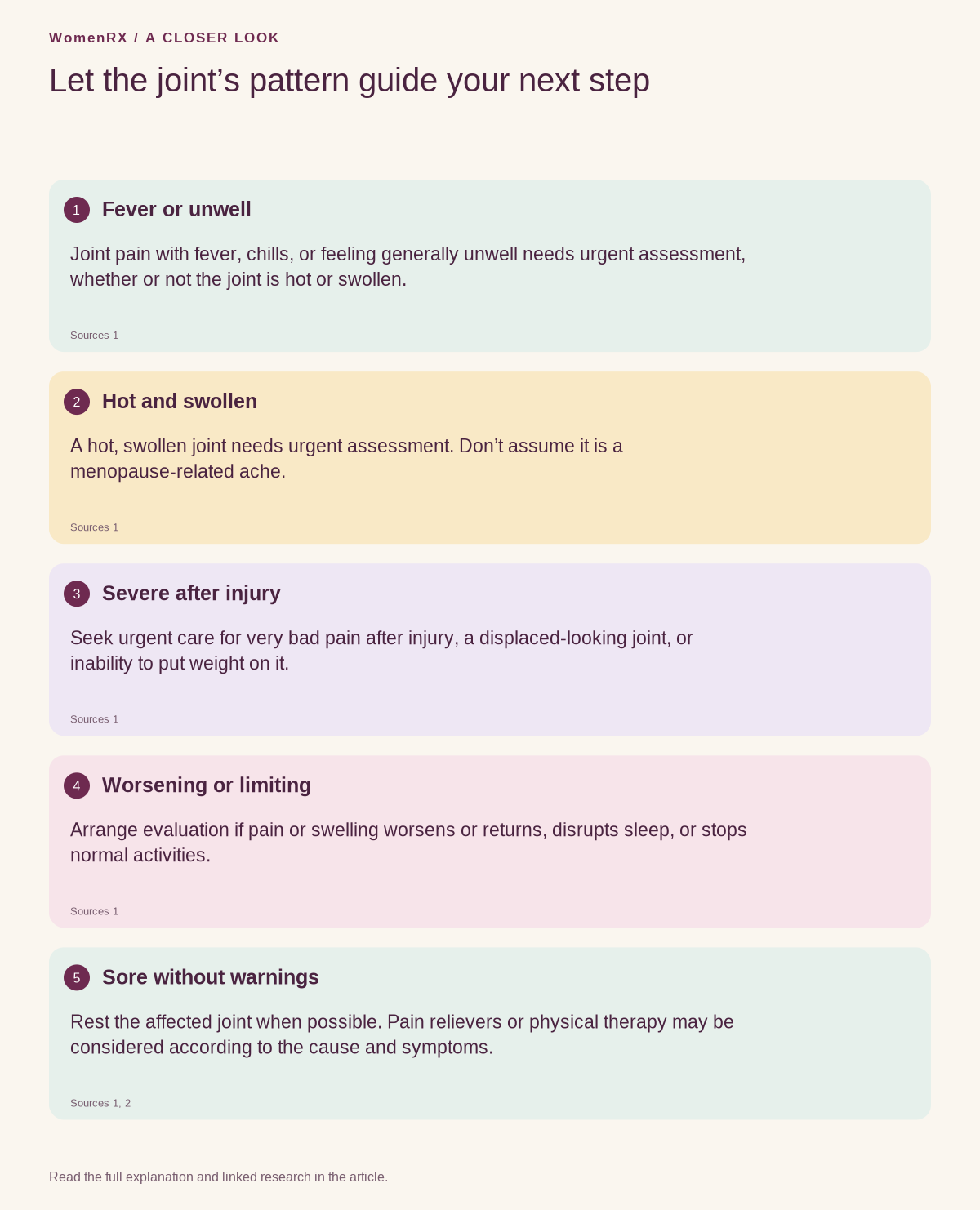
Let the joint’s pattern guide your next step
Fever or unwell: Joint pain with fever, chills, or feeling generally unwell needs urgent assessment, whether or not the joint is hot or swollen.1
Hot and swollen: A hot, swollen joint needs urgent assessment. Don’t assume it is a menopause-related ache.1
Severe after injury: Seek urgent care for very bad pain after injury, a displaced-looking joint, or inability to put weight on it.1
Worsening or limiting: Arrange evaluation if pain or swelling worsens or returns, disrupts sleep, or stops normal activities.1
Sore without warnings: Rest the affected joint when possible. Pain relievers or physical therapy may be considered according to the cause and symptoms.12
Read the figure as text
Start with urgent warning signs, then consider how pain affects daily life. These clues guide action, not self-diagnosis.- Fever or unwell: Joint pain with fever, chills, or feeling generally unwell needs urgent assessment, whether or not the joint is hot or swollen.1
- Hot and swollen: A hot, swollen joint needs urgent assessment. Don’t assume it is a menopause-related ache.1
- Severe after injury: Seek urgent care for very bad pain after injury, a displaced-looking joint, or inability to put weight on it.1
- Worsening or limiting: Arrange evaluation if pain or swelling worsens or returns, disrupts sleep, or stops normal activities.1
- Sore without warnings: Rest the affected joint when possible. Pain relievers or physical therapy may be considered according to the cause and symptoms.12
More questions, answered
Does hormone therapy treat joint pain?
Hormone changes may play a role in musculoskeletal pain, but whether hormone therapy relieves joint pain after it starts is much less established. A painful joint still deserves attention on its own terms, especially if it’s worsening, limiting what you can do, or hot and swollen. 1 4
Sources you can check
- Joint pain - NHSAccessed 2026-09-25Return to first citation
- Pain | MedlinePlusAccessed 2026-09-25Return to first citation
- Musculoskeletal Manifestations of Perimenopause: A Systematic Review and Meta-Analysis of 93,021 Women.Kruse C, McKechnie T, Dworsky-Fried J, Sardar A, Hacker G, Rattansi S, Fang E, Sprague S, Shea AK, Bhandari M. · JB & JS open access · 2026Return to first citation
- The influence of sex hormones on musculoskeletal pain and osteoarthritis.Gulati M, Dursun E, Vincent K, Watt FE. · The Lancet. Rheumatology · 2023Return to first citation