Joint Pain During Menopause: What to Notice and Do
Menopause may be part of the picture, but the pattern of pain, stiffness, and swelling helps you decide what needs attention.
Joint and muscle aches are reported more often during perimenopause and after menopause, but a new joint problem could also be related to injury or arthritis. Notice which joints hurt, when stiffness occurs, whether there’s swelling or warmth, and what the pain stops you doing. Pain that disrupts sleep or daily activities deserves assessment; a hot, swollen joint needs urgent care. 6 1
A knee that aches on the stairs or hands that feel stiff on waking can make you wonder whether menopause is the reason. It may be part of the picture. A 2026 analysis of 37 observational studies involving 93,021 women estimated that muscle or joint pain was reported by 40% of premenopausal women, 57% of perimenopausal women, and 59% of postmenopausal women. The studies varied considerably and often did not identify a specific joint condition. Those figures describe a pattern across groups, not the cause of your pain. 6
Changing estrogen levels may influence musculoskeletal pain, but age, previous injuries, and joint conditions can overlap with the menopause transition. Joint pain isn’t something you have to accept as inevitable, and its timing alone doesn’t tell you what treatment will help. 7 6 1
What does the pain pattern suggest?
The most useful clues are often what happens around the ache: what you were doing before it started, when stiffness is worst, and whether the joint looks different. These patterns suggest possibilities, not diagnoses:
- After intense or repetitive activity: Pain with swelling or bruising can fit a sprain or strain. 1
- Worse when walking, with stiffness after activity: This can occur with osteoarthritis. 1
- On both sides and worse after being still: Pain and stiffness in joints on both sides of the body, particularly after rest, can be a clue to rheumatoid arthritis. 1
- Suddenly very painful, hot, and swollen: A big-toe joint with this pattern can fit gout. A hot, swollen joint that’s difficult to move, especially if you feel feverish or unwell, can signal a joint infection. 1
For example, “My right knee began hurting after a long walk and is bruised” describes a different problem from “Both hands are stiff when I wake up.” Neither description settles the cause, but each helps direct the assessment. 1
Keep a short record, not a complicated diary
If the pain continues or returns, jot down which joints are affected and whether the pain is on one side or both. Note when it began, whether it came on suddenly or gradually, and whether it comes and goes. Add any injury or unusual activity, stiffness after rest or activity, and visible swelling, warmth, or bruising. Then name the practical effect: for example, difficulty walking, gripping, sleeping, or doing your usual activities. Pain location, timing, what relieves it, and its effect on daily life are useful details when the cause isn’t clear. 1 2
You don’t need to wait for a record to be complete before getting help. Arrange an assessment if joint pain affects your sleep or normal activities, or if pain or swelling is getting worse or keeps coming back. 1
Seek urgent care for a painful joint with hot, swollen skin around it, or joint pain accompanied by fever, chills, or feeling generally unwell. Seek emergency care if you cannot walk or put weight on a joint, or if you have very severe joint pain after a fall or injury. These patterns need attention rather than an assumption that hormones are responsible. 1
Relief depends on the cause
For an uncomplicated painful joint, temporarily resting it and using an ice pack wrapped in a towel may ease symptoms. A pharmacist or clinician can help you choose a pain reliever that fits your circumstances. Don’t use home care to delay assessment of a hot, swollen joint or pain that is worsening or limiting what you can do. 1
Longer-term care may look different for an injury, osteoarthritis, or an inflammatory joint condition. Exercise and weight loss may be helpful considerations particularly when osteoarthritis is involved, but they aren’t one-size-fits-all remedies for new joint pain. If movement currently hurts, finding out what’s going on comes before trying to push through it. 4 1
Sleep belongs in the conversation, too. In a cross-sectional study of 305 Japanese women aged 40 to 59 attending a menopause clinic, daily muscle or joint pain was associated with more insomnia symptoms and lower grip strength. The study cannot tell which came first. If pain wakes you or poor sleep seems to make a difficult day harder, describe both. 5
Hormone therapy is not an established stand-alone treatment for joint pain. A review of sex hormones and musculoskeletal pain found that hormone changes may influence pain, while the effects of hormone replacement as a treatment after symptoms develop remain much less certain. The Menopause Society’s hormone-therapy guidance identifies established benefits for hot flashes and night sweats, genitourinary symptoms, and prevention of bone loss and fracture, not joint-pain treatment. If you’re discussing hormone therapy for other symptoms, your joint pain still deserves its own assessment. 7 3
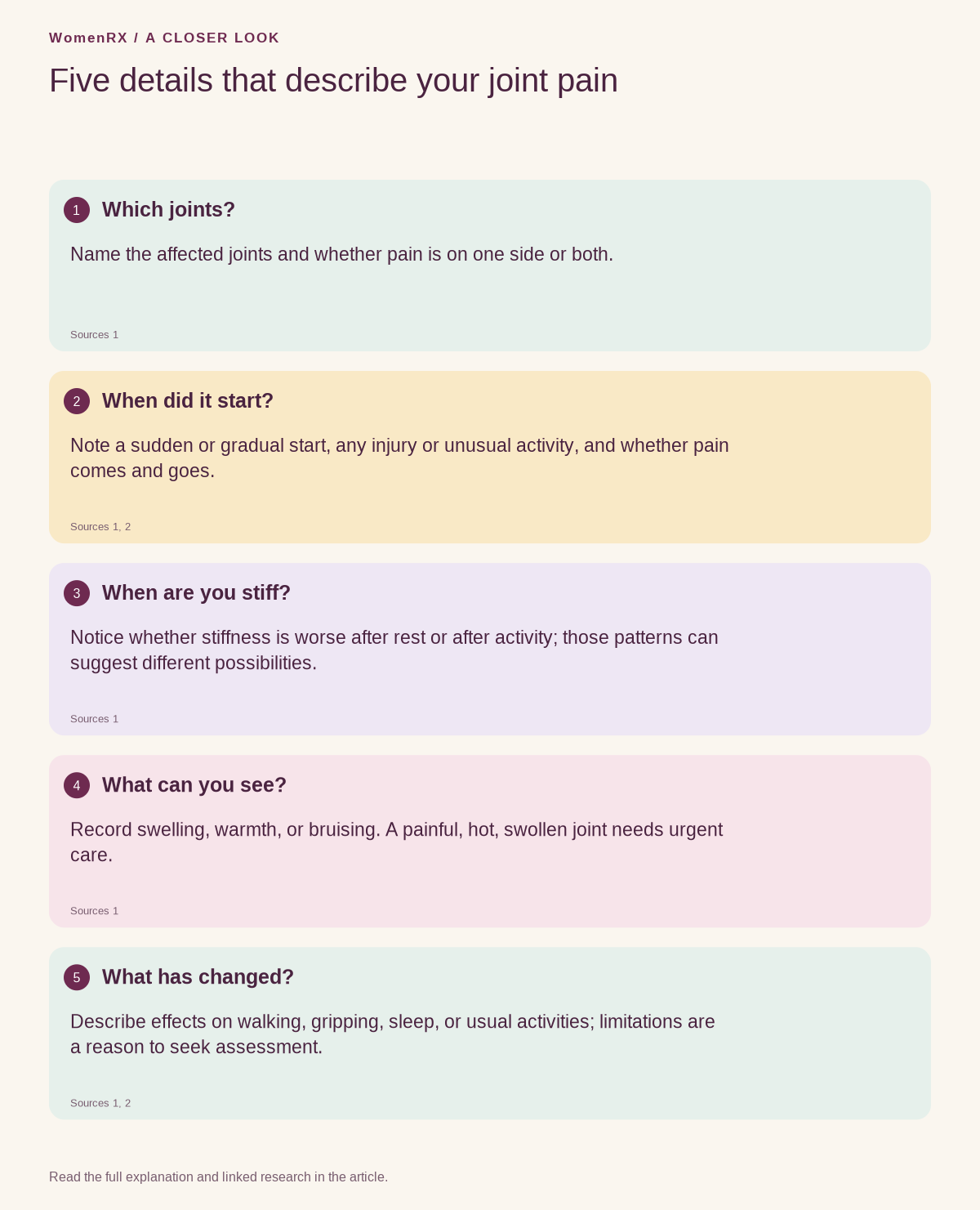
Five details that describe your joint pain
Which joints?: Name the affected joints and whether pain is on one side or both.1
When did it start?: Note a sudden or gradual start, any injury or unusual activity, and whether pain comes and goes.12
When are you stiff?: Notice whether stiffness is worse after rest or after activity; those patterns can suggest different possibilities.1
What can you see?: Record swelling, warmth, or bruising. A painful, hot, swollen joint needs urgent care.1
What has changed?: Describe effects on walking, gripping, sleep, or usual activities; limitations are a reason to seek assessment.12
Read the figure as text
A short note can make the pattern easier to explain. This is a conversation aid, not a diagnostic score.- Which joints?: Name the affected joints and whether pain is on one side or both.1
- When did it start?: Note a sudden or gradual start, any injury or unusual activity, and whether pain comes and goes.12
- When are you stiff?: Notice whether stiffness is worse after rest or after activity; those patterns can suggest different possibilities.1
- What can you see?: Record swelling, warmth, or bruising. A painful, hot, swollen joint needs urgent care.1
- What has changed?: Describe effects on walking, gripping, sleep, or usual activities; limitations are a reason to seek assessment.12
Sources you can check
- Joint pain - NHSAccessed 2026-09-25Return to first citation
- Pain | MedlinePlusAccessed 2026-09-25Return to first citation
- The 2022 hormone therapy position statement of The North American Menopause Society.“The 2022 Hormone Therapy Position Statement of The North American Menopause Society” Advisory Panel. · Menopause (New York, N.Y.) · 2022Return to first citation
- Menopausal arthralgia: Fact or fiction.Magliano M. · Maturitas · 2010Return to first citation
- Muscle and joint pains in middle-aged women are associated with insomnia and low grip strength: a cross-sectional study.Terauchi M, Odai T, Hirose A, Kato K, Akiyoshi M, Miyasaka N. · Journal of psychosomatic obstetrics and gynaecology · 2020Return to first citation
- Musculoskeletal Manifestations of Perimenopause: A Systematic Review and Meta-Analysis of 93,021 Women.Kruse C, McKechnie T, Dworsky-Fried J, Sardar A, Hacker G, Rattansi S, Fang E, Sprague S, Shea AK, Bhandari M. · JB & JS open access · 2026Return to first citation
- The influence of sex hormones on musculoskeletal pain and osteoarthritis.Gulati M, Dursun E, Vincent K, Watt FE. · The Lancet. Rheumatology · 2023Return to first citation