Menopause Joint Pain: Where Diet Fits
Diet may support osteoarthritis care, but studies of osteoarthritis don’t show whether food changes ease joint pain related to menopause.
A dietary change can be a reasonable supportive step, particularly if osteoarthritis is part of the picture. Randomized trials in people with osteoarthritis found overall improvements in pain and function across varied dietary interventions, but they don’t establish a menopause-specific food or diet. A hot, swollen joint or prolonged stiffness needs assessment; severe injury signs need urgent or emergency care. 1 2 4
Menopause timing doesn’t identify the cause
Joint aches can occur around perimenopause and menopause, but timing alone can’t show what’s behind them. Injury, osteoarthritis, and inflammatory conditions can also cause joint pain. The pattern matters: osteoarthritis often hurts more with use, while prolonged morning stiffness or stiffness after rest can point to a different joint condition. 1 2
For example, a knee that aches more on stairs may fit an osteoarthritis pattern. Pain and stiffness on both sides of the body that are worse after not moving, or morning stiffness that lasts a long time, are reasons to get assessed rather than assume the pain is simply hormonal. These patterns are clues, not a diagnosis. 1 2
What diet studies in osteoarthritis found
A 2025 systematic review and meta-analysis included nine randomized trials with 898 people with osteoarthritis. The trials tested varied approaches, including reduced-energy, Mediterranean, low-fat, anti-inflammatory, low-carbohydrate, and plant-based diets. Taken together, the interventions were associated with improvements in pain and physical function. That finding is about osteoarthritis; it doesn’t establish that diet eases joint pain specifically associated with menopause. 4
The results also don’t identify a single best food or eating pattern. In the review, the Mediterranean-diet subgroup did not show statistically significant improvements in pain or physical function. A separate four-week, open-label pilot of an anti-inflammatory diet in 20 people with knee osteoarthritis reported reduced pain, but the small study can’t establish how well that approach works more broadly. 4 6
So if you want to change how you eat, treat it as possible support for osteoarthritis care, not a proven menopause treatment. If weight is contributing to strain on weight-bearing joints, weight management may be relevant; it doesn’t require assuming a particular “anti-inflammatory” food list will relieve pain. Exercise that strengthens muscles and improves general fitness is also a key part of osteoarthritis care. 2 3
Supplements are a separate question
Evidence about whole-diet changes doesn’t automatically apply to supplements. A 2026 review found uncertain evidence for glucosamine supplements in preventing or reducing knee osteoarthritis progression or joint replacement. Those outcomes don’t establish a benefit for current joint pain, and they don’t address menopause-related aches. 5
When the next step is assessment
Arrange an assessment if joint pain keeps returning, gets worse, persists, affects sleep, or makes everyday activities difficult. Prolonged morning stiffness is another reason to look beyond self-treatment, since it can suggest a condition other than osteoarthritis. 1 2
A hot, swollen joint needs urgent medical assessment, especially if you also have a fever or feel generally unwell. After an injury, very severe pain, inability to put weight on the joint, or tingling or loss of feeling around it calls for emergency assessment. Ordinary post-activity soreness or a possible strain isn’t the same as these serious injury signs. 1
Diet can be one supportive part of care, but it can’t tell you why a joint hurts. Heat and swelling, prolonged stiffness, or serious injury signs change the question from what to eat to what needs assessment.
Diet support or symptom assessment?
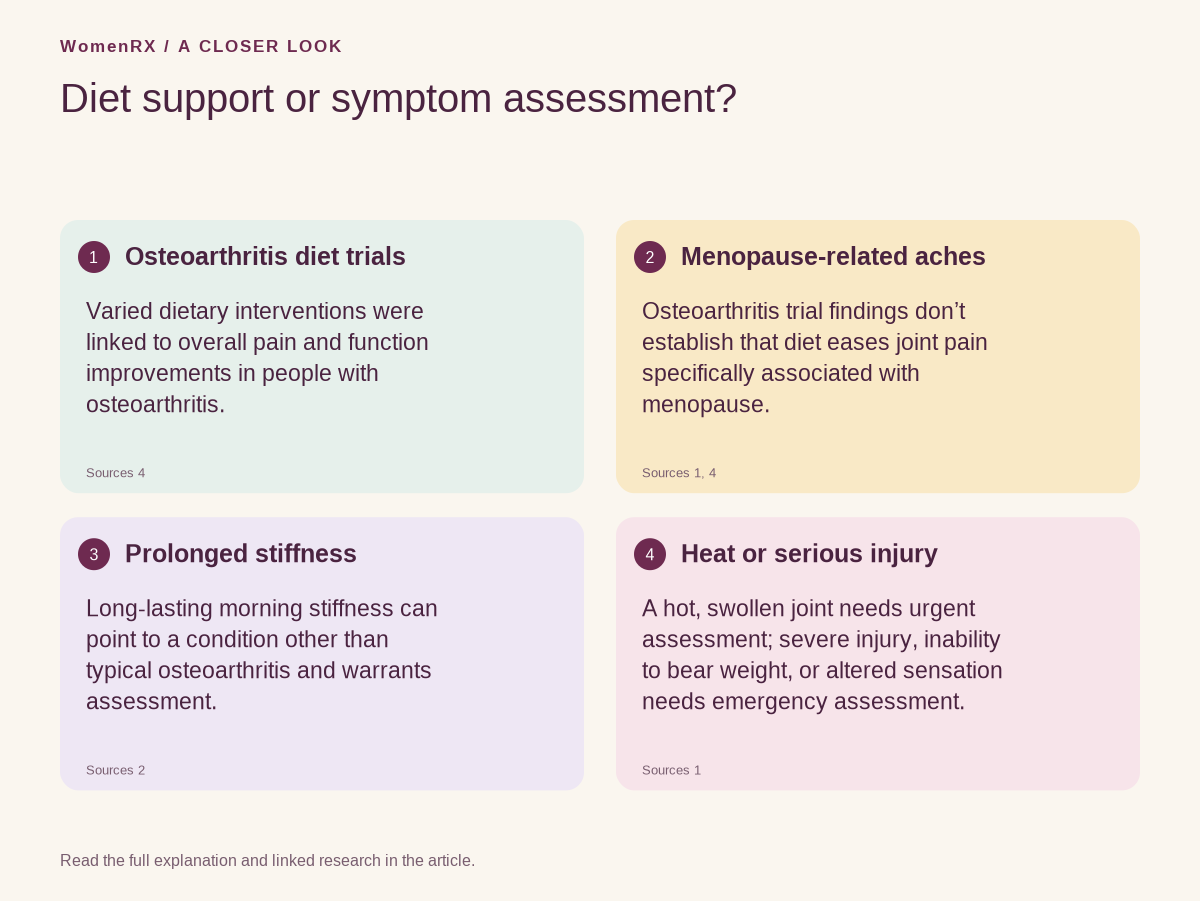
Osteoarthritis diet trials: Varied dietary interventions were linked to overall pain and function improvements in people with osteoarthritis.4
Menopause-related aches: Osteoarthritis trial findings don’t establish that diet eases joint pain specifically associated with menopause.14
Prolonged stiffness: Long-lasting morning stiffness can point to a condition other than typical osteoarthritis and warrants assessment.2
Heat or serious injury: A hot, swollen joint needs urgent assessment; severe injury, inability to bear weight, or altered sensation needs emergency assessment.1
Read the figure as text
These distinctions show where osteoarthritis diet findings may fit and which joint symptoms call for assessment instead of self-treatment.- Osteoarthritis diet trials: Varied dietary interventions were linked to overall pain and function improvements in people with osteoarthritis.4
- Menopause-related aches: Osteoarthritis trial findings don’t establish that diet eases joint pain specifically associated with menopause.14
- Prolonged stiffness: Long-lasting morning stiffness can point to a condition other than typical osteoarthritis and warrants assessment.2
- Heat or serious injury: A hot, swollen joint needs urgent assessment; severe injury, inability to bear weight, or altered sensation needs emergency assessment.1
More questions, answered
Does a Mediterranean diet help menopause-related joint pain?
It hasn’t been established for menopause-related joint pain. In a review of osteoarthritis trials, the Mediterranean-diet subgroup did not show statistically significant improvements in pain or function. That result doesn’t prove the diet has no value; it means those findings don’t establish it as a joint-pain treatment. 4
Can I wait to see if diet changes help a hot, swollen joint?
No. A hot, swollen joint needs urgent assessment, particularly if you also have a fever or feel unwell. Diet changes can’t identify the cause of that symptom. 1
Sources you can check
- Joint pain - NHSAccessed 2026-09-25Return to first citation
- Osteoarthritis - NHSAccessed 2026-09-25Return to first citation
- Osteoarthritis - Treatment and support - NHSAccessed 2026-09-25Return to first citation
- The effectiveness of dietary intervention in osteoarthritis management: a systematic review and meta-analysis of randomized clinical trials.Asadi S, Grafenauer S, Burley CV, Fitzgerald C, Humburg P, Parmenter BJ. · European journal of clinical nutrition · 2025Return to first citation
- Intervention Strategies for Preventing Knee Osteoarthritis: A Systematic Review.Almeida Silva HJ, Perea J, Dantas G, Ferrari AV, Wolden M, Salvini TF, de Campos TF. · JOSPT open · 2026Return to first citation
- Targeted Microbial Shifts and Metabolite Profiles Were Associated with Clinical Response to an Anti-Inflammatory Diet in Osteoarthritis.Sala-Climent M, Bu K, Coras R, Cedeno M, Zuffa S, Murillo-Saich J, Mannochio-Russo H, Allaband C, Hose MK, Quan A, Choi SI, Nguyen K, Golshan S, Blank RB, Holt T, Lane NE, Knight R... · Nutrients · 2025Return to first citation