Menopause and Joint Pain: What the Hormone Link Shows
Joint aches can coincide with menopause, but timing alone can’t tell you whether estrogen is the cause.
Hormone changes may contribute to joint pain around menopause, but an ache that starts at midlife isn’t proof that estrogen caused it. Age, injury, arthritis, and other influences can also matter. Research into estrogen offers plausible explanations and observed links, but available evidence doesn’t establish hormone therapy as a treatment for general joint pain. 1 3 4 5
A midlife pattern isn’t a personal diagnosis
Joint aches can appear around perimenopause or menopause. That makes hormones reasonable to consider when pain begins during this transition. But timing is a clue, not a diagnosis: it can’t show what is causing pain in your knee, hands, or another joint. 1 3
Age and menopause also overlap. Osteoarthritis becomes more common with age, and researchers have examined whether declining estrogen contributes to its prevalence after menopause. That overlap makes it hard to separate aging from hormonal change. Neither one explains every new ache. 4 6
Three questions the research answers differently
Could estrogen matter biologically? Estrogen receptors have been identified in joint and spinal-disc tissues. A review also describes animal studies in which estrogen deficiency was linked with changes in joint cartilage and bone. These findings give researchers a reason to investigate a hormone link. They don’t show that falling estrogen directly caused pain in an individual woman. 4
Do joint pain and other factors occur together? In a cross-sectional survey of 371 women attending a Canadian menopause clinic, 52% reported moderate-to-severe joint pain. Smoking was associated with joint pain after researchers accounted for age, estrogen use, alcohol use, obesity, and depression. Because the survey captured information at one point in time, it can’t establish why participants had pain. A specialty-clinic sample also may not reflect all women at midlife. 2
Does hormone treatment relieve joint pain? That requires evidence about treatment, not just a plausible mechanism or an association. A small cross-sectional study compared 45 women with a specific painful jaw disorder, including groups with and without hormone therapy. It found differences in how much pain interfered with daily activities and in emotional measures. It wasn’t a treatment trial, so it can’t establish that hormone therapy caused those differences or that it relieves general joint pain. 5
Those distinctions matter if you’re weighing what to do next. Pain that arrives during menopause deserves attention, but its timing alone isn’t a reason to assume hormone treatment will fix it.
Look at the pain, not just the calendar
Joint pain can follow an injury or repetitive strain, or be related to arthritis and other conditions. For example, osteoarthritis may involve pain with walking and stiffness after activity. Rheumatoid arthritis may involve stiffness after resting and symptoms on both sides of the body. These patterns are clues, not ways to diagnose yourself. 1
Pain is also more than a measure of what’s happening in a joint. A review of menopause-related pain describes hormonal, psychosocial, and other influences; sleep disturbance and stress may affect how pain feels. In the menopause-clinic survey, age and obesity weren’t significantly associated with joint pain in that sample. That finding doesn’t rule out their relevance for you or for women in other settings. 2 3
If pain keeps returning, is getting worse, or disrupts your sleep or usual activities, arrange a medical assessment rather than writing it off as menopause. Seek prompt medical assessment if the skin around a painful joint is hot and swollen, or if you have joint pain and feel feverish or generally unwell. Either sign warrants urgent attention on its own. 1
What the hormone evidence can tell you
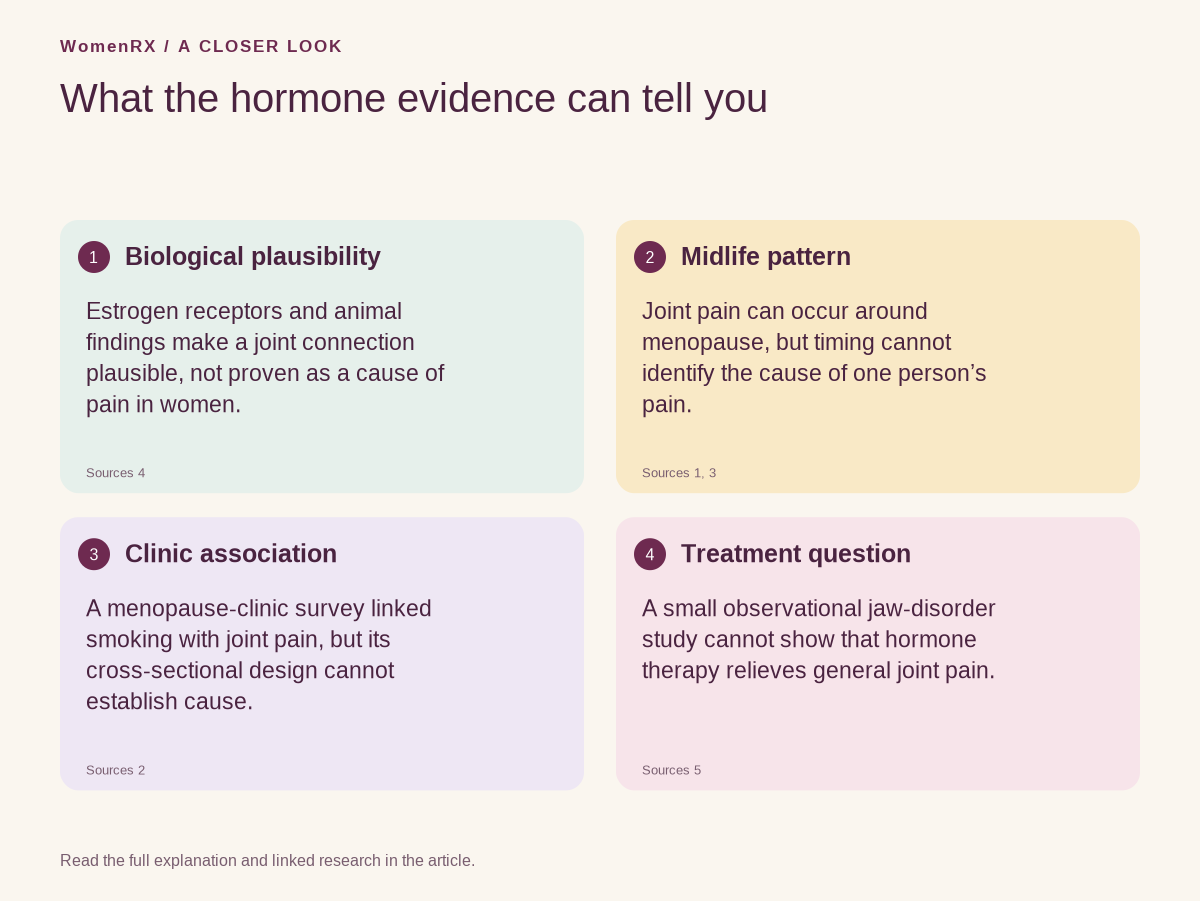
Biological plausibility: Estrogen receptors and animal findings make a joint connection plausible, not proven as a cause of pain in women.4
Midlife pattern: Joint pain can occur around menopause, but timing cannot identify the cause of one person’s pain.13
Clinic association: A menopause-clinic survey linked smoking with joint pain, but its cross-sectional design cannot establish cause.2
Treatment question: A small observational jaw-disorder study cannot show that hormone therapy relieves general joint pain.5
Read the figure as text
A mechanism, an observed pattern, and a treatment finding answer different questions about menopause and joint pain.- Biological plausibility: Estrogen receptors and animal findings make a joint connection plausible, not proven as a cause of pain in women.4
- Midlife pattern: Joint pain can occur around menopause, but timing cannot identify the cause of one person’s pain.13
- Clinic association: A menopause-clinic survey linked smoking with joint pain, but its cross-sectional design cannot establish cause.2
- Treatment question: A small observational jaw-disorder study cannot show that hormone therapy relieves general joint pain.5
More questions, answered
Does joint pain around menopause mean I have osteoarthritis?
No. Joint pain has several possible causes, including injury and different forms of arthritis. The timing and symptom pattern can offer clues, but they can’t establish the cause on their own. 1
Sources you can check
- Joint pain - NHSAccessed 2026-09-25Return to first citation
- The association between smoking and joint pain in women attending a specialized menopause clinic.Roebotham T, Ghasemi F, Wolfman W. · Climacteric : the journal of the International Menopause Society · 2026Return to first citation
- Pain during menopause.Strand NH, D'Souza RS, Gomez DA, Whitney MA, Attanti S, Anderson MA, Moeschler SM, Chadwick AL, Maloney JA. · Maturitas · 2025Return to first citation
- Low back pain and osteoarthritis pain: a perspective of estrogen.Pang H, Chen S, Klyne DM, Harrich D, Ding W, Yang S, Han FY. · Bone research · 2023Return to first citation
- Hormone therapy and psychosocial factors in menopausal women with painful TMD: a pilot cross-sectional study.Farias LNG, Costa Neto RED, Pinheiro MA, Cavalcanti YW. · Journal of applied oral science : revista FOB · 2026Return to first citation
- The intersection of aging and estrogen in osteoarthritis.Atasoy-Zeybek A, Showel KK, Nagelli CV, Westendorf JJ, Evans CH. · npj women's health · 2025Return to first citation