Joint Pain Around Menopause: What May Help and When to Look Further
Aches can overlap with the menopause transition, but their timing alone can’t tell you what’s causing them or whether hormone therapy will help.
Joint aches can happen around menopause, but timing doesn’t establish their cause. A fibromyalgia review finds limited evidence for hormone therapy as primary treatment of that separate condition; a menopause-arthralgia review does not establish whether it helps general joint aches. Regular exercise can help osteoarthritis symptoms, but that finding doesn’t explain unexplained aches. Persistent or limiting pain, or a hot, swollen joint, needs assessment. 1 3 4 5
Menopause may be part of the picture, not the whole answer
Joint aches are reported around menopause, and changes in sex hormones have been proposed as one possible part of the picture. But joint pain also has many other causes, including injury and arthritis. A review of menopause-related joint pain describes the relationship with changing hormones and age-related muscle loss, while noting that treatment approaches have generally focused on symptoms. That makes the timing a useful clue to mention, not a diagnosis. 1 5
Whether hormone therapy helps general menopause-related joint pain isn’t established by these reviews. A review focused on fibromyalgia says evidence for menopausal hormone therapy as a primary treatment is limited, and fibromyalgia is not the same as unexplained joint aches or arthritis. The menopause-related arthralgia review describes symptomatic approaches but does not report a hormone-therapy treatment effect. The practical point is narrower: joint pain alone does not show that hormone therapy will help, so don’t assume the cause or expected benefit from timing alone. 4 5
The pattern can offer clues
Aches in several places or stiffness after resting can occur for different reasons. Osteoarthritis often affects the knees, hips, or small joints of the hands. Pain may worsen with use, and stiffness after waking is usually brief. Persistent morning stiffness, especially with pain and stiffness on both sides of the body that is worse after being still, can point to a different kind of joint problem and is worth discussing. These patterns are clues, not a way to diagnose yourself. 1 2
A single joint that becomes hot and swollen is different from a mild, familiar ache. So is a sudden, very painful swollen joint. A hot, swollen joint with fever or feeling generally unwell needs urgent assessment, because joint infection is one possible cause. 1
Match the response to the problem
When osteoarthritis is the cause, choose movement you can sustain. Regular activity that builds strength and general fitness usually helps symptoms. Starting too quickly or doing the wrong kind of exercise can aggravate or injure a joint, so a gradual plan, with guidance from a physical therapist when needed, is a better fit than pushing through a flare or avoiding movement altogether. 3
For diagnosed knee osteoarthritis, education can support exercise, but it isn’t a proven upgrade for every outcome. A review of eight randomized trials found that education combined with exercise reduced pain in its pooled analysis. It did not find significant improvement across the measured knee-function domains, and the authors said the combination may not be more effective than exercise alone for daily activities, symptoms, or quality of life. Those findings apply to knee osteoarthritis, not menopause-related joint aches generally. 6
For pain relief, the cause and your health matter. Osteoarthritis guidance describes short-term paracetamol as one option a clinician may suggest, and topical anti-inflammatory medicines as an option for some knee or hand osteoarthritis. The same guidance says medicine choice depends on pain severity and other health conditions. These are options for a discussion about suspected or diagnosed osteoarthritis, not evidence that a particular medicine treats menopause-related joint pain. 3
If everyday tasks are becoming harder, ask about practical support. For osteoarthritis, physiotherapy or occupational therapy may help with an exercise plan, ways to reduce strain during daily activities, or an assistive device. The right support depends on which joint is affected and what you’re finding difficult. 2 3
When to get another cause checked
Arrange an evaluation if pain persists, keeps returning, or interferes with ordinary activities. A clinician can ask about the pattern and examine the joint; tests may be used when another cause needs to be ruled out. Don’t wait for a routine discussion if the joint is hot and swollen, especially if you also have a fever or feel unwell. Seek urgent care for a joint that has moved out of place, or numbness or tingling around an injured joint. 1 2
To make the conversation more useful, note which joints hurt, whether one or both sides are affected, what movement or rest does to the pain, and whether you see swelling or warmth. Mention when the aches began in relation to changes in your menstrual cycle or other menopause symptoms. This information can help explain the pattern; it can’t by itself identify the cause.
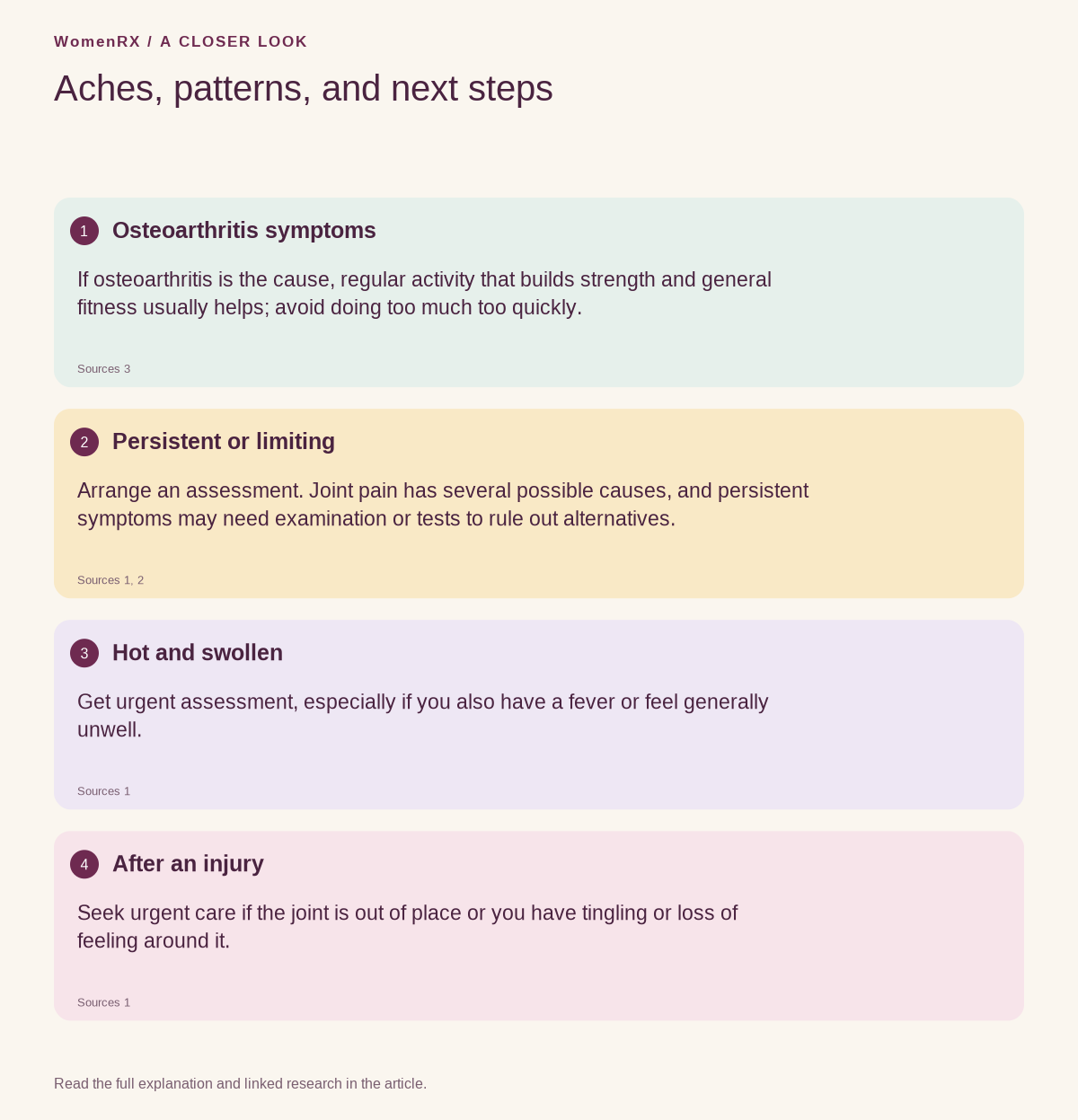
Aches, patterns, and next steps
Osteoarthritis symptoms: If osteoarthritis is the cause, regular activity that builds strength and general fitness usually helps; avoid doing too much too quickly.3
Persistent or limiting: Arrange an assessment. Joint pain has several possible causes, and persistent symptoms may need examination or tests to rule out alternatives.12
Hot and swollen: Get urgent assessment, especially if you also have a fever or feel generally unwell.1
After an injury: Seek urgent care if the joint is out of place or you have tingling or loss of feeling around it.1
Read the figure as text
Use joint-pain patterns to identify an osteoarthritis-specific activity option and signs calling for assessment or urgent care.- Osteoarthritis symptoms: If osteoarthritis is the cause, regular activity that builds strength and general fitness usually helps; avoid doing too much too quickly.3
- Persistent or limiting: Arrange an assessment. Joint pain has several possible causes, and persistent symptoms may need examination or tests to rule out alternatives.12
- Hot and swollen: Get urgent assessment, especially if you also have a fever or feel generally unwell.1
- After an injury: Seek urgent care if the joint is out of place or you have tingling or loss of feeling around it.1
More questions, answered
Does joint pain mean I have arthritis?
No. Joint pain can follow an injury or have other causes, and symptoms can overlap. Persistent pain or stiffness is a reason to have the cause assessed rather than assume it is arthritis or menopause-related. 1 2
Can exercise make a painful joint worse?
Doing too much too soon or choosing an unsuitable activity can aggravate or damage a joint. For osteoarthritis, regular activity that builds strength and fitness usually helps, so a gradual plan suited to your symptoms is preferable to stopping all movement. 3
Sources you can check
- Joint pain - NHSAccessed 2026-09-25Return to first citation
- Osteoarthritis - NHSAccessed 2026-09-25Return to first citation
- Osteoarthritis - Treatment and support - NHSAccessed 2026-09-25Return to first citation
- Climacteric and fibromyalgia: a review.Vidal-Neira LF, Neyro JL, Maldonado G, Messina OD, Moreno-Alvarez M, Ríos C. · Climacteric : the journal of the International Menopause Society · 2024Return to first citation
- Arthralgia of menopause - A retrospective review.Blumer J. · Post reproductive health · 2023Return to first citation
- Impact of education protocols and physiotherapeutic management in improving pain, symptoms, activities of daily living, and quality of life in patients with knee osteoarthritis: A systematic review and meta-analysis.Parmar Y, Sharma S. · The Knee · 2026Return to first citation