Joint Pain Around Menopause: What Can Supplements Actually Do?
Some supplements have improved pain or function in knee osteoarthritis studies, but those findings don’t establish a benefit for aches specifically linked to menopause.
A few supplements have shown improvements in pain, stiffness, or function in studies of people diagnosed with knee osteoarthritis. Results differ by supplement and outcome, and the analyses discussed here don’t report participants’ menopausal stage. So they can’t tell you whether supplements help menopause-related aches or whether your pain has another cause. 23
Menopause may be part of the picture, but it isn’t a diagnosis
Joint aches can happen during perimenopause and menopause. But when pain starts around the same time as other changes, that timing alone can’t tell you what’s causing it. An injury or arthritis may also be involved, and different joint symptoms can point to different possibilities. 1
For example, pain that’s worse when walking, with stiffness after activity, can fit osteoarthritis. A hot, swollen joint or pain and stiffness on both sides of the body that’s worse after resting may fit other conditions. These patterns aren’t enough to diagnose the cause, but they’re a reason not to treat every midlife ache as the same problem. 1
What the supplement studies actually measured
The main comparison here is between supplements studied in people with diagnosed knee osteoarthritis and the separate question of menopause-related aches. One network meta-analysis included 39 randomized trials, with 4,599 people who had knee osteoarthritis. Women made up a larger share of participants than men, but the analysis details don’t report their menopausal stage. That means the results can’t show whether the supplements work differently, or at all, for menopause-related pain. 2
In that analysis, Boswellia performed better than placebo on measured knee pain, stiffness, and physical function. Curcumin and some other supplements showed benefits on some outcomes. Those are symptom and function findings, not evidence that a supplement repairs cartilage or treats a change in estrogen. 2
A separate analysis of 22 studies and 2,777 participants ranked different named products for different outcomes, including pain, stiffness, and function. Its rankings don’t point to one clear winner across every measure. A high ranking in one analysis also doesn’t establish that every product containing a similar ingredient will have the same effect. 3
How to use these findings when weighing a supplement
Start with the condition and outcome, not a broad promise like “joint support.” The reviewed studies concern knee osteoarthritis. They don’t establish a benefit for pain in several joints, an undiagnosed ache, or pain specifically associated with menopause. And while glucosamine and chondroitin are mentioned in the background to one review, its reported results don’t give a useful comparison of those supplements. 23
The studies also used different products and study durations. The larger analysis notes that more trials using standardized formulations are needed. So even where a result looks promising, it may not tell you which version of a supplement to choose or what to expect over the long term. 2
When pain deserves attention beyond self-treatment
Arrange an evaluation if pain keeps returning or worsening, affects your sleep, or makes normal activities difficult. A hot, swollen joint, especially with a fever or feeling generally unwell, calls for urgent medical assessment. 1
Get emergency care for very severe joint pain after a fall or injury, inability to walk or put weight on the joint, a joint that has moved out of place, or new tingling or loss of feeling near an injured joint. 1
A supplement result in knee osteoarthritis may be one clue about symptom relief for that condition. It can’t confirm that menopause is causing your pain or rule out another explanation.
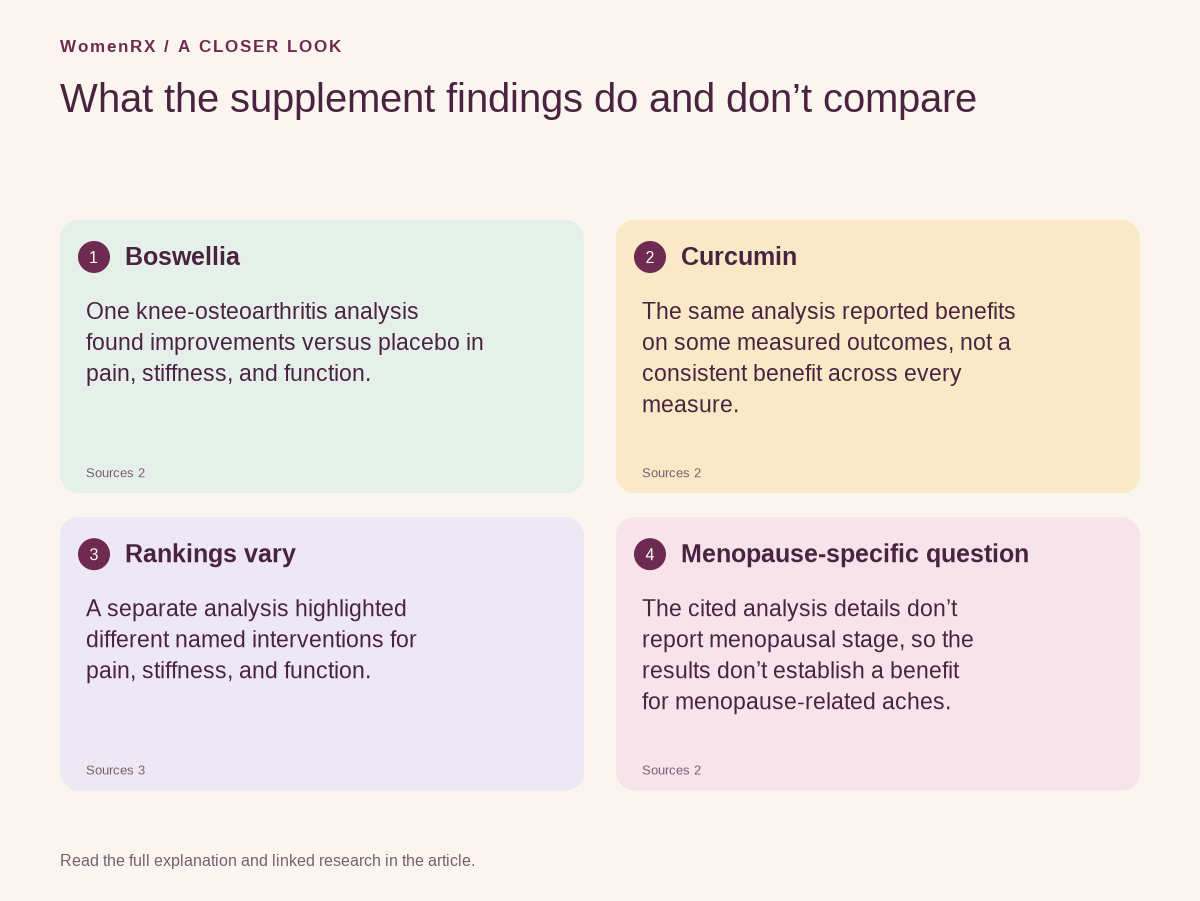
What the supplement findings do and don’t compare
Boswellia: One knee-osteoarthritis analysis found improvements versus placebo in pain, stiffness, and function.2
Curcumin: The same analysis reported benefits on some measured outcomes, not a consistent benefit across every measure.2
Rankings vary: A separate analysis highlighted different named interventions for pain, stiffness, and function.3
Menopause-specific question: The cited analysis details don’t report menopausal stage, so the results don’t establish a benefit for menopause-related aches.2
Read the figure as text
The reported results are about diagnosed knee osteoarthritis. They don’t answer whether supplements ease pain specifically linked to menopause.- Boswellia: One knee-osteoarthritis analysis found improvements versus placebo in pain, stiffness, and function.2
- Curcumin: The same analysis reported benefits on some measured outcomes, not a consistent benefit across every measure.2
- Rankings vary: A separate analysis highlighted different named interventions for pain, stiffness, and function.3
- Menopause-specific question: The cited analysis details don’t report menopausal stage, so the results don’t establish a benefit for menopause-related aches.2
Sources you can check
- Joint pain - NHSAccessed 2026-09-25Return to first citation
- Comparative Effectiveness of Nutritional Supplements in the Treatment of Knee Osteoarthritis: A Network Meta-Analysis.Zhang Y, Gui Y, Adams R, Farragher J, Itsiopoulos C, Bow K, Cai M, Han J. · Nutrients · 2025Return to first citation
- Efficacy of dietary supplements for treating knee osteoarthritis: a systematic review and network meta-analysis.Du P, Ajia A, Xiang Z, Zheng S, Hu C, Wang P. · Frontiers in nutrition · 2025Return to first citation