Do Joint Supplements Help With Osteoarthritis Pain?
For knee osteoarthritis, glucosamine may offer a small pain benefit, but clear improvement in daily function hasn’t been shown.
For knee osteoarthritis, glucosamine has produced a small reduction in pain on one measure, but not another, and it hasn’t clearly improved function. The effects were at or below levels usually considered meaningful. That makes it a preference-based purchase, not a proven cornerstone of care. Evidence for osteoarthritis shouldn’t be assumed to apply to other joint pain. 4
First, match the supplement to the joint problem
A supplement studied for osteoarthritis isn’t automatically relevant to a sore joint from a strain, gout, rheumatoid arthritis, or another cause. Osteoarthritis commonly affects the knees, hips, and hands. Pain that worsens with use and stiffness after resting can fit osteoarthritis, but joint symptoms have several possible causes. A hot, swollen joint with fever or feeling unwell needs prompt medical attention, rather than a trial of supplements. 12
The clearest supplement findings in the research discussed below concern glucosamine for knee osteoarthritis. They don’t settle whether it helps hip or hand osteoarthritis, or joint pain from another condition.
Glucosamine: a small pain signal, no clear function benefit
A 2026 umbrella review combined findings from 19 systematic reviews of trials in adults with knee osteoarthritis. Glucosamine reduced pain by a small amount on a visual-analogue scale, but there was no significant difference on another pain measure, WOMAC. The review also found no significant improvement in overall WOMAC scores or physical function. The effects that reached statistical significance were at or below thresholds usually considered clinically meaningful, and most included reviews were rated low or critically low quality. 4
The review also found a signal for slower narrowing of the joint space on imaging, mainly in longer-duration trials of glucosamine sulfate. An imaging change isn’t proof that a supplement rebuilds cartilage or produces a noticeable improvement in pain or movement. The review’s overall conclusion was that any benefit is, at most, minimal to modest. 4
So, if you’re deciding whether to pay for glucosamine, weigh a possible small pain effect against the lack of clear functional improvement and the recurring cost. The review describes glucosamine as predominantly an out-of-pocket purchase; it doesn’t establish a US price or cost-effectiveness. 4
Chondroitin and collagen aren’t interchangeable alternatives
Guidance on osteoarthritis treatment says there isn’t strong evidence that glucosamine or chondroitin works as a treatment. That cautious position fits the glucosamine review’s small, uncertain effects. 34
Collagen peptides are a separate ingredient, and the glucosamine knee-osteoarthritis review doesn’t evaluate them. It can’t establish that collagen peptides relieve osteoarthritis pain or improve function, and it doesn’t support ranking them as a better buy. 4
What the evidence says about safety, and what it doesn’t
In the knee-osteoarthritis review, adverse-event rates for glucosamine did not differ from placebo. That finding is reassuring for the trials reviewed, but it doesn’t establish safety for every product, formulation, or combination with someone’s medications. 4
If you’re considering a supplement while taking prescription or over-the-counter medicines, have a pharmacist check the specific product and ingredient list. Don’t assume that a supplement is safe for you just because it’s sold without a prescription. The findings above also don’t provide a product-by-product safety comparison for chondroitin or collagen peptides.
Women’s results and menopause remain unclear
The knee-osteoarthritis umbrella review doesn’t report sex-specific results in its findings, or outcomes by menopause status. It therefore can’t tell us whether glucosamine works differently for women, or whether menopause changes its effects. Age is a risk factor for osteoarthritis, but that alone doesn’t establish a women-specific supplement treatment. 24
A separate review looked at glucosamine for temporomandibular, or jaw-joint, disorders. Most participants were women, but the review found no clinically important pain reduction for jaw-joint osteoarthritis at the reported time points. Jaw-joint disorders are a different condition from knee, hip, or hand osteoarthritis, so those findings shouldn’t be used to predict effects in other joints. 5
Keep supplements in perspective
For osteoarthritis, regular exercise that keeps you active and strengthens muscles usually helps symptoms. Care may combine exercise with other approaches, depending on the joint and the person. A supplement with uncertain, small effects shouldn’t crowd out options with a clearer role in managing pain and function. 3
A practical decision: consider glucosamine only if a possible small pain benefit feels worth the ongoing cost to you, while recognizing that a meaningful improvement isn’t established. For chondroitin, guidance doesn’t find strong evidence of benefit; for collagen peptides, these findings don’t establish an osteoarthritis benefit. If your joint pain is persistent, worsening, or interfering with sleep or daily activities, get the cause assessed rather than relying on a supplement. 134
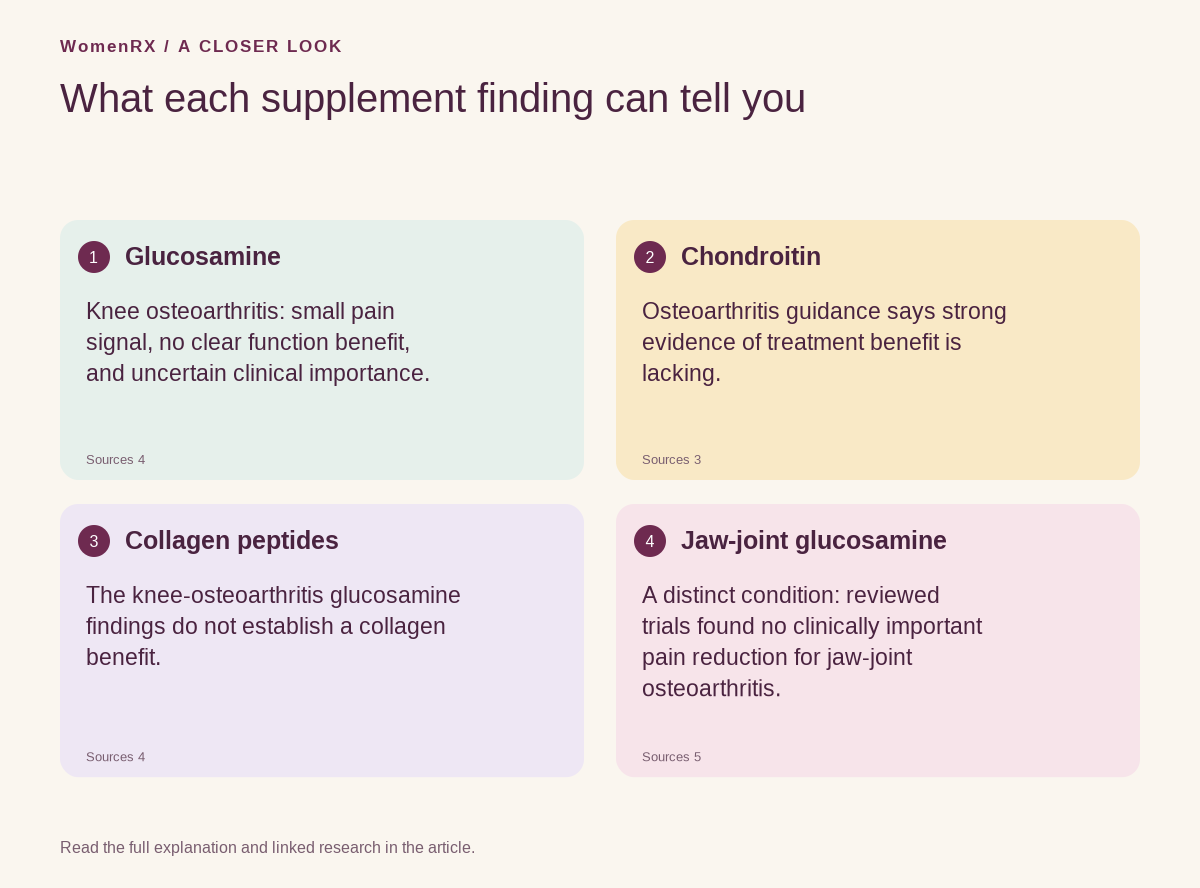
What each supplement finding can tell you
Glucosamine: Knee osteoarthritis: small pain signal, no clear function benefit, and uncertain clinical importance.4
Chondroitin: Osteoarthritis guidance says strong evidence of treatment benefit is lacking.3
Collagen peptides: The knee-osteoarthritis glucosamine findings do not establish a collagen benefit.4
Jaw-joint glucosamine: A distinct condition: reviewed trials found no clinically important pain reduction for jaw-joint osteoarthritis.5
Read the figure as text
The evidence differs by ingredient and joint condition, so these comparisons shouldn’t be treated as a ranking of products for all joint pain.- Glucosamine: Knee osteoarthritis: small pain signal, no clear function benefit, and uncertain clinical importance.4
- Chondroitin: Osteoarthritis guidance says strong evidence of treatment benefit is lacking.3
- Collagen peptides: The knee-osteoarthritis glucosamine findings do not establish a collagen benefit.4
- Jaw-joint glucosamine: A distinct condition: reviewed trials found no clinically important pain reduction for jaw-joint osteoarthritis.5
More questions, answered
Does glucosamine help every kind of joint pain?
No. The main findings discussed here concern knee osteoarthritis. They don’t establish a benefit for pain from a strain, gout, rheumatoid arthritis, or other causes. A review of jaw-joint disorders also found no clinically important pain reduction for jaw-joint osteoarthritis, which is distinct from osteoarthritis in other joints. 145
Does a change on an X-ray mean glucosamine rebuilt cartilage?
No. The knee-osteoarthritis review found a signal for slower joint-space narrowing in some longer-term trials, mainly with glucosamine sulfate. That imaging finding doesn’t prove cartilage was rebuilt or that people had meaningful improvement in pain or function. 4
Sources you can check
- Joint pain - NHSAccessed 2026-09-25Return to first citation
- Osteoarthritis - NHSAccessed 2026-09-25Return to first citation
- Osteoarthritis - Treatment and support - NHSAccessed 2026-09-25Return to first citation
- Glucosamine for knee osteoarthritis: an umbrella review.Li Y, Wang R, Xu J, Shen Y, Hu G, Lu S. · Frontiers in nutrition · 2026Return to first citation
- Glucosamine supplementation in the treatment of temporomandibular joint disorders: a systematic review and meta-analysis.Calzada-Gonzales N, Aguirre-Ipenza R, Serna-Alarcón V, Valeriano-Mamani J, Mendoza-Torres R, Hueda-Zavaleta M, Taype-Rondan A, Brañez-Condorena A, Alarcon-Ruiz CA. · Frontiers in dental medicine · 2026Return to first citation