Collagen for Joint Pain: What Trials Actually Measure
Some trials report changes in pain or daily function, but the studies test different conditions and multi-ingredient products, so their results don’t establish that collagen works for every kind of joint pain.
Collagen studies have measured pain scores, stiffness, questionnaires about daily activities, walking and other function tests, and, in some knee osteoarthritis trials, imaging or blood markers. A few small trials report symptom improvements, but several tested collagen alongside other ingredients, and the results don’t show that collagen rebuilds cartilage or treats every cause of joint pain. The evidence also doesn’t establish a different effect in women.
The outcome matters as much as the word “collagen”
“Joint pain” can mean osteoarthritis, a meniscus problem, an injury, or another condition. Those aren’t interchangeable, and a supplement trial in one group can’t answer whether collagen helps a different joint or diagnosis. Osteoarthritis commonly affects the knees, hips, and hands, while joint pain has many possible causes. 1 2
Trials also measure different things. Pain scales and questionnaires ask how someone feels or manages daily activities. Walking, chair-standing, and stair tests assess particular kinds of physical function. Imaging and blood markers are different again: they may help researchers study joint changes, but they aren’t the same as showing that a person feels better or that cartilage has been rebuilt.
What the trials have measured
Osteoarthritis symptoms and function: One small trial enrolled 31 people with grade 2-3 osteoarthritis, including 23 women. Over eight weeks, it assessed pain and quality-of-life questionnaires, several knee-related scores, and physical tests such as walking and standing from a chair. The study reported improvements on several symptom and quality-of-life measures, and on two functional measures, but not on every function test. The study description doesn’t identify the affected joint, so its knee-related measurements shouldn’t be taken as proof that every participant had knee osteoarthritis. 4
That trial tested a blend of type I, II, and III collagen with glucosamine, chondroitin, hyaluronic acid, and vitamin C. It can’t tell us which ingredient, if any, accounted for the reported changes. 4
Knee osteoarthritis and structural measures: A five-arm, 90-day trial in 100 people with knee osteoarthritis compared a particular bovine collagen peptide product at different amounts with conventional collagen peptides and placebo. It measured WOMAC symptoms and quality of life, as well as a blood marker and MRI-based knee scores. The authors reported improvements in some measures, including MRI-based scores and the blood marker. Those results are worth distinguishing from symptom-only studies, but they don’t establish that a supplement rebuilds cartilage or prevents arthritis. Nor do results for one specific product prove that other collagen products have the same effects. 6
Another knee osteoarthritis pilot tested a combination of type II collagen, glucosamine, and chondroitin for 12 weeks. Of 54 participants enrolled, 52 completed the study. The report described improvements versus placebo on some symptom, stiffness, sport-and-recreation, and quality-of-life measures. Pain and chair-stand performance improved in both groups, and the study did not meet its primary endpoint. Because this was a combination product and a pilot study, it can’t isolate collagen’s contribution or settle whether the observed differences are reliable and meaningful for a wider group. 7
Meniscus-related symptoms: A separate eight-week study enrolled 32 people with meniscopathy, a condition involving the knee’s meniscus. It tested a multi-ingredient product containing several collagen forms and other ingredients. The study reported improvements in pain and some quality-of-life measures. It found no significant differences in balance, proprioception, back strength, and several functional test results. These findings apply to that meniscus-related group and product, not automatically to osteoarthritis or other joint pain. 5
What this means if you’re a woman considering collagen
The clearest reported sex breakdown among these trials is the small osteoarthritis study: 23 of its 31 participants were women, and participants ranged from 35 to 65 years old. The study description doesn’t report menopause status or separate results for women, so it can’t tell us whether the findings apply differently to premenopausal, perimenopausal, or postmenopausal women. The reported details for the other trials also don’t establish a women-specific effect. 4 5 6 7
The practical comparison is not simply “collagen worked” versus “collagen didn’t.” Ask what condition was studied, what was measured, and whether the trial tested collagen alone. Improvement in a pain questionnaire is a symptom finding; a change in an MRI score or blood marker is a different kind of result. Neither, on its own, means collagen has repaired a joint.
If you’re considering a supplement, compare its ingredients with the study product before assuming the trial applies. A product that combines collagen with glucosamine and chondroitin is not evidence for collagen by itself. And if you have persistent joint symptoms, knowing the cause matters: osteoarthritis care can include exercise and other treatments, and supplement studies don’t replace that care. 2 3
A hot, swollen joint accompanied by feeling unwell or a fever needs prompt medical attention; severe pain after an injury also warrants urgent assessment. Those situations call for evaluating the joint, not waiting to see whether a supplement helps. 1
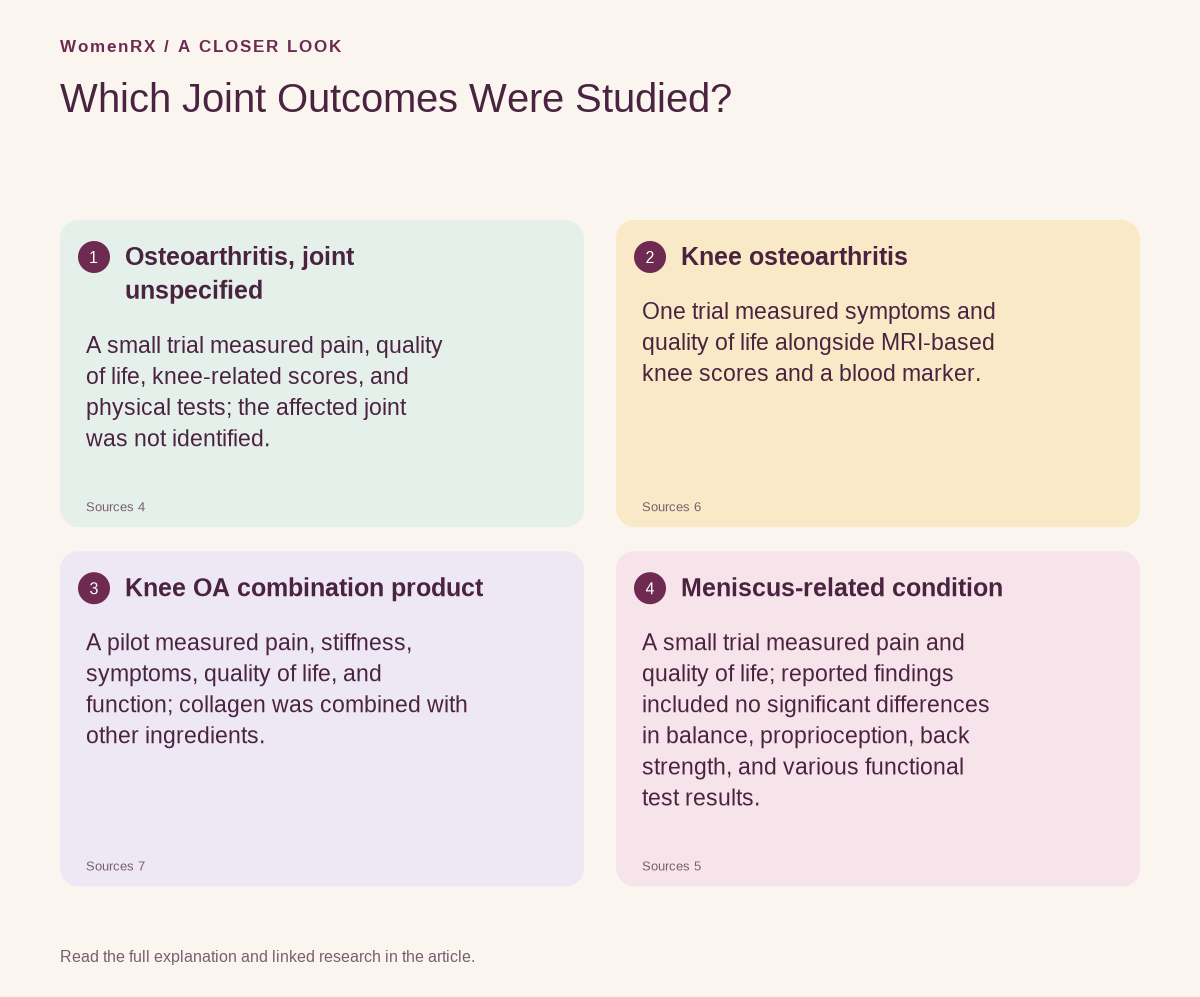
Which Joint Outcomes Were Studied?
Osteoarthritis, joint unspecified: A small trial measured pain, quality of life, knee-related scores, and physical tests; the affected joint was not identified.4
Knee osteoarthritis: One trial measured symptoms and quality of life alongside MRI-based knee scores and a blood marker.6
Knee OA combination product: A pilot measured pain, stiffness, symptoms, quality of life, and function; collagen was combined with other ingredients.7
Meniscus-related condition: A small trial measured pain and quality of life; reported findings included no significant differences in balance, proprioception, back strength, and various functional test results.5
Read the figure as text
The studies cover different conditions and separate symptom questionnaires from function tests and structural measures.- Osteoarthritis, joint unspecified: A small trial measured pain, quality of life, knee-related scores, and physical tests; the affected joint was not identified.4
- Knee osteoarthritis: One trial measured symptoms and quality of life alongside MRI-based knee scores and a blood marker.6
- Knee OA combination product: A pilot measured pain, stiffness, symptoms, quality of life, and function; collagen was combined with other ingredients.7
- Meniscus-related condition: A small trial measured pain and quality of life; reported findings included no significant differences in balance, proprioception, back strength, and various functional test results.5
More questions, answered
Does a change in an MRI score mean collagen rebuilt cartilage?
No. One knee osteoarthritis trial measured MRI-based scores and a blood marker and reported changes, but those findings don’t by themselves establish that collagen rebuilt cartilage or prevented disease progression. The product and trial were specific, and the results shouldn’t be generalized to all collagen supplements. 6
Do these studies show collagen helps meniscus problems and osteoarthritis equally?
No. The meniscopathy study and osteoarthritis studies enrolled different groups and measured different outcomes. The meniscus findings apply to that small trial’s multi-ingredient product and participants; they don’t establish the same effect for osteoarthritis or other causes of pain. 4 5
Sources you can check
- Joint pain - NHSAccessed 2026-09-25Return to first citation
- Osteoarthritis - NHSAccessed 2026-09-25Return to first citation
- Osteoarthritis - Treatment and support - NHSAccessed 2026-09-25Return to first citation
- Effect of supplementation with type 1 and type 3 collagen peptide and type 2 hydrolyzed collagen on osteoarthritis-related pain, quality of life, and physical function: A double-blind, randomized, placebo-controlled study.Genç AS, Yılmaz AK, Anıl B, Korkmaz Salkılıç E, Akdemir E, Sancaklı A, Mor A, Ermiş E, Baraz LS, Güzel N, Kehribar L. · Joint diseases and related surgery · 2025Return to first citation
- The effect of supplementation with type I and type III collagen peptide and type II hydrolyzed collagen on pain, quality of life and physical function in patients with meniscopathy: a randomized, double-blind, placebo-controlled study.Genç AS, Yılmaz AK, Anıl B, Korkmaz Salkılıç E, Akdemir E, Güzel B, Mor A, Yarar HA, Güzel N, Kehribar L. · BMC musculoskeletal disorders · 2025Return to first citation
- Management and Amelioration of Knee Joint Osteoarthritis in Adults Using a Novel High-Functional Bovine Collagen Peptide as a Nutritional Therapy: A Double-Blind, Prospective, Multicentric, Randomized, Active and Placebo Controlled, Five-Arm, Clinical Study to Evaluate the Efficacy, Safety, and Tolerability.Devasia S, Joseph JT, P S S, Koizumi S, Clarke L, V T S, Kailas AP, Madhavan S. · Cartilage · 2024Return to first citation
- Effects of cartilage-supporting nutritional supplementation on knee osteoarthritis symptoms and quality of life in a 12-week randomized double-blind placebo-controlled pilot study.Fladerer-Grollitsch JP, Klein T, Kompek A, Steiner N, Menzel D, Schön C. · Scientific reports · 2025Return to first citation