Why Period Cramps Happen, and When to Look Deeper
Cramps often come from the uterus responding to prostaglandins, but pain that disrupts daily life or changes over time deserves a closer look.
Common period cramps happen when prostaglandins prompt the uterus to tighten and relax. They often begin around the start of bleeding and are most common in younger people, but severe pain isn’t something you have to accept as normal. Pain that is new, worsening, lasts beyond your period, or comes with pain during sex or bowel movements can warrant evaluation for another cause, including endometriosis. 123
Why cramps happen
During a period, the uterus tightens to shed its lining. Chemicals called prostaglandins help drive those contractions. When prostaglandin activity is high, the contractions can feel like cramping in the lower abdomen, sometimes spreading to the back or thighs. Nausea, diarrhea, or headaches can come along with the cramps. This is called primary dysmenorrhea when the pain isn’t caused by another pelvic condition. 13
Primary cramps often begin in adolescence, after periods have started. They tend to cluster around the beginning of bleeding and last a few days, though the pattern differs from person to person. Pain may lessen with age for some people. A familiar pattern can still be intense: cramps that regularly keep you from school, work, or ordinary activities are worth discussing rather than simply putting up with. 13
When the pattern points to another cause
Secondary dysmenorrhea means period pain linked to an underlying condition. It may begin later than the usual early-period cramp pattern, worsen over time, start before bleeding, or continue after it ends. These changes don’t identify a particular condition by themselves, but they’re a reason to look beyond routine cramps. 1
Endometriosis is one possibility. It occurs when tissue similar to the uterine lining grows elsewhere, often in the pelvis. It can cause severe period pain that interferes with normal activities, but symptoms vary, and period pain alone doesn’t establish that someone has endometriosis. Heavy bleeding, fatigue, or difficulty getting pregnant may also occur. 2
Other possible causes include adenomyosis, fibroids, and pelvic inflammatory disease. An IUD can also be associated with cramps, particularly during the first few months after insertion. These possibilities are one reason not to assume every painful period is endometriosis. 3
A useful comparison
A long-standing pattern of cramps around the start of bleeding may fit primary dysmenorrhea. A change in the pattern, pain outside the period, or symptoms with sex, urination, or bowel movements may prompt an assessment for secondary causes. Neither pattern is a diagnosis: symptoms can overlap, and a clinician considers the whole history. 13
It’s reasonable to seek an assessment if pain stops you doing usual activities, becomes more painful over time, or comes with pain during sex, peeing, or pooping. A change to heavier or irregular periods is another reason to bring it up. You don’t need to wait until the pain becomes unbearable. 23
What to note before a visit
A brief record can help show whether the pain is following a familiar cycle pattern or changing. For each period, note:
- Timing: when pain starts in relation to bleeding and when it eases.
- Pattern: whether it’s getting worse, lasting longer, or happening between periods.
- Effect on your day: missed school or work, interrupted sleep, or activities you couldn’t do.
- Other symptoms: pain during sex, bowel movements, or urination; heavier or irregular bleeding; nausea, diarrhea, or fatigue.
- What you tried: any pain relief or other approach, and whether it helped.
These details don’t diagnose the cause. They give the clinician a clearer starting point. Assessment may include questions about your history, an examination, and imaging such as an ultrasound. 123
Relief and evaluation can go together
For primary cramps, nonsteroidal anti-inflammatory drugs (NSAIDs) can ease pain by reducing prostaglandin production and their effects. MedlinePlus notes that NSAIDs aren’t suitable for everyone, including some people with ulcers or other stomach problems, bleeding problems, liver disease, or aspirin allergy. If you’re unsure whether they’re safe for you, check with a health care provider. Relaxation practices may also help some people. 1
If pain continues to disrupt your life, or the pattern is changing, relief measures don’t replace finding out why. An assessment can consider both symptom management and whether another condition may be contributing.
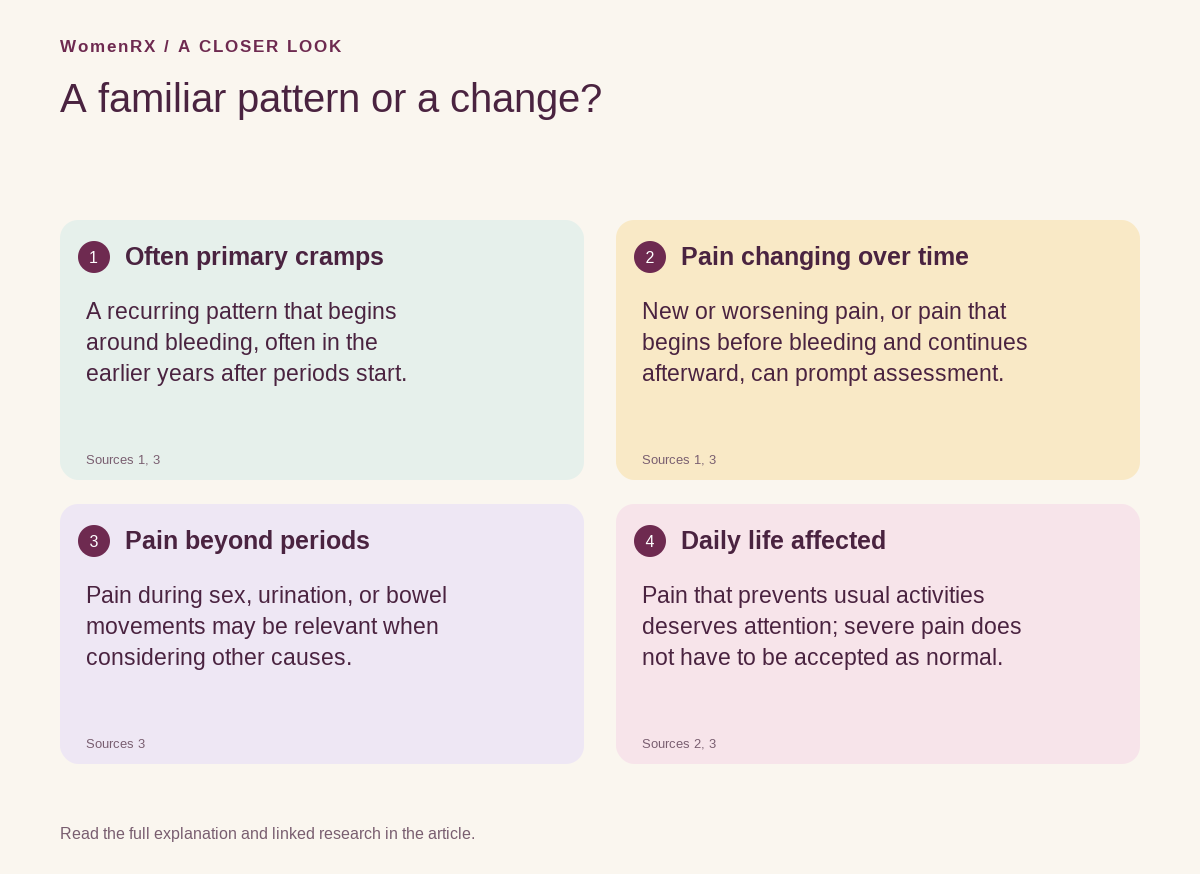
A familiar pattern or a change?
Often primary cramps: A recurring pattern that begins around bleeding, often in the earlier years after periods start.13
Pain changing over time: New or worsening pain, or pain that begins before bleeding and continues afterward, can prompt assessment.13
Pain beyond periods: Pain during sex, urination, or bowel movements may be relevant when considering other causes.3
Daily life affected: Pain that prevents usual activities deserves attention; severe pain does not have to be accepted as normal.23
Read the figure as text
Period pain patterns can help frame a conversation, but they do not diagnose the cause.- Often primary cramps: A recurring pattern that begins around bleeding, often in the earlier years after periods start.13
- Pain changing over time: New or worsening pain, or pain that begins before bleeding and continues afterward, can prompt assessment.13
- Pain beyond periods: Pain during sex, urination, or bowel movements may be relevant when considering other causes.3
- Daily life affected: Pain that prevents usual activities deserves attention; severe pain does not have to be accepted as normal.23
More questions, answered
Does severe period pain mean I have endometriosis?
No. Endometriosis is one possible cause of severe period pain, but adenomyosis, fibroids, pelvic inflammatory disease, and primary dysmenorrhea can also cause pain. Symptoms and, when appropriate, examination or imaging help assess possible causes. 123
Should I wait to seek help until I’ve tracked several periods?
No. A record can make the pattern easier to describe, but pain that stops your usual activities or is getting worse is already a reason to seek an assessment. 23
Sources you can check
- Period Pain | Menstrual Cramps | MedlinePlusAccessed 2026-09-25Return to first citation
- Endometriosis - NHSAccessed 2026-09-25Return to first citation
- Period pain - NHSAccessed 2026-09-25Return to first citation