Does Magnesium Help Muscle Cramps?
Magnesium is unlikely to help ordinary night cramps, while pregnancy and exercise-related cramps raise different questions.
It depends on when the cramps happen. In trials involving mostly older adults with ordinary rest cramps, magnesium offered little or no benefit over placebo after four weeks. Pregnancy studies gave conflicting results, and the reviewed trials did not test magnesium for exercise-related cramps. Magnesium deficiency can cause cramps, but a cramp alone doesn’t mean you’re deficient. 3 1
A calf cramp that wakes you up and one that stops you mid-workout may feel alike. They aren’t necessarily the same question for magnesium. The clearest supplement evidence concerns ordinary rest cramps, mostly in older adults. Pregnancy-associated cramps have been studied separately, with less certain results. 3
Night cramps: supplements are unlikely to help much
A Cochrane review examined randomized trials in people with idiopathic cramps, meaning cramps without an identified underlying cause. Participants were largely older adults whose cramps were presumed to occur at night. After four weeks, people taking magnesium had, on average, 0.18 fewer cramps per week than those taking a placebo, a difference compatible with no benefit. The review also found no significant improvement in cramp intensity or duration. It did not report a separate result for women. 3
That result doesn’t mean magnesium has nothing to do with muscles. Magnesium helps nerves and muscles function, and worsening magnesium deficiency can cause muscle contractions and cramps. But the fact that deficiency can cause cramps doesn’t mean an ordinary night cramp identifies a deficiency or that extra magnesium will prevent the next one. 1 3
Pregnancy cramps: mixed results, not a proven fix
Pregnancy-associated leg cramps deserve their own answer. The Cochrane review included five trials involving 408 pregnant participants. All five trials were judged at high risk of bias, and their results couldn’t be combined into one estimate. Among the three trials comparing magnesium with placebo, one found benefit, one found none, and one reported inconsistent results. Magnesium might help in some circumstances, but these studies don’t establish reliable relief for pregnancy cramps. 3
If you’re pregnant and cramps occur alongside weakness, numbness, or tingling, bring those symptoms to your prenatal care team rather than assuming they’re ordinary leg cramps or treating them as proof you need magnesium. Those symptoms can occur as magnesium deficiency worsens, though they don’t identify the cause on their own. A seizure or an irregular heartbeat calls for urgent medical assessment. 1
Exercise cramps: don’t borrow the night-cramp answer
The randomized trials in the Cochrane review did not test magnesium for preventing exercise-associated cramps. That leaves a different question open; it doesn’t make magnesium a proven workout remedy. 3
A later review of studies following people over time found that a previous exercise-associated cramp was associated with a greater chance of another. It also found higher post-race blood magnesium in people who cramped, but the evidence for that finding was limited. A blood level measured after a race can’t tell you that magnesium caused the cramp or that a supplement would have prevented it. The studies did not report a women-specific supplement effect. 2
When a cramp may point beyond a supplement
The setting is more useful than the assumption that every cramp signals low magnesium. A familiar cramp at rest fits the group in which supplements showed little benefit. Cramps linked to pregnancy or exercise have different, less conclusive evidence. And cramps accompanied by weakness, numbness, or tingling warrant assessment of the wider symptom picture, not a guess based on the cramp alone. Magnesium status itself can be difficult to judge from a blood test because most of the body’s magnesium is inside cells or bone. 3 1
If you’re considering magnesium anyway, account for magnesium already present in supplements and medicines such as some antacids and laxatives. High amounts from supplements or medicines can cause diarrhea, nausea, and abdominal cramping; very high amounts can cause serious harm. Foods that contain magnesium include leafy greens, legumes, nuts, seeds, and whole grains. 1
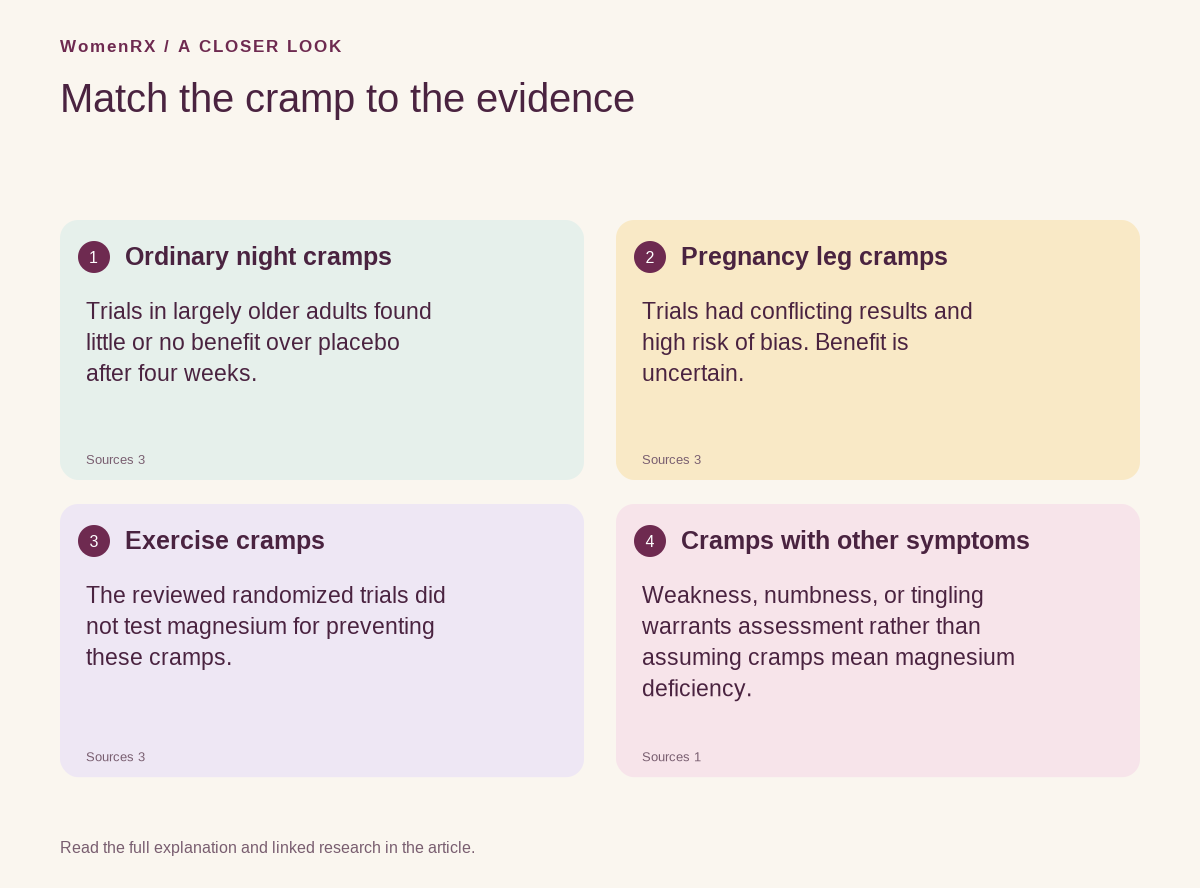
Match the cramp to the evidence
Ordinary night cramps: Trials in largely older adults found little or no benefit over placebo after four weeks.3
Pregnancy leg cramps: Trials had conflicting results and high risk of bias. Benefit is uncertain.3
Exercise cramps: The reviewed randomized trials did not test magnesium for preventing these cramps.3
Cramps with other symptoms: Weakness, numbness, or tingling warrants assessment rather than assuming cramps mean magnesium deficiency.1
Read the figure as text
Magnesium has not been tested with equally clear results in every cramp setting; accompanying symptoms can also change the next step.- Ordinary night cramps: Trials in largely older adults found little or no benefit over placebo after four weeks.3
- Pregnancy leg cramps: Trials had conflicting results and high risk of bias. Benefit is uncertain.3
- Exercise cramps: The reviewed randomized trials did not test magnesium for preventing these cramps.3
- Cramps with other symptoms: Weakness, numbness, or tingling warrants assessment rather than assuming cramps mean magnesium deficiency.1
Sources you can check
- Magnesium - Health Professional Fact SheetAccessed 2026-09-25Return to first citation
- Risk Factors for Exercise-Associated Muscle Cramps: A Systematic Review With Meta-Analysis.Costa LDS, Correa VAF, de Oliveira VF, Jahn AJS, Aliano GB, Nunes GS. · Muscle & nerve · 2026Return to first citation
- Magnesium for skeletal muscle cramps.Garrison SR, Korownyk CS, Kolber MR, Allan GM, Musini VM, Sekhon RK, Dugré N. · The Cochrane database of systematic reviews · 2020Return to first citation