Magnesium Glycinate for Sleep or Cramps: What We Know
Magnesium glycinate may be a convenient form, but current human evidence doesn’t show that it works better than other forms for sleep or cramps.
Magnesium glycinate hasn’t been shown to outperform other magnesium forms for sleep or muscle cramps. A review of adult sleep trials found mixed results and low to very low certainty, without establishing a glycinate-specific benefit. For cramps, results differ by situation: magnesium helped pregnancy-related leg cramps in one review, but not adult nocturnal or persistent leg cramps overall. That isn’t evidence about menstrual cramps. 3 4
The key distinction: magnesium versus glycinate
Magnesium helps regulate normal muscle and nerve function, but that role doesn’t mean taking extra magnesium will reliably improve sleep or stop cramps. To show that glycinate is better, human studies would need to compare it with other forms at comparable elemental-magnesium amounts and measure outcomes such as sleep or cramp frequency. The research summarized in an adult sleep review varies in magnesium form, amount, duration, and how sleep was measured; it doesn’t establish that glycinate has a special benefit. 1 3
A mouse study compared magnesium glycinate, citrate, malate, and acetyl taurate. It measured magnesium levels in tissues, not sleep or cramp relief in people. Those results can’t tell you whether glycinate works better for a human symptom. 5
Sleep: magnesium trials don’t prove glycinate is the answer
A 2026 systematic review included 12 randomized trials of magnesium for adult sleep, insomnia, or poor sleep. The studies varied in participants, formulations, amounts, duration, and measures. Their findings were inconsistent, and the reviewers rated the certainty of evidence low to very low. The review concluded that magnesium shouldn’t be considered a routine insomnia treatment, though some adults may see modest improvements in selected subjective sleep measures. It doesn’t identify glycinate as a superior form. 3
That distinction matters if a product promises “deep sleep” because glycinate is easily absorbed. Absorption and symptom relief are different questions: even evidence that a form enters the body well wouldn’t, on its own, show it improves insomnia. The NIH reference notes that absorption differs between forms and identifies aspartate, citrate, lactate, and chloride as more bioavailable than oxide and sulfate in small studies. It doesn’t establish glycinate’s superiority for sleep. 1
If sleep trouble is ongoing, magnesium shouldn’t distract from other possible causes. Insomnia can be related to stress, health conditions, medicines, caffeine, tobacco, alcohol, or other sleep disorders. 2
Cramps depend on which kind you mean
For adults with nocturnal or persistent leg cramps, a systematic review and meta-analysis found no significant overall benefit from magnesium. In contrast, its analysis of pregnancy-associated cramps found a reduction in cramp frequency compared with placebo. These are different populations and situations, and neither result shows that glycinate is better than another form. Pregnancy-related leg cramps also aren’t the same as menstrual cramps. 4
The review’s reported cramp categories don’t establish a benefit for menstrual cramps. That’s a limit on what these findings can answer, not proof that no relevant study exists. If you’re considering magnesium specifically for period pain, don’t treat results about pregnancy-related leg cramps as evidence that it will ease menstrual cramps. 4
Compare the number on the label, not the compound weight
On a Supplement Facts panel, the magnesium amount is the elemental magnesium: the amount of magnesium itself, not the total weight of the glycinate compound. That’s the useful number for comparing products. A capsule’s front label or the weight of a magnesium-containing compound can make the amount look larger without telling you how much elemental magnesium it provides. 1
For context, the adult tolerable upper intake level is 350 mg per day from supplements and medications; magnesium naturally present in food doesn’t count toward that limit. It’s a safety limit for supplemental and medication sources, not a target amount or a personalized treatment plan. Higher supplemental amounts can cause diarrhea, nausea, and abdominal cramps. 1
Kidney function matters: the kidneys remove excess magnesium, and impaired kidney function raises the risk of magnesium building up to harmful levels. Magnesium can also reduce absorption of oral bisphosphonates such as alendronate and can bind with tetracycline and quinolone antibiotics, including doxycycline and ciprofloxacin. If you take one of these medicines, check the product and medicine timing with a pharmacist or prescriber rather than guessing. 1
Read elemental magnesium before comparing sleep claims
If you’re comparing two products, first compare elemental magnesium per serving and the other ingredients. The sleep and cramp reviews don’t establish that glycinate works better for those outcomes than other magnesium forms. 3 4 If a clinician has identified low intake or a deficiency, the question is how to address that need safely, not whether a form marketed for sleep has a special effect. Magnesium status can be difficult to assess, and blood magnesium alone doesn’t reflect total body stores well. 1
For sleep or cramps without a diagnosed low intake, set expectations accordingly: there’s no established glycinate advantage, and results with magnesium itself vary by symptom and population. Choose based on the elemental amount and a clear reason to use it, not a promise that one form has been proven best.
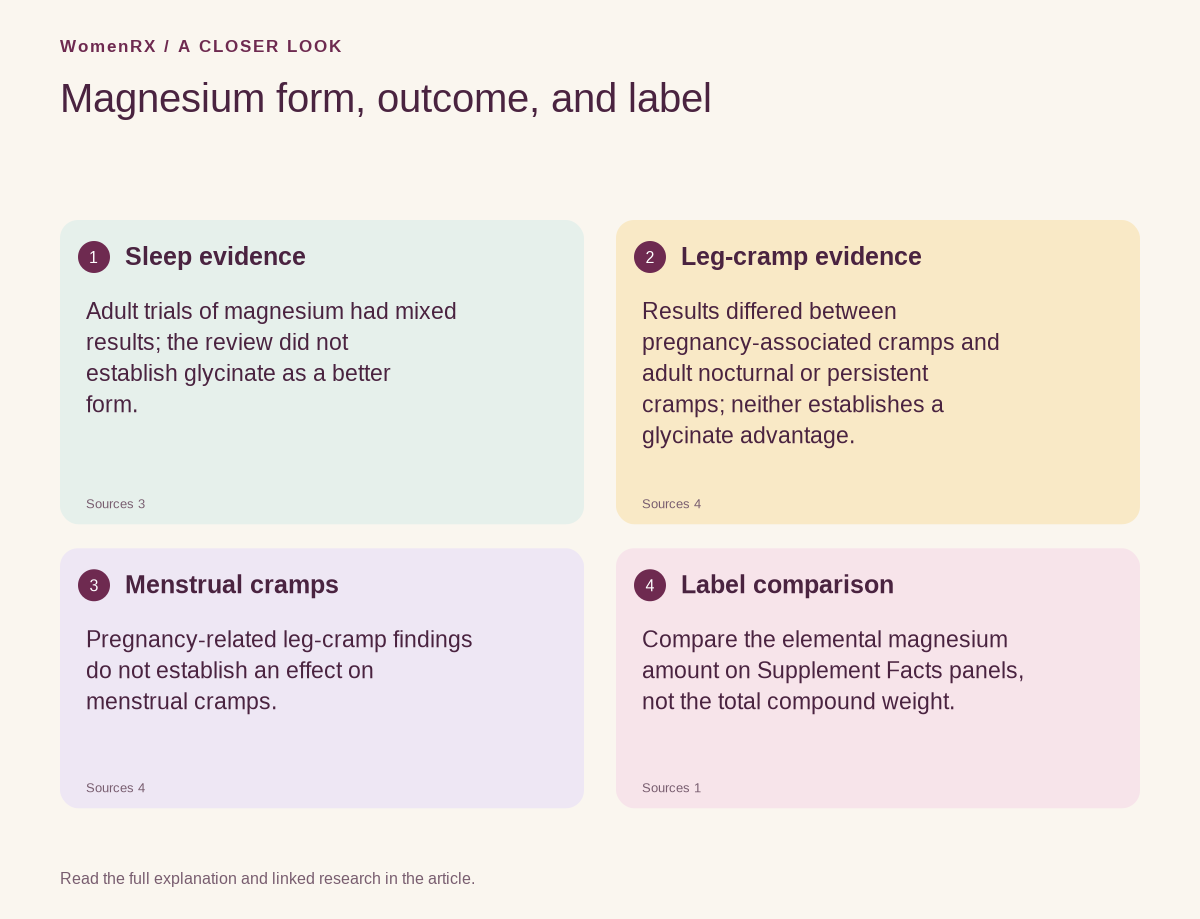
Magnesium form, outcome, and label
Sleep evidence: Adult trials of magnesium had mixed results; the review did not establish glycinate as a better form.3
Leg-cramp evidence: Results differed between pregnancy-associated cramps and adult nocturnal or persistent cramps; neither establishes a glycinate advantage.4
Menstrual cramps: Pregnancy-related leg-cramp findings do not establish an effect on menstrual cramps.4
Label comparison: Compare the elemental magnesium amount on Supplement Facts panels, not the total compound weight.1
Read the figure as text
These distinctions help separate evidence about magnesium generally from claims about glycinate specifically.- Sleep evidence: Adult trials of magnesium had mixed results; the review did not establish glycinate as a better form.3
- Leg-cramp evidence: Results differed between pregnancy-associated cramps and adult nocturnal or persistent cramps; neither establishes a glycinate advantage.4
- Menstrual cramps: Pregnancy-related leg-cramp findings do not establish an effect on menstrual cramps.4
- Label comparison: Compare the elemental magnesium amount on Supplement Facts panels, not the total compound weight.1
More questions, answered
Is magnesium glycinate more absorbable than magnesium oxide?
The NIH reference reports that small studies found several forms, including citrate and chloride, more bioavailable than oxide, but it doesn’t establish that glycinate is more absorbable than oxide in humans. A mouse study comparing several forms measured tissue magnesium, not human absorption or symptom relief. 1 5
Does evidence for pregnancy-related cramps apply to period cramps?
No. Pregnancy-associated leg cramps and menstrual cramps are distinct outcomes. A review reported results for pregnancy-related cramps but doesn’t establish that magnesium glycinate, or magnesium generally, treats menstrual cramps. 4
Sources you can check
- Magnesium - Health Professional Fact SheetAccessed 2026-09-25Return to first citation
- Insomnia | MedlinePlusAccessed 2026-09-25Return to first citation
- Magnesium Supplementation for Sleep in Adults: A Systematic Review of Randomized Controlled Trials.Lopresti AL, Smith SJ, Drummond PD. · Journal of dietary supplements · 2026Return to first citation
- The Role of Electrolytes in Muscle Pain Syndromes: A Systematic Review and Meta-Analysis With Implications for Temporomandibular Disorder.Patil S, Falkowski A, Venkataiah VS, Bhandi S, Licari FW, Patil AG. · International dental journal · 2026Return to first citation
- Dose-Dependent Absorption Profile of Different Magnesium Compounds.Ates M, Kizildag S, Yuksel O, Hosgorler F, Yuce Z, Guvendi G, Kandis S, Karakilic A, Koc B, Uysal N. · Biological trace element research · 2019Return to first citation