Magnesium Glycinate: What the Evidence Actually Supports
The clearest glycinate-specific finding concerns leg cramps during pregnancy; most other research tests magnesium generally, not this particular form.
Magnesium glycinate isn’t proven to help with every advertised use. The clearest direct finding is one bisglycinate trial for pregnancy-related leg cramps, though other pregnancy-cramp trials had mixed results. Magnesium more broadly may help prevent migraines; blood-pressure effects are small, and diabetes or bone benefits remain uncertain. Adult leg-cramp results are pooled across adults, so they don’t establish a women-specific effect. 1 2
Magnesium is needed for normal nerve and muscle function, but that role alone doesn’t prove that a supplement treats cramps, sleep problems, or another symptom. The key question is whether a study tested magnesium glycinate itself or magnesium in another form. Most of the clinical findings discussed below concern magnesium generally or a different magnesium salt, not glycinate. 1 2
The most direct finding: cramps in pregnancy
A systematic review of trials on cramps and muscle pain included four randomized trials of magnesium for pregnancy-related leg cramps. One trial tested magnesium bisglycinate chelate and reported reductions in cramp frequency and intensity. Other pregnancy trials tested different forms, with mixed results: some reported improvement, while a citrate trial found no difference from placebo. The review’s pooled result favored magnesium for pregnancy cramps, but it doesn’t show how much benefit an individual woman should expect from glycinate specifically. 2
That distinction matters if you’re pregnant: the direct glycinate finding is from pregnant women with cramps, not from studies of cramps across all women or life stages. It also doesn’t establish that glycinate is better than other forms.
For leg cramps outside pregnancy, the picture is less encouraging. In four trials involving adults with nocturnal or persistent leg cramps, magnesium did not significantly reduce cramps compared with the control groups. The review reported no significant pooled effect. So pregnancy-related cramping and ordinary nighttime leg cramps shouldn’t be treated as the same evidence question. The reported adult result is pooled across the adult trials, so it doesn’t establish whether the effect differs for women. 2
Migraine prevention: magnesium, not glycinate
The NIH Office of Dietary Supplements summarizes small, short-term trials in which three of four placebo-controlled studies found modest reductions in migraine frequency with magnesium. The American Academy of Neurology and American Headache Society concluded that magnesium is probably effective for migraine prevention. These findings concern magnesium therapy broadly; the summary doesn’t establish that glycinate was the form tested or that it has a special advantage. 1
The cited summary doesn’t say whether the migraine trial populations included women or report results separately by sex, so it can’t show whether the findings differ for women. This is evidence about preventing migraines, not a general claim that glycinate treats any headache. The cited guidance also notes that magnesium amounts used for migraine prevention can exceed the adult upper limit for magnesium from supplements and medications, so this use calls for individualized medical guidance rather than choosing a product by form alone. 1
Blood pressure: a small effect, not a glycinate result
Across magnesium supplement trials, blood-pressure changes have been small. One review summarized by NIH found a reduction of about 2.2 mmHg in diastolic pressure among 545 people with hypertension in 12 trials lasting 8 to 26 weeks. Another meta-analysis of 22 studies in adults reported average decreases of 3 to 4 mmHg systolic and 2 to 3 mmHg diastolic. These are results for magnesium supplementation, not evidence that glycinate lowers blood pressure specifically. 1
The NIH summary doesn’t report whether these trial populations included women or whether results were analyzed separately by sex. 1
Diabetes and bone health: don’t overread the signal
For blood sugar, some small trials of magnesium in people with type 2 diabetes have found improvement and others have not. The American Diabetes Association says there isn’t enough evidence to recommend routine magnesium supplementation to improve glycemic control. That does not establish a diabetes benefit for glycinate. The NIH summary doesn’t report whether the diabetes trial populations included women or whether results were analyzed by sex. 1
For bone health, magnesium is involved in bone biology, and some research links higher magnesium intake with bone mineral density. But that’s not the same as showing that a glycinate supplement prevents or treats osteoporosis. One small, short study in 20 postmenopausal women with osteoporosis tested magnesium citrate, not glycinate; NIH says more research is needed to determine whether supplements help prevent or manage osteoporosis. 1
A practical way to read the claims
If you’re considering glycinate for a specific outcome, ask two questions: did the study test glycinate, and did it measure the outcome you care about? For pregnancy cramps, there is a direct but limited glycinate finding. For migraine prevention and blood pressure, the cited evidence is about magnesium more broadly. For diabetes and osteoporosis, the results do not establish a glycinate benefit. 1 2
Also check the label for elemental magnesium, which is the amount listed on the Supplement Facts panel, rather than assuming the weight of the whole magnesium compound is the amount of magnesium you’re getting. For adults, the upper limit of 350 mg per day applies to magnesium from supplements and medications, not magnesium naturally present in food; it’s a safety limit, not a recommended target. Higher supplemental amounts can cause diarrhea, nausea, and abdominal cramping. 1
Magnesium can also reduce absorption of oral bisphosphonates such as alendronate and of tetracycline or quinolone antibiotics. If you take one of these, ask a pharmacist how to separate it from a magnesium product. 1
How direct is the evidence for glycinate?
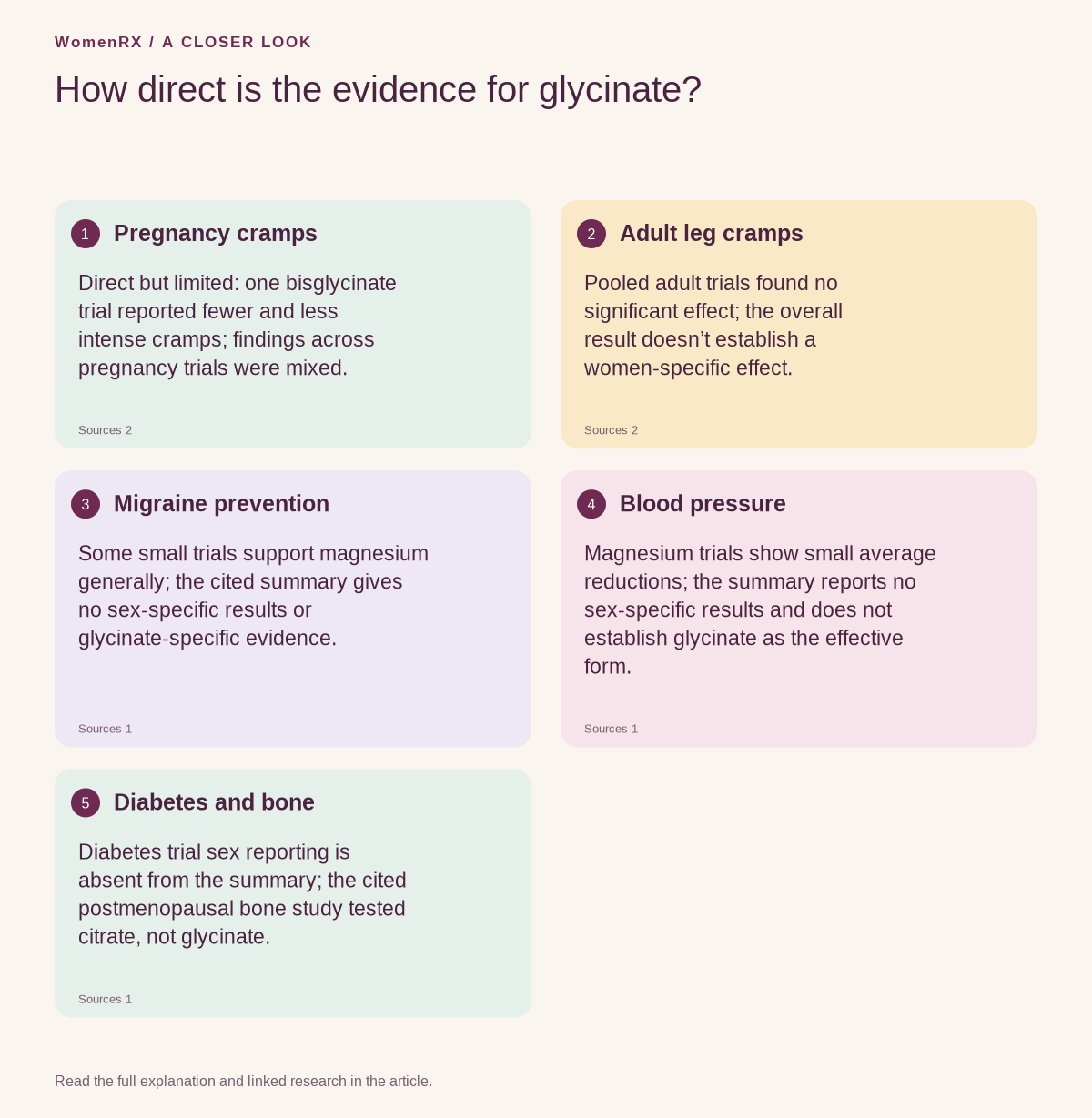
Pregnancy cramps: Direct but limited: one bisglycinate trial reported fewer and less intense cramps; findings across pregnancy trials were mixed.2
Adult leg cramps: Pooled adult trials found no significant effect; the overall result doesn’t establish a women-specific effect.2
Migraine prevention: Some small trials support magnesium generally; the cited summary gives no sex-specific results or glycinate-specific evidence.1
Blood pressure: Magnesium trials show small average reductions; the summary reports no sex-specific results and does not establish glycinate as the effective form.1
Diabetes and bone: Diabetes trial sex reporting is absent from the summary; the cited postmenopausal bone study tested citrate, not glycinate.1
Read the figure as text
The key distinction is whether a finding tested glycinate itself or magnesium in another form or unspecified form.- Pregnancy cramps: Direct but limited: one bisglycinate trial reported fewer and less intense cramps; findings across pregnancy trials were mixed.2
- Adult leg cramps: Pooled adult trials found no significant effect; the overall result doesn’t establish a women-specific effect.2
- Migraine prevention: Some small trials support magnesium generally; the cited summary gives no sex-specific results or glycinate-specific evidence.1
- Blood pressure: Magnesium trials show small average reductions; the summary reports no sex-specific results and does not establish glycinate as the effective form.1
- Diabetes and bone: Diabetes trial sex reporting is absent from the summary; the cited postmenopausal bone study tested citrate, not glycinate.1
More questions, answered
Does magnesium glycinate have a proven advantage over other forms?
The cited clinical findings don’t establish that glycinate is superior. A pregnancy-cramp trial tested bisglycinate, while the migraine and blood-pressure findings concern magnesium more broadly; those aren’t head-to-head comparisons of forms. 1 2
Does magnesium glycinate count toward the supplemental upper limit?
Yes. The adult upper limit of 350 mg per day applies to magnesium from supplements and medications, counted as elemental magnesium. It doesn’t include magnesium naturally present in food. 1
Sources you can check
- Magnesium - Health Professional Fact SheetAccessed 2026-09-25Return to first citation
- The Role of Electrolytes in Muscle Pain Syndromes: A Systematic Review and Meta-Analysis With Implications for Temporomandibular Disorder.Patil S, Falkowski A, Venkataiah VS, Bhandi S, Licari FW, Patil AG. · International dental journal · 2026Return to first citation