Magnesium Glycinate vs. L-Threonate: What the Evidence Shows
L-threonate has a short-term placebo-controlled sleep study, but that doesn’t show it works better than glycinate.
A 21-day trial compared magnesium L-threonate with a placebo, not glycinate, in adults reporting sleep problems. Some sleep and daytime measures favored L-threonate, but the trial can’t tell you which form is better for sleep or cognition. Its reported results also don’t establish a benefit specific to women. 2
What a head-to-head comparison would tell you
To choose between two forms, the most useful evidence would compare them directly, in similar people, measuring the same outcomes. A study that tests one form against a placebo can suggest whether that form may help, but it cannot establish that it works better than another form.
A human sleep trial tested magnesium L-threonate against a placebo, not magnesium glycinate. So it offers a preliminary signal about L-threonate and sleep, not a form-to-form verdict. 2
What the L-threonate sleep trial found
The randomized, double-blind trial included 80 adults ages 35 to 55 who reported sleep problems. Participants took L-threonate or a placebo for 21 days. Some measures favored L-threonate, including selected wearable sleep scores and self-reported mood, alertness, and behavior after waking. But results weren’t consistent across every sleep questionnaire measure: several dimensions improved over time in both groups, without a clear difference between the groups’ changes. 2
That’s a reason to describe the finding as promising but limited. The study was short, involved adults with self-reported sleep problems rather than a specific sleep diagnosis, and did not compare L-threonate with glycinate. It also did not test cognition as a clinical outcome. A report of feeling more mentally alert is not the same as evidence that a supplement improves memory or cognitive performance. 2
Brain-delivery claims aren’t a comparison of benefits
L-threonate is often discussed in connection with brain delivery. The sleep paper describes that rationale and refers to animal research on magnesium reaching the brain and affecting neural processes. That biological explanation may help motivate a human study, but it does not demonstrate that L-threonate improves sleep or cognition more than glycinate in people. The placebo-controlled sleep findings address L-threonate versus placebo only. 2
The NIH Office of Dietary Supplements notes that magnesium absorption varies among supplement forms, but its summary does not establish a sleep or cognition advantage for glycinate over L-threonate, or the reverse. Absorption is not itself proof of a better outcome for a particular concern. 1
What this means if you’re choosing
If sleep is your main reason for considering magnesium, L-threonate has a small, short-term placebo-controlled study behind it. That is more specific than a mechanism claim, but it still doesn’t tell you whether it is a better choice than glycinate. The trial’s reported results do not establish a benefit specific to women. 2
If cognition is your main reason, don’t treat “brain delivery” as proof of a cognitive benefit, or as proof that one form is best. The sleep trial did not measure cognitive performance, and it did not compare the two forms. 2
A practical way to read labels is to look at the amount of elemental magnesium, rather than comparing the total weight of the magnesium compound. The Supplement Facts panel lists elemental magnesium. That helps you compare how much magnesium a product provides, but it still won’t answer which form is better for sleep or cognition. 1
Bottom line: The L-threonate sleep trial cannot settle glycinate versus L-threonate. It found some favorable results compared with placebo, but did not test whether L-threonate works better than glycinate. For cognition, the proposed brain-delivery explanation should not be mistaken for a demonstrated advantage.
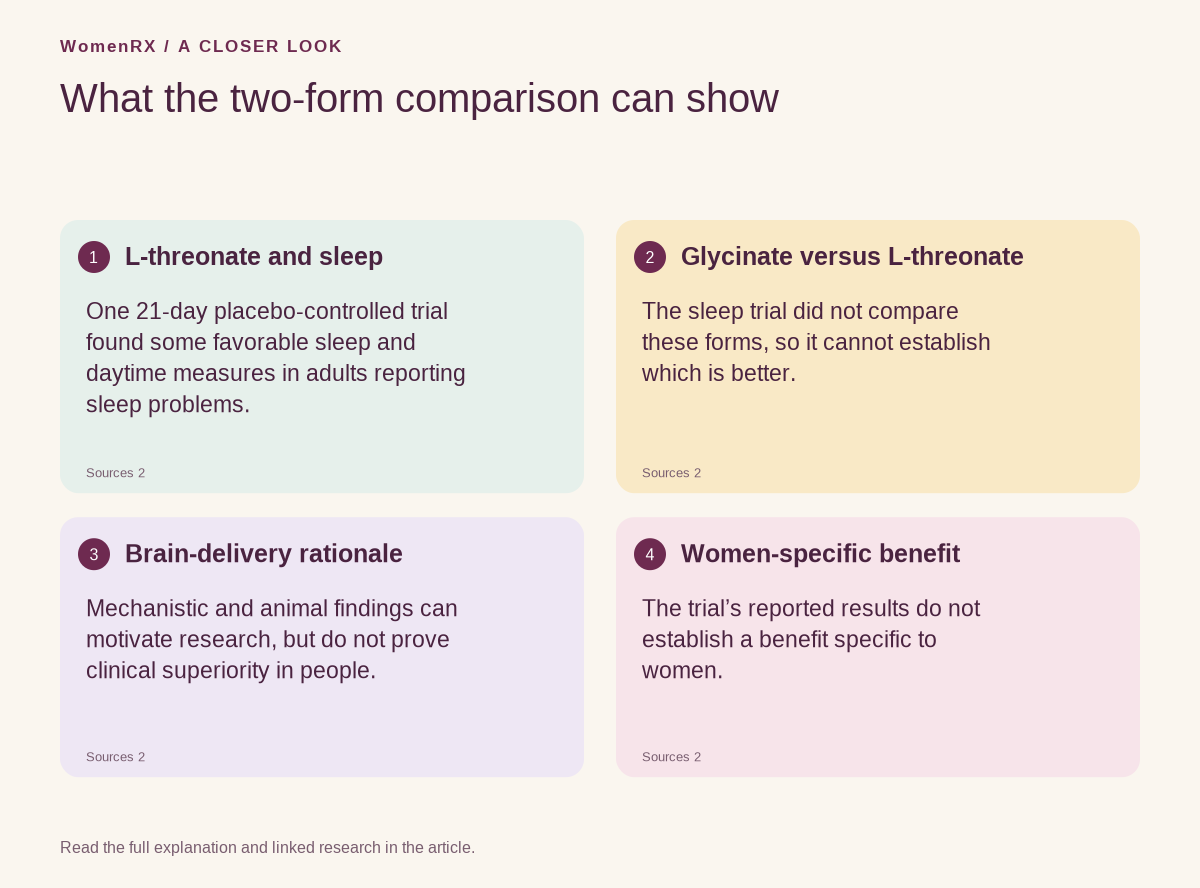
What the two-form comparison can show
L-threonate and sleep: One 21-day placebo-controlled trial found some favorable sleep and daytime measures in adults reporting sleep problems.2
Glycinate versus L-threonate: The sleep trial did not compare these forms, so it cannot establish which is better.2
Brain-delivery rationale: Mechanistic and animal findings can motivate research, but do not prove clinical superiority in people.2
Women-specific benefit: The trial’s reported results do not establish a benefit specific to women.2
Read the figure as text
Separate the measured human outcome from the proposed mechanism and the unanswered comparison.- L-threonate and sleep: One 21-day placebo-controlled trial found some favorable sleep and daytime measures in adults reporting sleep problems.2
- Glycinate versus L-threonate: The sleep trial did not compare these forms, so it cannot establish which is better.2
- Brain-delivery rationale: Mechanistic and animal findings can motivate research, but do not prove clinical superiority in people.2
- Women-specific benefit: The trial’s reported results do not establish a benefit specific to women.2
More questions, answered
Did the L-threonate sleep trial show better cognition?
No. It measured sleep and daytime functioning, including self-reported alertness and mood, but did not test cognitive performance. Those reports don’t establish an improvement in memory or other cognitive abilities. 2
Sources you can check
- Magnesium - Health Professional Fact SheetAccessed 2026-09-25Return to first citation
- Magnesium-L-threonate improves sleep quality and daytime functioning in adults with self-reported sleep problems: A randomized controlled trial.Hausenblas HA, Lynch T, Hooper S, Shrestha A, Rosendale D, Gu J. · Sleep medicine: X · 2024Return to first citation