Magnesium L-Threonate: What Have Human Studies Shown?
A short human trial found some sleep-related improvements, while reports of earlier cognition findings need more careful appraisal.
Magnesium L-threonate has been tested in people, but its benefits aren’t proven. In one 21-day trial, adults with self-reported sleep problems showed improvements in selected sleep and daytime measures, but the study did not test memory. The trial’s authors also report positive findings from earlier human cognition studies; their account does not provide enough detail to judge how reliable those findings are. 2
Magnesium L-threonate is often promoted for memory, focus, or sleep. The evidence behind those claims isn’t equally strong: a small, short human trial tested sleep and daytime outcomes, while the brain-delivery and memory rationale draws heavily on preclinical research. The sleep-trial authors also report positive findings from earlier human cognition studies, but their account does not provide enough detail to confidently assess those findings. That makes “promising” a fair description. “Proven to improve cognition” isn’t. 23
What the human sleep trial found
A randomized, double-blind, placebo-controlled trial enrolled 80 adults ages 35 to 55 who reported sleep problems. Participants took magnesium L-threonate or placebo for 21 days. The study assessed sleep with questionnaires and an Oura ring, and also tracked mood and daily activity. 2
Compared with placebo, the supplement group had statistically significant improvements in several reported measures, including wearable sleep-stage scores, behavior on waking, alertness, mood, and some activity measures. But the results weren’t uniformly about falling asleep faster: the trial reported a slight increase in sleep latency, meaning participants took somewhat longer to fall asleep. The study therefore points more toward possible changes in sleep quality and how people felt during the day than toward a sleep-onset benefit. 2
These findings are a reason to study the supplement further, not a guarantee that you’ll notice the same changes. The trial lasted only three weeks, enrolled a small group with self-reported sleep problems, and measured many different outcomes. The results reported don’t establish whether any differences last, matter in everyday life over the long term, or apply to people with diagnosed sleep disorders. 2
What the cognition findings do, and don’t, show
The sleep trial’s alertness and mood measures aren’t the same as tests showing improved memory, learning, or thinking. Its reported outcomes don’t establish a cognitive benefit from that 21-day trial. 2
The proposed brain mechanism is biologically interesting, but a mechanism isn’t an outcome. A review describes research in rodents in which raising brain magnesium was linked to changes in the NMDA receptor subunit NR2B and better performance on memory tasks. Those preclinical findings can help explain why researchers are interested in magnesium L-threonate, but they don’t demonstrate that taking it improves memory in people. 3
The sleep-trial authors also report that earlier human studies found improvements in cognitive scores covering executive function, working memory, episodic memory, and attention by six weeks, as well as memory-related measures in another study. These are reports of human findings, not just animal findings, but the authors’ account does not provide enough information about the studies’ methods or participant numbers to confidently judge their reliability. They’re an early signal, not conclusive proof of a cognitive benefit. 2
Don’t assume all magnesium studies apply
Magnesium is an essential nutrient, but a result from one form of magnesium doesn’t automatically apply to another. The NIH Office of Dietary Supplements notes that absorption varies among supplemental forms; its examples of forms with higher bioavailability than magnesium oxide or sulfate include citrate, chloride, lactate, and aspartate. That general information doesn’t establish a specific cognitive or sleep benefit for magnesium L-threonate. 1
The sleep trial tested magnesium L-threonate itself, which makes it more relevant to product-specific claims than a study of magnesium in another form. Even so, one short trial can’t settle whether the supplement works consistently or for whom. The trial report describes participants by age and sleep concerns but doesn’t establish a women-specific effect or clarify how results might differ by sex or life stage. 2
If you’re weighing a supplement for memory, the practical takeaway is to treat strong cognition claims cautiously while recognizing that earlier human studies have reported positive results. If your main concern is sleep, there is a small early human trial, but it doesn’t yet show a reliable, lasting benefit. And if you’re comparing labels, remember that the weight of a magnesium compound isn’t the same as its elemental magnesium amount. 12
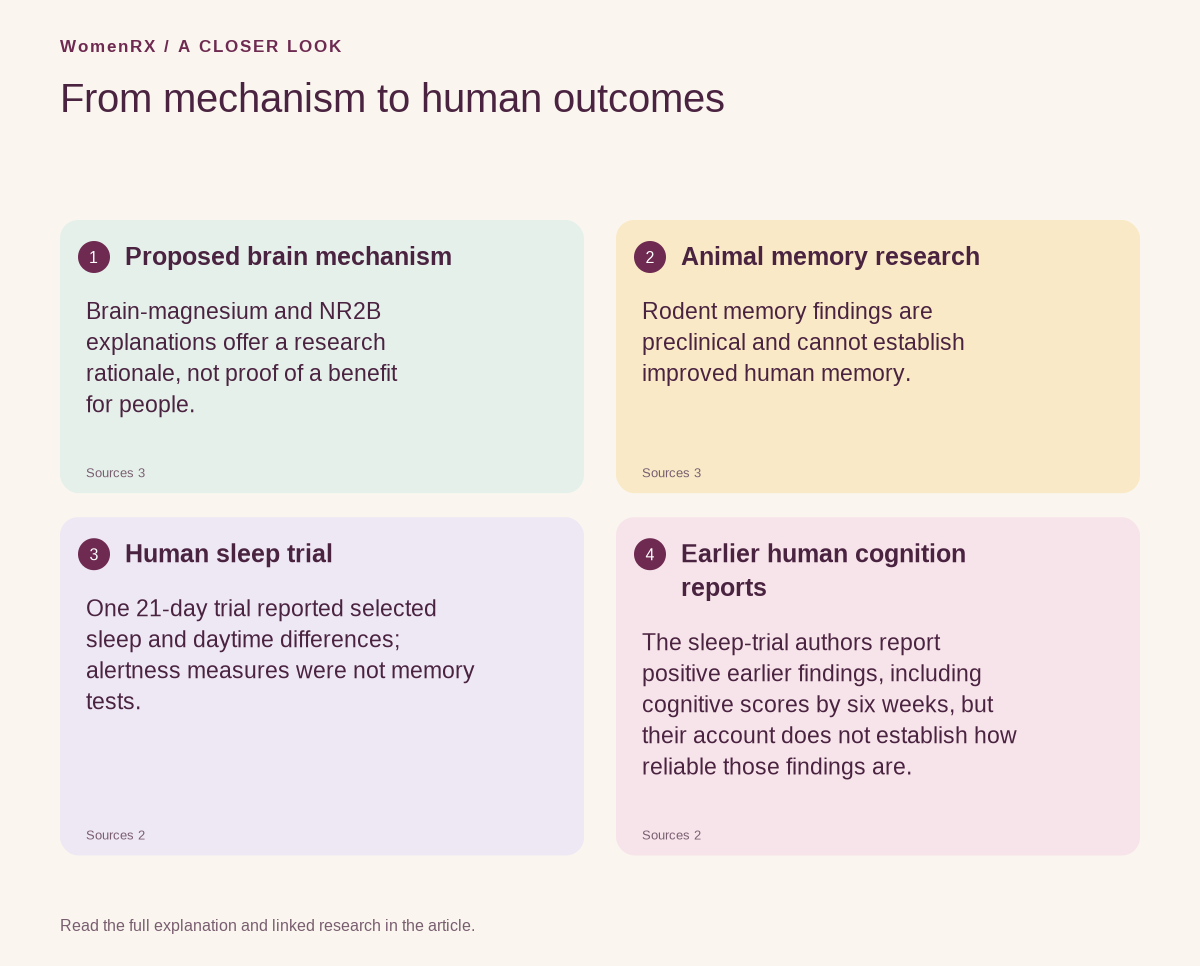
From mechanism to human outcomes
Proposed brain mechanism: Brain-magnesium and NR2B explanations offer a research rationale, not proof of a benefit for people.3
Animal memory research: Rodent memory findings are preclinical and cannot establish improved human memory.3
Human sleep trial: One 21-day trial reported selected sleep and daytime differences; alertness measures were not memory tests.2
Earlier human cognition reports: The sleep-trial authors report positive earlier findings, including cognitive scores by six weeks, but their account does not establish how reliable those findings are.2
Read the figure as text
These evidence types answer different questions: a proposed brain mechanism and animal results are not human outcomes, while reported human findings still need enough study detail to judge their strength.- Proposed brain mechanism: Brain-magnesium and NR2B explanations offer a research rationale, not proof of a benefit for people.3
- Animal memory research: Rodent memory findings are preclinical and cannot establish improved human memory.3
- Human sleep trial: One 21-day trial reported selected sleep and daytime differences; alertness measures were not memory tests.2
- Earlier human cognition reports: The sleep-trial authors report positive earlier findings, including cognitive scores by six weeks, but their account does not establish how reliable those findings are.2
More questions, answered
Does magnesium L-threonate help you fall asleep faster?
That benefit wasn’t demonstrated in the 21-day trial. The study reported a slight increase in sleep latency in the supplement group compared with placebo, alongside improvements in some other sleep and daytime measures. 2
Is there evidence it works differently for women?
The reported trial results don’t establish a women-specific effect or explain whether outcomes differed by sex or life stage. They can’t tell us whether results vary between cycling years, perimenopause, or postmenopause. 2
Sources you can check
- Magnesium - Health Professional Fact SheetAccessed 2026-09-25Return to first citation
- Magnesium-L-threonate improves sleep quality and daytime functioning in adults with self-reported sleep problems: A randomized controlled trial.Hausenblas HA, Lynch T, Hooper S, Shrestha A, Rosendale D, Gu J. · Sleep medicine: X · 2024Return to first citation
- Targeting the NMDA receptor subunit NR2B for treating or preventing age-related memory decline.Wang D, Jacobs SA, Tsien JZ. · Expert opinion on therapeutic targets · 2014Return to first citation