Magnesium L-Threonate Benefits: What Human Studies Have Tested
A six-week human trial found gains on some cognitive measures and one self-reported sleep measure, but it doesn’t establish a benefit specific to women.
In a six-week placebo-controlled trial, adults with dissatisfied sleep improved on some cognitive measures and one self-reported sleep measure, but not on every test. Resting heart rate fell more and heart-rate variability rose more than with placebo; these physiological findings don’t prove a clinical stress benefit. Whether women respond differently remains unclear, and laboratory or animal results aren’t proof of clinical benefits. 23
What has actually been tested in people?
A randomized, double-blind, placebo-controlled trial studied magnesium L-threonate in 100 adults ages 18 to 45 who reported dissatisfied sleep. Participants took the study product or a placebo for six weeks. Researchers assessed cognitive tests, self-reported sleep and emotional well-being, reaction time, and sleep-tracker data. 2
Compared with placebo, the L-threonate group improved more on the study’s overall cognitive composite and reaction time. Researchers also reported larger treatment effects on working and episodic memory measures and an improvement in estimated cognitive age. But not every cognitive test improved: there was no group difference on Raven’s test. These are promising early findings, not proof of a lasting or meaningful improvement in everyday memory. 2
The sleep findings were mixed. Participants reported a greater improvement in sleep-related impairment, but there were no group differences in sleep disturbances, restorative sleep, or general well-being. The wearable data also showed no group differences in sleep outcomes. A sleep-related improvement on a questionnaire is not the same as evidence that people slept longer or more soundly. 2
The wearable did capture two other findings: compared with placebo, the L-threonate group had a greater reduction in resting heart rate and an increase in heart-rate variability during sleep. These are physiological outcomes from one six-week trial, not proof that the supplement reduces stress in daily life. 2
Earlier human cognitive trials are mentioned in the research, including one in older adults. Those brief descriptions don’t give enough detail to judge the trials’ methods, women’s representation, or how convincing their results are. 23
What can this trial tell women?
The six-week trial enrolled adults ages 18 to 45. The reported findings don’t establish how many participants were women or whether responses differed by sex, so they can’t establish a benefit unique to women. The study didn’t test menstrual or menopause symptoms, and its results can’t tell you what to expect during pregnancy, postpartum, perimenopause, or postmenopause. 2
What the other evidence can, and can’t, show
There is a proposed explanation for why the threonate form might affect the brain: laboratory work in cultured neurons found that threonate could affect intracellular magnesium and measures related to synapses. That is mechanistic research, not a demonstration that taking a supplement improves memory in women or treats a brain condition. 3
Animal studies have also examined outcomes such as brain changes, inflammation, and bladder function. Those findings can motivate human research, but they don’t establish that L-threonate prevents or treats Alzheimer’s disease, bladder pain, or other conditions in people. One rat study of a hypothyroidism model, for example, reported reduced amyloid-beta load but no significant improvement on behavioral cognitive tasks. 467
A separate European food-safety assessment concluded that magnesium is bioavailable from magnesium L-threonate. That addresses whether the body can obtain magnesium from the ingredient; it doesn’t show that this form improves cognition, sleep, or health outcomes better than other forms. 5
It’s also easy to confuse evidence about magnesium generally with evidence about L-threonate specifically. NIH’s overview discusses magnesium research on topics such as migraine prevention and bone health, but those findings concern magnesium broadly or other forms, not proof that L-threonate produces the same effects. 1
A practical way to weigh a product claim
For cognition and sleep, the six-week human trial found some positive results alongside several outcomes that didn’t differ from placebo. It also found changes in resting heart rate and heart-rate variability, but didn’t establish a clinical stress benefit. For the disease-treatment claims discussed here, the direct L-threonate findings are preclinical, not clinical. None of these results establishes that L-threonate is uniquely effective for women. 2467
If you’re comparing labels, check the amount of elemental magnesium, not just the weight of the L-threonate compound. The six-week trial described its product as 2 grams of magnesium L-threonate, providing 145 mg of elemental magnesium; that’s what the study tested, not a recommended dose. 2 NIH notes that supplement labels list elemental magnesium, and that absorption varies among magnesium forms. 1
The six-week trial product was described as well tolerated during the study, but a short study can’t settle long-term safety. High amounts of magnesium from supplements or medicines can cause diarrhea, nausea, and abdominal cramping. 12 A useful buying question is whether the claim you’re considering is backed by a human outcome that matters to you, rather than only by a proposed mechanism or an animal result.
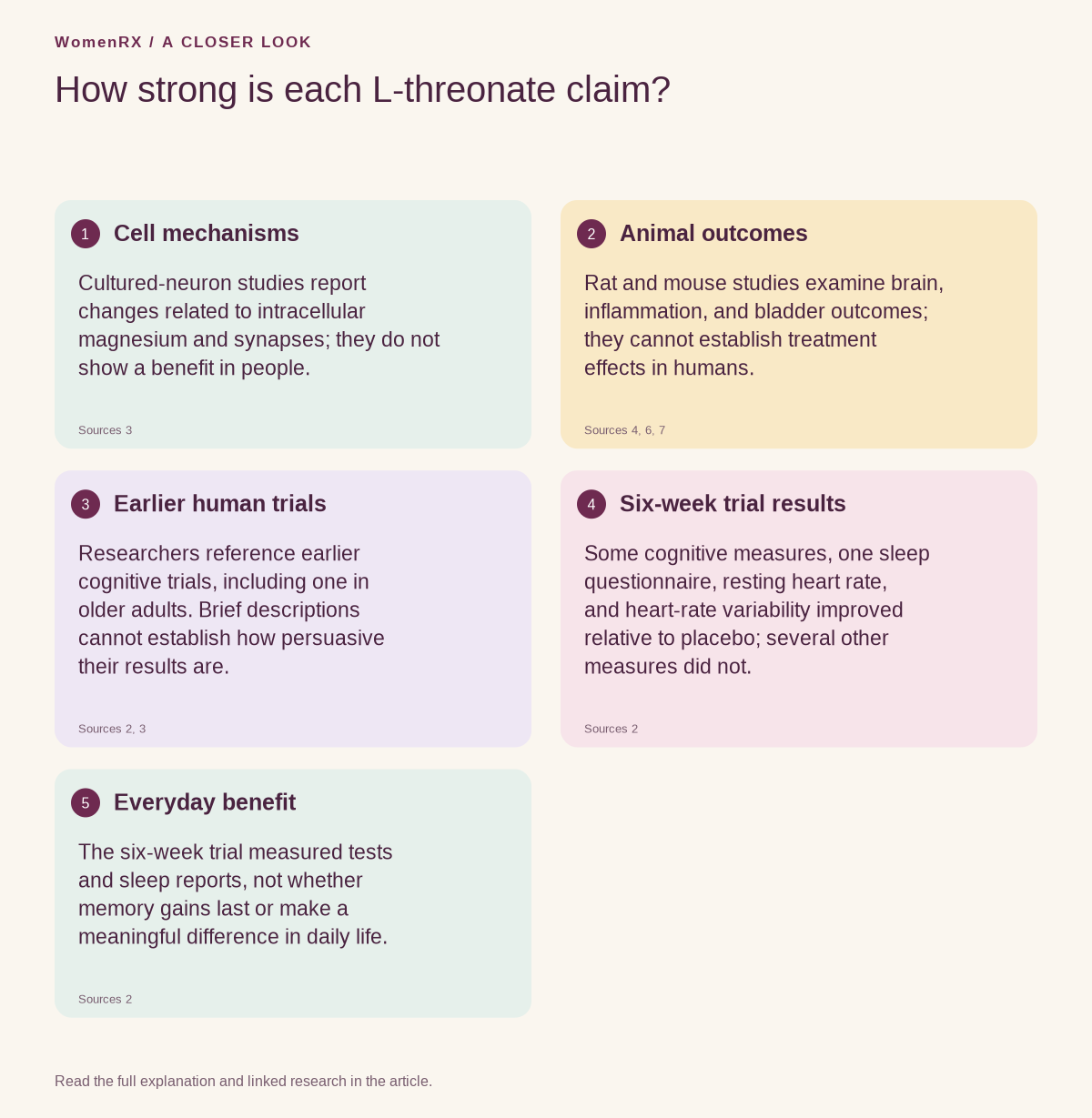
How strong is each L-threonate claim?
Cell mechanisms: Cultured-neuron studies report changes related to intracellular magnesium and synapses; they do not show a benefit in people.3
Animal outcomes: Rat and mouse studies examine brain, inflammation, and bladder outcomes; they cannot establish treatment effects in humans.467
Earlier human trials: Researchers reference earlier cognitive trials, including one in older adults. Brief descriptions cannot establish how persuasive their results are.23
Six-week trial results: Some cognitive measures, one sleep questionnaire, resting heart rate, and heart-rate variability improved relative to placebo; several other measures did not.2
Everyday benefit: The six-week trial measured tests and sleep reports, not whether memory gains last or make a meaningful difference in daily life.2
Read the figure as text
Follow the evidence from proposed mechanisms to measured human outcomes, then ask whether those outcomes show a meaningful everyday benefit.- Cell mechanisms: Cultured-neuron studies report changes related to intracellular magnesium and synapses; they do not show a benefit in people.3
- Animal outcomes: Rat and mouse studies examine brain, inflammation, and bladder outcomes; they cannot establish treatment effects in humans.467
- Earlier human trials: Researchers reference earlier cognitive trials, including one in older adults. Brief descriptions cannot establish how persuasive their results are.23
- Six-week trial results: Some cognitive measures, one sleep questionnaire, resting heart rate, and heart-rate variability improved relative to placebo; several other measures did not.2
- Everyday benefit: The six-week trial measured tests and sleep reports, not whether memory gains last or make a meaningful difference in daily life.2
More questions, answered
Is magnesium L-threonate proven to improve sleep?
No. In the six-week trial, one self-reported measure of sleep-related impairment improved, but several other self-reported sleep measures and wearable-tracked sleep outcomes did not differ between groups. 2
Sources you can check
- Magnesium - Health Professional Fact SheetAccessed 2026-09-25Return to first citation
- The effects of magnesium L-threonate (Magtein®) on cognitive performance and sleep quality in adults: a randomised, double-blind, placebo-controlled trial.Lopresti AL, Smith SJ. · Frontiers in nutrition · 2025Return to first citation
- Regulation of structural and functional synapse density by L-threonate through modulation of intraneuronal magnesium concentration.Sun Q, Weinger JG, Mao F, Liu G. · Neuropharmacology · 2016Return to first citation
- Magnesium L-Threonate Reduces Hippocampal Amyloid-β Load without Cognitive Improvement in a PTU-induced Hypothyroidism Model in Young Rats.Akkaya EC, Ilgin R, Adil H, Çelik A. · Molecular neurobiology · 2025Return to first citation
- Safety of magnesium l-threonate as a novel food pursuant to regulation (EU) 2015/2283 and bioavailability of magnesium from this source in the context of Directive 2002/46/EC.EFSA Panel on Nutrition, Novel Foods and Food Allergens (NDA), Turck D, Bohn T, Castenmiller J, De Henauw S, Hirsch-Ernst KI, Maciuk A, Mangelsdorf I, McArdle HJ, Naska A, Pentieva... · EFSA journal. European Food Safety Authority · 2024Return to first citation
- Effects of long-term magnesium L-threonate supplementation on neuroinflammation, demyelination and blood-brain barrier integrity in mice with neuromyelitis optica spectrum disorder.Fu C, Huang L, Lian C, Yue J, Lin P, Xu L, Lai W, Gao C, Li C, Long Y. · Brain research · 2025Return to first citation
- Normalization of magnesium deficiency with magnesium-L-Threonate alleviates bladder overactivity in cyclophosphamide-induced cystitis: Mechanisms of inflammatory modulation and barrier restoration.Chen J, Luo R, Huang J, Xie M, Liu C, Huang Y, Ding H, Zhang C, Li W, Xu B. · European journal of pharmacology · 2026Return to first citation