Magnesium L-Threonate Long-Term: What Safety Evidence Shows
Short studies and an adult safety assessment offer some reassurance, but they don’t establish what happens with years of use.
Magnesium L-threonate has been studied in adults for periods ranging from three weeks to about 12 weeks, and EFSA concluded that a specified adult-use level was safe under its proposed conditions. That isn’t the same as proving long-term safety. Check the Supplement Facts panel for elemental magnesium, not just the weight of the L-threonate compound. Pregnancy and breastfeeding weren’t covered by the adult safety conclusion.
Magnesium L-threonate has some short-term human safety data, but this evidence doesn’t establish the effects of taking it for years. A European food-safety panel concluded that a specific adult-use level was safe under proposed conditions. That conclusion doesn’t make every product, dose, or duration equivalent, and it excludes pregnant and breastfeeding women. 2
For an ongoing supplement, two questions matter: how much elemental magnesium are you actually taking, and what specific reason do you have to continue? The form’s reputation or a product’s compound weight can’t answer either one.
The label’s magnesium number matters more than compound weight
Magnesium L-threonate is a compound containing magnesium and L-threonate. A label may show the weight of the compound, but the Supplement Facts panel declares the amount of elemental magnesium. Those numbers aren’t interchangeable. 1
For context, EFSA assessed an intended adult intake of up to 3,000 mg of magnesium L-threonate a day, corresponding to about 250 mg of elemental magnesium. This was a particular proposed use, not a universal dose recommendation or a guarantee that products with the same compound weight are identical. Check the elemental-magnesium amount on your own product’s Supplement Facts panel. 2
The US upper limit for magnesium from supplements and medications is 350 mg a day for adults. It does not include magnesium naturally present in food, and it’s a limit set to reduce the risk of adverse effects, not a target to aim for. If you use other magnesium-containing supplements, antacids, or laxatives, their magnesium may contribute to your total. 1
What the safety studies can, and can’t, tell you
The human studies described in EFSA’s assessment were limited in duration and scope. One randomized trial included 51 adults and followed magnesium-related measures through 12 weeks; another randomized trial gave 109 healthy adults 2,000 mg of the compound daily for 30 days. EFSA noted the small number of participants and limited safety measures in the 51-person trial. 2
A separate randomized trial studied 80 adults who reported sleep problems. They took 1,000 mg of magnesium L-threonate or placebo daily for 21 days; the tested product contained about 75 mg of elemental magnesium per gram. The study reported that the supplement was well tolerated over that period. A three-week study can describe short-term experience, but it can’t establish safety over years. 3
Taken together, these studies and EFSA’s assessment offer some short-term reassurance at the studied conditions. They don’t show that long-term use is risk-free, establish long-term cognitive or sleep benefits, or settle safety for every product and user. EFSA’s conclusion applied to a defined adult-use proposal, not pregnant or breastfeeding women. 23
Magnesium-wide cautions still apply
Some safety information concerns magnesium generally, not L-threonate specifically. High supplemental or medication-related magnesium can cause diarrhea, nausea, and abdominal cramps. The risk of magnesium toxicity is greater when kidney function is impaired, because the kidneys have a reduced ability to remove excess magnesium. These general points don’t establish that L-threonate has a unique long-term risk, but they do matter when considering total magnesium exposure. 1
EFSA considered magnesium bioavailable from L-threonate and concluded that the ingredient was safe under the proposed conditions of use for the general adult population it assessed. That is useful formulation-specific evidence, but it isn’t a years-long trial. It also shouldn’t be treated as proof that ongoing use is beneficial: the safety assessment and the short trials don’t establish a long-term benefit that would, by itself, justify continuing. 23
Pregnancy and breastfeeding are a separate evidence gap
EFSA’s intended population excluded pregnant and lactating women. The 21-day sleep trial also excluded people who were pregnant, trying to conceive, or breastfeeding. Those exclusions mean the studies don’t establish safety or harm for these groups. General magnesium intake guidance for pregnancy or lactation doesn’t fill the formulation-specific evidence gap. 23
If you’re deciding whether to keep taking it, start with the elemental amount, add up other magnesium sources from supplements and medicines, and identify the benefit you’re expecting. If you’re pregnant or breastfeeding, don’t assume that adult findings apply to you. For anyone with impaired kidney function, excess magnesium deserves particular caution. 12
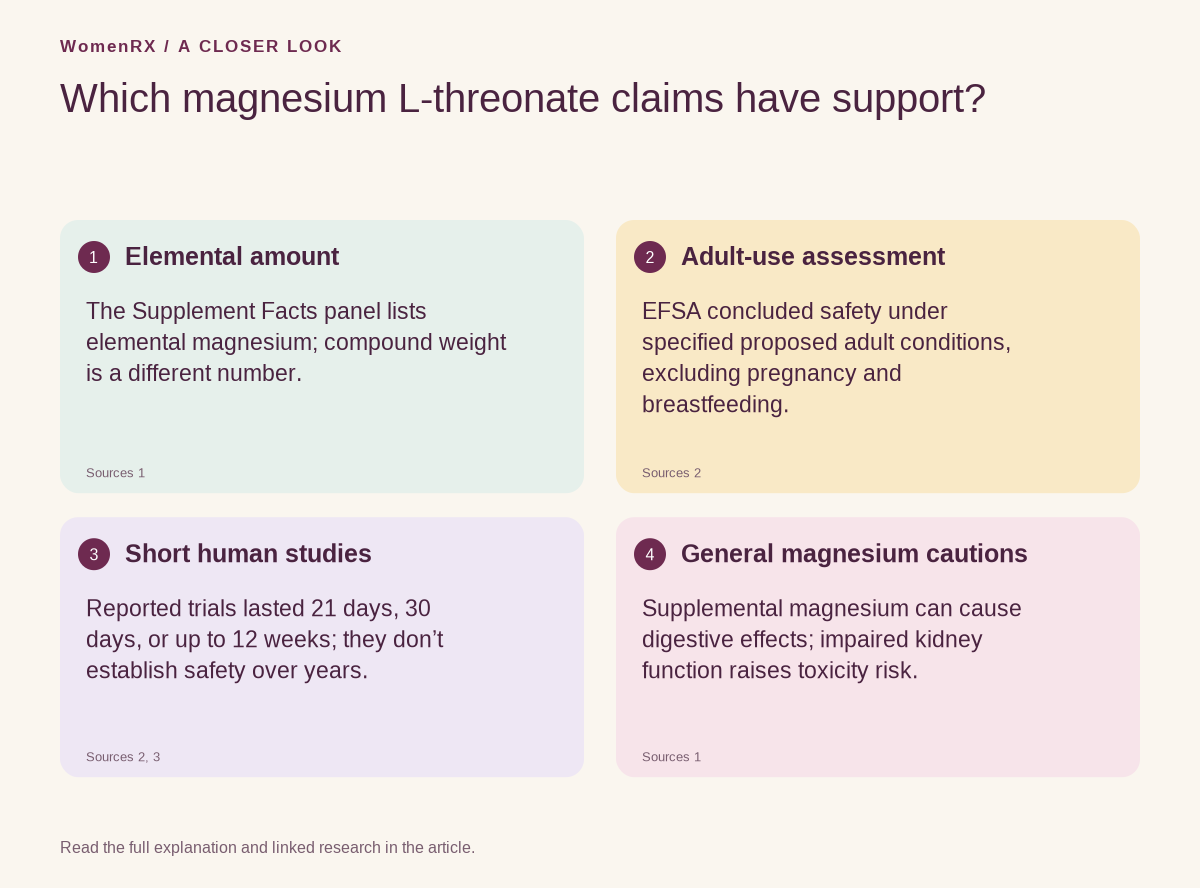
Which magnesium L-threonate claims have support?
Elemental amount: The Supplement Facts panel lists elemental magnesium; compound weight is a different number.1
Adult-use assessment: EFSA concluded safety under specified proposed adult conditions, excluding pregnancy and breastfeeding.2
Short human studies: Reported trials lasted 21 days, 30 days, or up to 12 weeks; they don’t establish safety over years.23
General magnesium cautions: Supplemental magnesium can cause digestive effects; impaired kidney function raises toxicity risk.1
Read the figure as text
Separate what short human studies and magnesium-wide guidance can tell you from what remains unanswered about ongoing use.- Elemental amount: The Supplement Facts panel lists elemental magnesium; compound weight is a different number.1
- Adult-use assessment: EFSA concluded safety under specified proposed adult conditions, excluding pregnancy and breastfeeding.2
- Short human studies: Reported trials lasted 21 days, 30 days, or up to 12 weeks; they don’t establish safety over years.23
- General magnesium cautions: Supplemental magnesium can cause digestive effects; impaired kidney function raises toxicity risk.1
More questions, answered
Does EFSA’s conclusion prove magnesium L-threonate is safe for years?
No. EFSA concluded that the ingredient was safe under specified proposed conditions for the general adult population assessed. The human studies described were limited in duration and safety measures, so they don’t establish safety over years. 2
Does a label showing 2,000 mg mean 2,000 mg of magnesium?
Not necessarily. The compound weight and elemental magnesium are different quantities. Check the Supplement Facts panel, which declares elemental magnesium. 1
Sources you can check
- Magnesium - Health Professional Fact SheetAccessed 2026-09-25Return to first citation
- Safety of magnesium l-threonate as a novel food pursuant to regulation (EU) 2015/2283 and bioavailability of magnesium from this source in the context of Directive 2002/46/EC.EFSA Panel on Nutrition, Novel Foods and Food Allergens (NDA), Turck D, Bohn T, Castenmiller J, De Henauw S, Hirsch-Ernst KI, Maciuk A, Mangelsdorf I, McArdle HJ, Naska A, Pentieva... · EFSA journal. European Food Safety Authority · 2024Return to first citation
- Magnesium-L-threonate improves sleep quality and daytime functioning in adults with self-reported sleep problems: A randomized controlled trial.Hausenblas HA, Lynch T, Hooper S, Shrestha A, Rosendale D, Gu J. · Sleep medicine: X · 2024Return to first citation