Should You Take Magnesium L-Threonate With Food?
There’s no established food-timing advantage for magnesium L-threonate, but the elemental magnesium amount and your stomach’s response matter.
You can use your product’s directions to decide whether to take magnesium L-threonate with food. A safety assessment found that magnesium is bioavailable from this form, but it did not establish that taking it with or without food works better. Check the elemental magnesium amount on the label, and don’t fast in hopes of improving brain delivery or cognitive effects. 21
Does food change how well it works?
There’s no demonstrated reason to take magnesium L-threonate on an empty stomach. The European Food Safety Authority concluded that magnesium is bioavailable from the L-threonate ingredient it evaluated, drawing in part on a human study. That answers whether the ingredient can provide magnesium, not whether a dose is absorbed differently with breakfast than before it. It also doesn’t show that fasting changes where magnesium goes in the body. 2
So start with the directions on your particular product. If they allow either approach, choose a time that’s easy to stick with. If taking it without food seems to upset your stomach, you don’t need to keep doing that for an unproven absorption advantage. Food may be a practical choice for you, though a benefit for L-threonate-specific stomach tolerance hasn’t been established.
The number to check on the label
Elemental magnesium is the amount to look for on the Supplement Facts panel. It’s different from the weight of the full magnesium L-threonate compound. For example, the ingredient evaluated in the European assessment provided about 250 mg of magnesium from 3,000 mg of magnesium L-threonate. That’s an example of why the two numbers aren’t interchangeable, not a suggested dose or a conversion to apply to every product. 12
If you also take a multivitamin, another magnesium supplement, or a magnesium-containing antacid or laxative, count the elemental magnesium from those products too. For US adults, the upper limit is 350 mg per day from supplements and medications; magnesium naturally present in food isn’t included in that limit. It’s a safety limit, not a goal to reach. 1
Higher amounts of supplemental magnesium can cause diarrhea, nausea, and abdominal cramping. Kidney impairment also raises the risk of magnesium building up in the body. If stomach symptoms persist, or you have kidney disease and are considering a magnesium supplement, the amount you’re taking deserves more attention than whether you took it with a meal. 1
What if you’re pregnant or breastfeeding?
Don’t assume the usual adult findings cover this stage of life. The European assessment evaluated proposed use in adults excluding pregnant and breastfeeding women. A clinical trial of magnesium L-threonate in women after breast cancer surgery also excluded participants who were pregnant or breastfeeding. Neither exclusion proves harm, but neither study establishes food timing or safety for those groups. 23
The practical choice is to follow your product’s directions, use food if that suits your stomach, and judge the amount by elemental magnesium. Claims about brain effects need their own evidence; they aren’t a reason to take this supplement fasting.
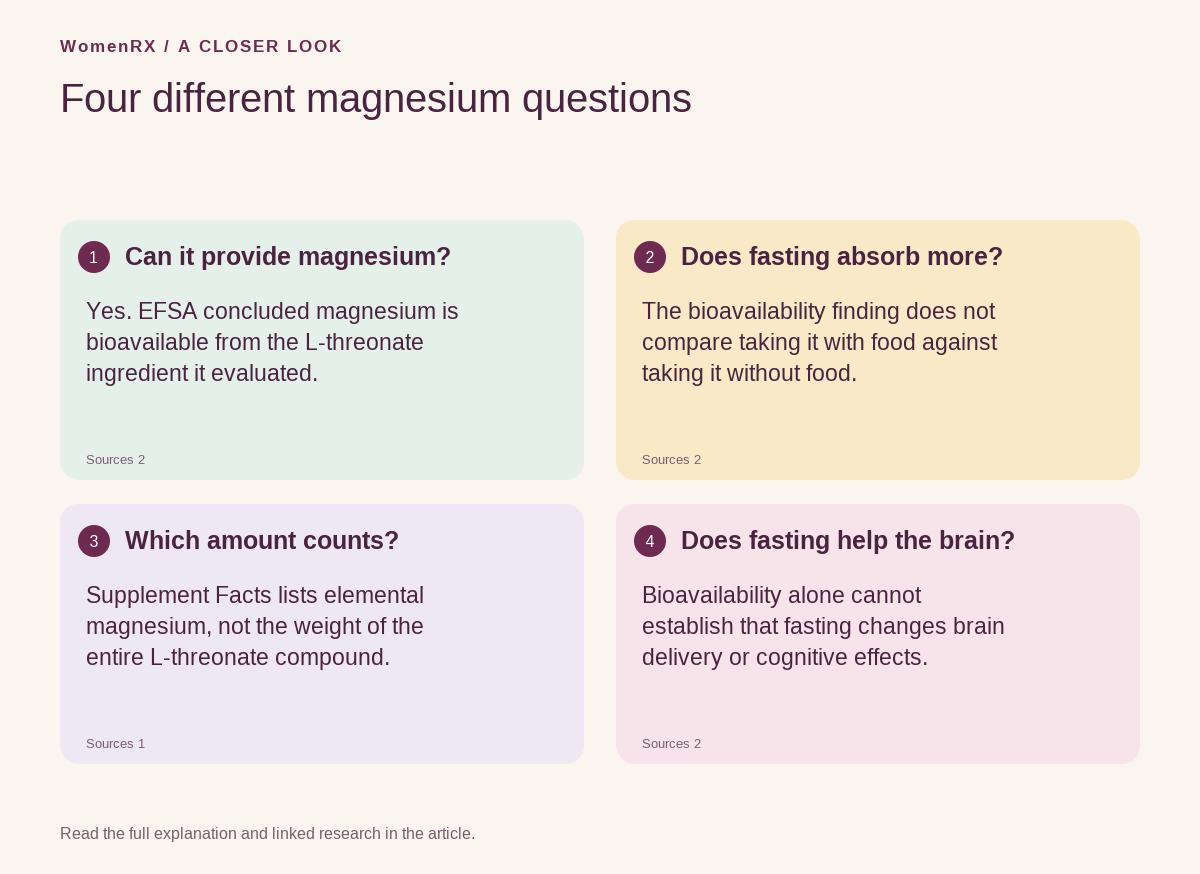
Four different magnesium questions
Can it provide magnesium?: Yes. EFSA concluded magnesium is bioavailable from the L-threonate ingredient it evaluated.2
Does fasting absorb more?: The bioavailability finding does not compare taking it with food against taking it without food.2
Which amount counts?: Supplement Facts lists elemental magnesium, not the weight of the entire L-threonate compound.1
Does fasting help the brain?: Bioavailability alone cannot establish that fasting changes brain delivery or cognitive effects.2
Read the figure as text
These distinctions keep a food-timing decision separate from claims the timing research cannot answer.- Can it provide magnesium?: Yes. EFSA concluded magnesium is bioavailable from the L-threonate ingredient it evaluated.2
- Does fasting absorb more?: The bioavailability finding does not compare taking it with food against taking it without food.2
- Which amount counts?: Supplement Facts lists elemental magnesium, not the weight of the entire L-threonate compound.1
- Does fasting help the brain?: Bioavailability alone cannot establish that fasting changes brain delivery or cognitive effects.2
More questions, answered
Will taking it without food help magnesium reach my brain?
That hasn’t been established. Finding that magnesium is bioavailable from L-threonate doesn’t tell us whether fasting changes brain delivery or cognitive effects. 2
Sources you can check
- Magnesium - Health Professional Fact SheetAccessed 2026-09-25Return to first citation
- Safety of magnesium l-threonate as a novel food pursuant to regulation (EU) 2015/2283 and bioavailability of magnesium from this source in the context of Directive 2002/46/EC.EFSA Panel on Nutrition, Novel Foods and Food Allergens (NDA), Turck D, Bohn T, Castenmiller J, De Henauw S, Hirsch-Ernst KI, Maciuk A, Mangelsdorf I, McArdle HJ, Naska A, Pentieva... · EFSA journal. European Food Safety Authority · 2024Return to first citation
- A Randomized, Double-Blind, Placebo-Controlled Trial to Evaluate the Therapeutic Effect of Magnesium-L-Threonate Supplementation for Persistent Pain After Breast Cancer Surgery.Ni Y, Deng F, Yu S, Zhang J, Zhang X, Huang D, Zhou H. · Breast cancer (Dove Medical Press) · 2023Return to first citation