Magnesium L-Threonate: How to Read the Dose and Safety
The amount of magnesium L-threonate in a serving isn’t the same as its elemental magnesium amount, and the research doesn’t establish one dose for everyone.
Check the Supplement Facts panel for the amount listed as “Magnesium”; that is elemental magnesium, not the weight of the whole L-threonate compound. Human research has tested specific products and amounts, not established a universal dose. Count magnesium from other supplements and medicines too, and get individualized advice if you’re pregnant, breastfeeding, or have impaired kidney function. 123
Start with the Supplement Facts panel
Magnesium L-threonate labels can show two different amounts: the weight of the magnesium L-threonate compound and the amount of elemental magnesium it provides. The Supplement Facts panel declares elemental magnesium. A prominent claim elsewhere on the bottle may instead give the compound amount, so check which number you’re reading before comparing products. 1
The conversion isn’t identical across every product. In the European Food Safety Authority’s assessment, 3,000 mg of a specific magnesium L-threonate novel food corresponded to about 250 mg of magnesium. In a separate trial, 1,000 mg per day of the product tested supplied about 75 mg of elemental magnesium. These are examples tied to specific products, not a conversion rule to apply to every bottle. 23
A label-reading example: If a product advertises “1,000 mg magnesium L-threonate,” look for the separate elemental magnesium amount in Supplement Facts. Don’t assume that 1,000 mg is the amount of magnesium itself.
What the dose studies actually tell you
One randomized, placebo-controlled trial studied 80 adults ages 35-55 who reported sleep problems. Participants took 1,000 mg of magnesium L-threonate or placebo daily for 21 days. The researchers reported some differences in sleep and daytime measures, but this short study tested one particular product and amount. It doesn’t establish a general dose for sleep, other purposes, longer-term use, or women at different life stages. The study excluded people who were pregnant, trying to conceive, or breastfeeding, so it doesn’t answer questions about use during those times. 3
EFSA assessed a proposed maximum use of 3,000 mg per day of its specific novel food, corresponding to about 250 mg of magnesium, for the general adult population excluding pregnant and breastfeeding women. That was a safety assessment under proposed European conditions of use, not a US dosing recommendation or proof of a health benefit. EFSA also distinguished evaluating safety from evaluating efficacy. 2
For context, the US adult upper limit for magnesium from supplements and medications is 350 mg per day; it doesn’t include magnesium naturally present in food. This limit applies to supplemental magnesium, not to the weight of the whole L-threonate compound. It is not a target dose, and it doesn’t mean that an amount below it is right for every person or situation. 1
When to get an individual review
Pregnancy or breastfeeding: Don’t use the adult trial amount as a pregnancy or breastfeeding dose. The sleep trial excluded these groups, and EFSA’s proposed use specifically excluded pregnant and breastfeeding women. Ask your prenatal or postpartum care team to review the product and your total magnesium intake. 23
Kidney conditions: The kidneys help remove excess magnesium. The NIH Office of Dietary Supplements warns that toxicity risk rises when kidney function is impaired. If you have kidney disease or reduced kidney function, ask your clinician or pharmacist before adding magnesium L-threonate. 1
Medicines and other products: Add up magnesium from supplements, antacids, and laxatives, not just the product you’re considering. Magnesium is included in some antacids and laxatives, and high supplemental amounts can cause diarrhea, nausea, or abdominal cramping. A pharmacist can check your exact medicine and supplement labels together. 1
A practical decision
Before deciding whether the amount seems reasonable, note the elemental magnesium per serving, how many servings the label describes, and any magnesium in other products you use. Then compare the total supplemental and medication amount with the 350 mg adult upper limit, while remembering that the limit isn’t an individualized recommendation. Pregnancy, breastfeeding, and impaired kidney function call for a personalized review rather than borrowing a dose from an adult trial. 123
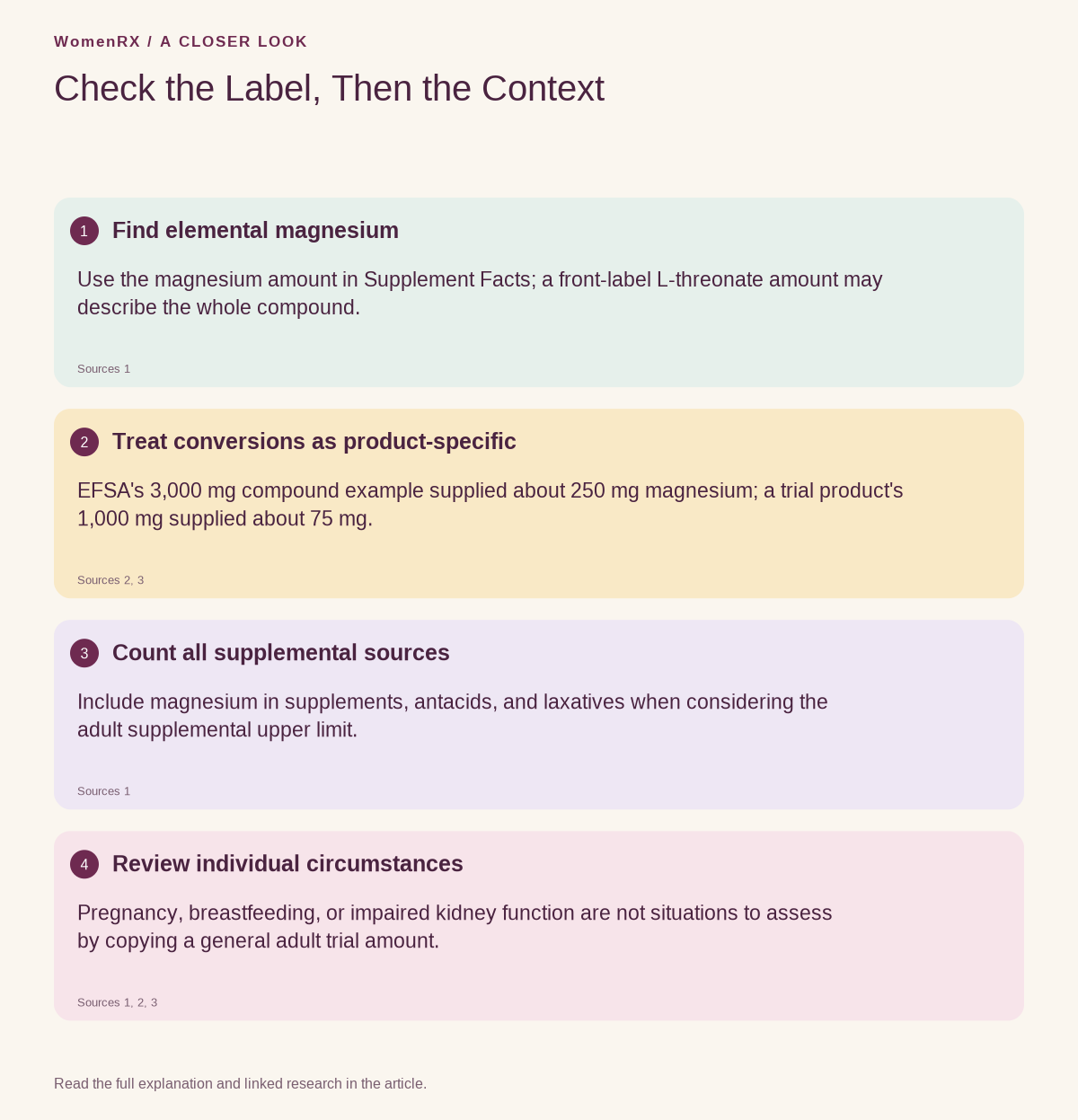
Check the Label, Then the Context
Find elemental magnesium: Use the magnesium amount in Supplement Facts; a front-label L-threonate amount may describe the whole compound.1
Treat conversions as product-specific: EFSA's 3,000 mg compound example supplied about 250 mg magnesium; a trial product's 1,000 mg supplied about 75 mg.23
Count all supplemental sources: Include magnesium in supplements, antacids, and laxatives when considering the adult supplemental upper limit.1
Review individual circumstances: Pregnancy, breastfeeding, or impaired kidney function are not situations to assess by copying a general adult trial amount.123
Read the figure as text
Use these checks to distinguish compound weight from elemental magnesium and to recognize when a trial amount may not apply to you.- Find elemental magnesium: Use the magnesium amount in Supplement Facts; a front-label L-threonate amount may describe the whole compound.1
- Treat conversions as product-specific: EFSA's 3,000 mg compound example supplied about 250 mg magnesium; a trial product's 1,000 mg supplied about 75 mg.23
- Count all supplemental sources: Include magnesium in supplements, antacids, and laxatives when considering the adult supplemental upper limit.1
- Review individual circumstances: Pregnancy, breastfeeding, or impaired kidney function are not situations to assess by copying a general adult trial amount.123
More questions, answered
Does the recommended dietary allowance mean I should take that much as a supplement?
No. The recommended dietary allowance refers to magnesium intake from all sources, including food and supplements. The 350 mg adult upper limit is different: it applies to magnesium from supplements and medications, not magnesium naturally found in food. 1
Does a short trial establish long-term safety?
No. The sleep trial followed adults for 21 days, and EFSA noted limitations in some small, open-label studies it reviewed. Those findings don’t establish long-term safety for every product or for pregnancy, breastfeeding, or kidney conditions. 23
Sources you can check
- Magnesium - Health Professional Fact SheetAccessed 2026-09-25Return to first citation
- Safety of magnesium l-threonate as a novel food pursuant to regulation (EU) 2015/2283 and bioavailability of magnesium from this source in the context of Directive 2002/46/EC.EFSA Panel on Nutrition, Novel Foods and Food Allergens (NDA), Turck D, Bohn T, Castenmiller J, De Henauw S, Hirsch-Ernst KI, Maciuk A, Mangelsdorf I, McArdle HJ, Naska A, Pentieva... · EFSA journal. European Food Safety Authority · 2024Return to first citation
- Magnesium-L-threonate improves sleep quality and daytime functioning in adults with self-reported sleep problems: A randomized controlled trial.Hausenblas HA, Lynch T, Hooper S, Shrestha A, Rosendale D, Gu J. · Sleep medicine: X · 2024Return to first citation