When to Take Magnesium L-Threonate: Does Timing Matter?
A human trial used one specific schedule, but didn’t compare morning with bedtime. Let your routine and medicine instructions guide the choice.
A human trial in people with advanced cancer took magnesium L-threonate once daily before the first morphine dose, but it didn’t compare morning with bedtime or test sleep. 2 That schedule doesn’t establish a best time for other uses. If you’re considering it, check the product directions and any medicine-spacing needs, then choose a repeatable time that fits your routine.
The short answer: the trial didn’t test the clock
A human trial of magnesium L-threonate used one daily schedule, but it didn’t compare morning with evening or bedtime. That means the trial can’t tell you which time is better for routine use. If you’re considering it, follow the product directions and any prescription instructions, then choose a time that’s easy to remember.
Taking it at night shouldn’t be treated as a proven way to improve sleep: the human trial wasn’t a sleep study or a timing comparison. 2
If the product bothers your stomach, check its label and consider whether another point in your routine suits you better. Magnesium from supplements can cause diarrhea, nausea, or abdominal cramping, and changing the time won’t necessarily prevent those effects. 1
What one human trial’s schedule can and can’t tell you
A randomized, placebo-controlled trial studied oral magnesium L-threonate in people with advanced cancer who were already taking oral opioids. Participants took it once daily 30 minutes before their first morphine dose. That schedule was part of the trial’s pain-treatment plan; the researchers did not compare morning with evening dosing, and the finding does not establish a general best time for L-threonate. 2
So, if you’re taking it for a particular goal, don’t assume that moving it to bedtime will make it work better. This trial’s schedule applies to its specific research question, not to sleep, routine supplementation, or women at a particular life stage.
Check medicine timing before choosing your own
Magnesium can reduce absorption of some medicines when they’re taken too close together. The separation depends on the medicine:
- Tetracycline or quinolone antibiotics: Magnesium can bind to medicines such as doxycycline, ciprofloxacin, and levofloxacin. NIH guidance says to take the antibiotic at least 2 hours before, or 4 to 6 hours after, a magnesium-containing supplement. Follow the directions for your specific prescription if they differ. 1
- Oral bisphosphonates: Magnesium can reduce absorption of medicines such as alendronate. NIH guidance says magnesium supplements or medicines should be taken at least 2 hours before or after an oral bisphosphonate. 1
These are concrete timing considerations in the NIH guidance. The schedule used in the cancer trial, by contrast, was tied to that study’s opioid treatment plan. If spacing medicines is difficult, a pharmacist can help you fit a supplement around your prescriptions rather than moving a medicine on your own.
Also consider the full amount of magnesium you use. Some antacids and laxatives contain magnesium, and supplement labels list the amount of elemental magnesium, not the full weight of the magnesium compound. 1
Pregnancy, breastfeeding, and other life stages
Magnesium intake recommendations differ by age and life stage, including pregnancy and breastfeeding. That affects recommended intake, not a known time-of-day schedule for L-threonate. The NIH reference gives life-stage intake recommendations but no morning-or-night instruction specific to this form. 1
As a practical safeguard, if you’re pregnant or breastfeeding, check the product label and your total magnesium intake, including any prenatal supplement, antacid, or laxative. You might also review the product with a pharmacist or your prenatal or postpartum care team, particularly if you take prescription medicines. The trial in people taking opioids does not establish a schedule or benefit for pregnancy or breastfeeding. 1 2
A study in female mice doesn’t establish a different timing rule for cycling years, perimenopause, or postmenopause. 3
A quick way to choose
- Check the reason you’re taking it. Don’t use bedtime as a substitute for evidence that it improves sleep.
- Check your medicines. Pay particular attention to tetracycline or quinolone antibiotics and oral bisphosphonates, which need spacing from magnesium. 1
- Choose a repeatable time. If no product or medicine instructions conflict, pick a time that fits your routine. If you notice stomach symptoms, review the product label and consider changing the routine.
- Review the whole product list. Include other supplements, magnesium-containing antacids or laxatives, and prescribed medicines. 1
If you have reduced kidney function, get individualized advice before using a magnesium supplement. The kidneys help remove excess magnesium, and the risk of toxicity is higher when kidney function is impaired. 1
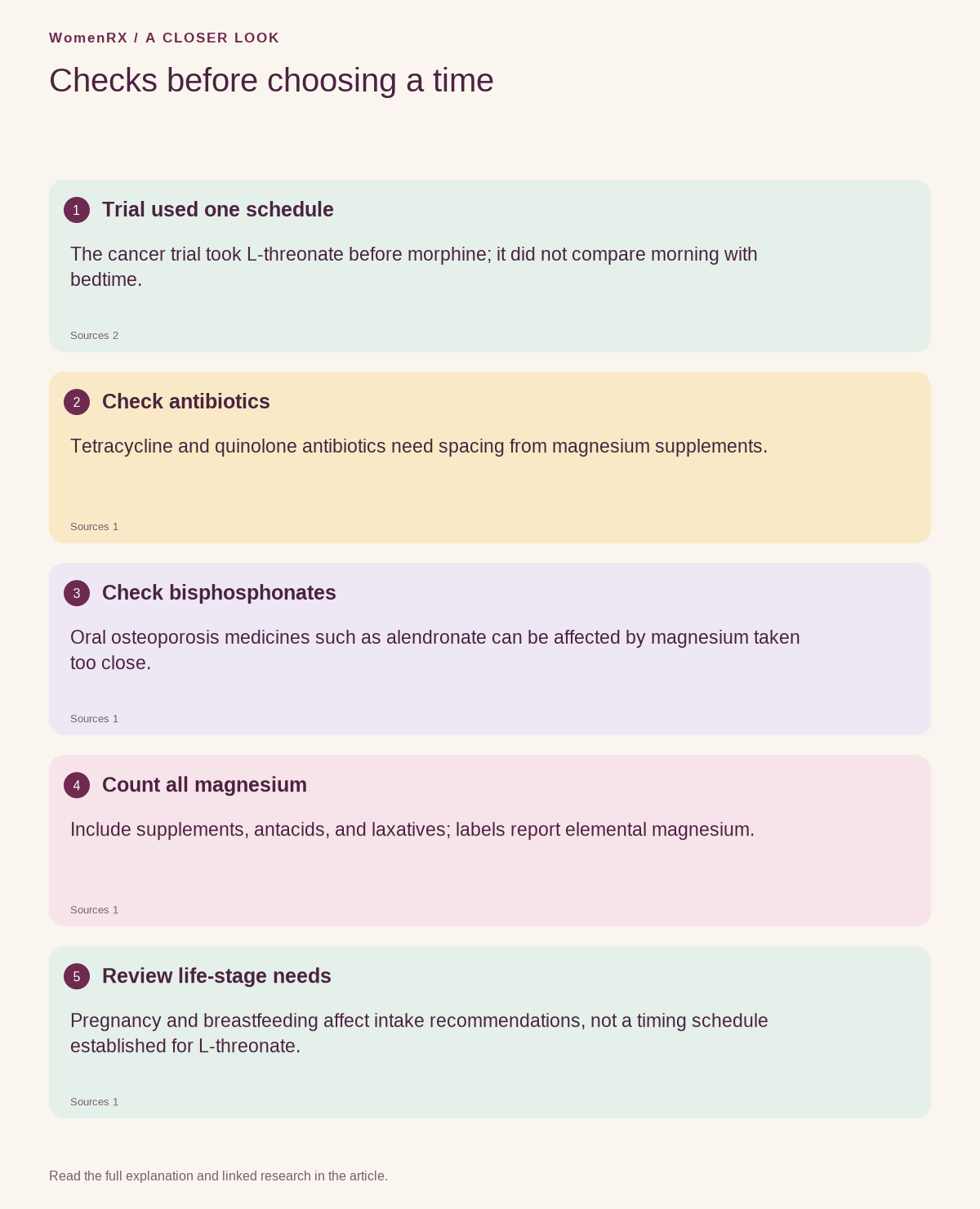
Checks before choosing a time
Trial used one schedule: The cancer trial took L-threonate before morphine; it did not compare morning with bedtime.2
Check antibiotics: Tetracycline and quinolone antibiotics need spacing from magnesium supplements.1
Check bisphosphonates: Oral osteoporosis medicines such as alendronate can be affected by magnesium taken too close.1
Count all magnesium: Include supplements, antacids, and laxatives; labels report elemental magnesium.1
Review life-stage needs: Pregnancy and breastfeeding affect intake recommendations, not a timing schedule established for L-threonate.1
Read the figure as text
Separate the schedule used in one specific human trial from practical medicine-spacing and intake considerations.- Trial used one schedule: The cancer trial took L-threonate before morphine; it did not compare morning with bedtime.2
- Check antibiotics: Tetracycline and quinolone antibiotics need spacing from magnesium supplements.1
- Check bisphosphonates: Oral osteoporosis medicines such as alendronate can be affected by magnesium taken too close.1
- Count all magnesium: Include supplements, antacids, and laxatives; labels report elemental magnesium.1
- Review life-stage needs: Pregnancy and breastfeeding affect intake recommendations, not a timing schedule established for L-threonate.1
More questions, answered
Does taking L-threonate at bedtime help with sleep?
The human trial discussed here did not compare bedtime with morning use or test sleep, so it can’t show that bedtime improves sleep. Choose a time for convenience rather than assuming the clock changes the effect. 2
Should I take it with food?
The NIH guidance cited here doesn’t establish a food rule specific to magnesium L-threonate. Check your product’s directions; if it upsets your stomach, review the label and consider a different routine.
Do menopause or menstrual-cycle changes affect the timing?
A study in female mice doesn’t establish a human dosing-time recommendation based on menstrual-cycle stage or menopause. 3
Sources you can check
- Magnesium - Health Professional Fact SheetAccessed 2026-09-25Return to first citation
- Oral application of magnesium-L-threonate enhances analgesia and reduces the dosage of opioids needed in advanced cancer patients-A randomized, double-blind, placebo-controlled trial.Wu S, Jin T, Ma B, Ji Y, Huang X, Wang P, Liu X, Krylov BV, Liu X, Ma K. · Cancer medicine · 2023Return to first citation
- The Causal Role of Magnesium Deficiency in the Neuroinflammation, Pain Hypersensitivity and Memory/Emotional Deficits in Ovariectomized and Aged Female Mice.Zhang J, Mai CL, Xiong Y, Lin ZJ, Jie YT, Mai JZ, Liu C, Xie MX, Zhou X, Liu XG. · Journal of inflammation research · 2021Return to first citation