Magnesium Threonate: Does Timing Matter for Sleep or Cognition?
Two short trials tested magnesium L-threonate on different schedules, but neither compared times of day to find which works best.
The magnesium L-threonate trials described here don’t establish an ideal time to take it. One used a morning dose and an evening dose two hours before bed; the other tested a daily amount without reporting a timing comparison. Sleep and cognition results varied by measure, and the grams of the compound were not the same as the elemental magnesium provided. 1 2
The study schedules weren’t timing tests
If you’re considering magnesium L-threonate for sleep or cognition, the available trial schedules don’t tell you that bedtime is better than morning. In a six-week study, 100 adults ages 18 to 45 with self-reported dissatisfied sleep took 2 grams of Magtein® a day or placebo. The active group split the amount between morning and evening, with the evening capsule taken two hours before bed. The study didn’t compare that schedule with morning-only or bedtime-only dosing. 1
A separate three-week trial enrolled 80 adults ages 35 to 55 who reported sleep problems. Participants took 1 gram of magnesium L-threonate daily or placebo. The report doesn’t establish that a particular time of day was more effective. 2
So an evening dose was part of one tested schedule, not proof that taking it at night improves results. Neither trial compared dosing times directly. That distinction matters if a product’s marketing suggests that nighttime use is specifically better for sleep.
Sleep findings differed by what researchers measured
In the six-week study, the magnesium L-threonate group improved more than the placebo group on one self-reported measure of sleep-related impairment. But the groups didn’t differ on several other self-reported sleep measures or on sleep outcomes recorded by a wearable. The same trial found a greater improvement in the overall NIH cognition composite, but no difference on Raven’s Progressive Matrices. These are specific findings in adults with self-reported sleep concerns, not evidence that the supplement treats insomnia or cognitive disease. 1
The three-week study reported improvements versus placebo in selected wearable sleep measures and in some self-reported measures of waking, mood, alertness, and daytime function. Not every measure improved. Its results differ from the six-week trial’s wearable sleep findings, but the studies also differed in duration, amount, participants, and measures. Together, they offer early results on particular outcomes, not a settled answer that magnesium L-threonate reliably improves sleep for everyone. 1 2
Check the elemental magnesium amount
The weight of magnesium L-threonate is not the same as the amount of elemental magnesium it supplies. In the six-week trial, 2 grams of Magtein® provided 145 milligrams of elemental magnesium. In the three-week sleep trial, 1 gram of magnesium L-threonate was described as providing about 75 milligrams of elemental magnesium. 1 2
That difference helps put product claims in context: a number stated as grams of the whole compound shouldn’t be read as grams of magnesium itself. And the amounts used in these trials aren’t a proven target for everyone. They describe specific study products and groups, not a personalized recommendation.
These findings are specific to magnesium L-threonate. They don’t establish that other magnesium salts have the same sleep or cognition effects, or that results from other forms apply to this one.
What the safety findings can and can’t tell you
Both sleep-related trials described magnesium L-threonate as well tolerated during their short study periods. That is reassuring for the participants studied, but six weeks or three weeks of observation cannot establish longer-term safety. 1 2
The six-week trial excluded people who were pregnant, breastfeeding, or planning to become pregnant during the study. Its results therefore can’t guide pregnancy-specific use. These trials also don’t establish magnesium L-threonate’s benefits or safety during pregnancy or breastfeeding. If you’re pregnant or breastfeeding and considering this supplement, ask your maternity care team about your specific supplement question rather than using these study amounts as guidance. 1
The practical takeaway: don’t assume nighttime is the proven choice, and compare the stated elemental magnesium amount with the amount of the full compound. The studies offer limited, measure-specific findings, not a tested best-time schedule or a universal sleep or cognition benefit.
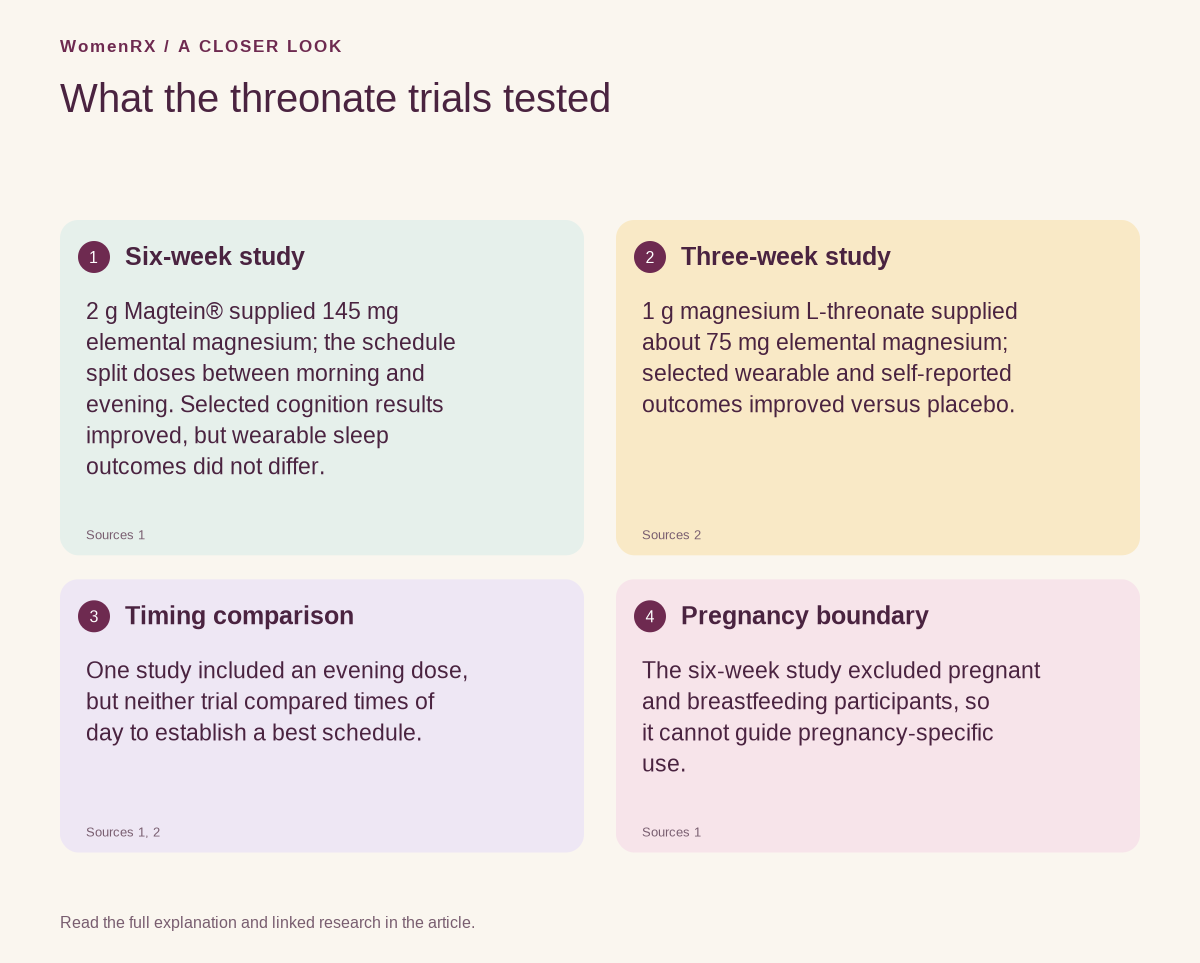
What the threonate trials tested
Six-week study: 2 g Magtein® supplied 145 mg elemental magnesium; the schedule split doses between morning and evening. Selected cognition results improved, but wearable sleep outcomes did not differ.1
Three-week study: 1 g magnesium L-threonate supplied about 75 mg elemental magnesium; selected wearable and self-reported outcomes improved versus placebo.2
Timing comparison: One study included an evening dose, but neither trial compared times of day to establish a best schedule.12
Pregnancy boundary: The six-week study excluded pregnant and breastfeeding participants, so it cannot guide pregnancy-specific use.1
Read the figure as text
Compare the study schedule, elemental magnesium amount, and outcomes without treating either schedule as proof of the best time.- Six-week study: 2 g Magtein® supplied 145 mg elemental magnesium; the schedule split doses between morning and evening. Selected cognition results improved, but wearable sleep outcomes did not differ.1
- Three-week study: 1 g magnesium L-threonate supplied about 75 mg elemental magnesium; selected wearable and self-reported outcomes improved versus placebo.2
- Timing comparison: One study included an evening dose, but neither trial compared times of day to establish a best schedule.12
- Pregnancy boundary: The six-week study excluded pregnant and breastfeeding participants, so it cannot guide pregnancy-specific use.1
More questions, answered
Does the evening dose in one trial prove bedtime is best?
No. Participants took an evening capsule two hours before bed as part of a morning-and-evening schedule, but the study didn’t compare that schedule with morning-only or bedtime-only dosing. 1
Can these trials guide magnesium L-threonate use during pregnancy?
No. The six-week trial excluded pregnant and breastfeeding participants, so its findings don’t establish pregnancy-specific benefits or safety. 1
Sources you can check
- The effects of magnesium L-threonate (Magtein®) on cognitive performance and sleep quality in adults: a randomised, double-blind, placebo-controlled trial.Lopresti AL, Smith SJ. · Frontiers in nutrition · 2025Return to first citation
- Magnesium-L-threonate improves sleep quality and daytime functioning in adults with self-reported sleep problems: A randomized controlled trial.Hausenblas HA, Lynch T, Hooper S, Shrestha A, Rosendale D, Gu J. · Sleep medicine: X · 2024Return to first citation