Magnesium L-Threonate and Cognition: What Human Studies Show
Human research offers a few signals, but it hasn’t established that magnesium L-threonate improves everyday memory or focus.
Human studies have tested cognition directly, sleep, and daytime experiences, but they don’t yet establish a reliable everyday memory or focus benefit. A randomized trial after breast cancer surgery found no significant cognitive-score difference over placebo. A sleep-trial paper also summarizes earlier cognitive findings, including reports in people with dementia and ADHD, but those summaries don’t establish how large or dependable the changes were. 2 3

What has actually been tested in people?
A randomized, placebo-controlled trial involving 109 people after breast cancer surgery directly assessed cognition. Participants received magnesium L-threonate or placebo for 12 weeks. Researchers assessed cognition with the Telephone Interview for Cognitive Status, or TICS, as well as sleep and mood measures. They found no significant difference between groups in cognitive scores at the reported follow-ups. The researchers did not compare participants’ cognitive condition with a baseline, so the results don’t show how scores changed from an initial assessment. 2
This result doesn’t prove the supplement can never help cognition. It does mean that this trial did not demonstrate a cognitive benefit in its study population. Its findings also can’t settle whether a different group, duration, or outcome would produce a different result.
A 2024 sleep trial provides a separate kind of evidence. It randomly assigned 80 adults ages 35 to 55 who reported sleep problems to magnesium L-threonate or placebo for 21 days. Researchers tracked sleep using questionnaires and an Oura ring, and asked participants about mood, energy, productivity, and alertness. Some sleep and daytime measures favored the supplement, but the study did not directly test memory or attention with cognitive tests. The trial reported statistically significant differences on several measures. Statistical significance alone, however, doesn’t show how large a change was or whether it would feel meaningful in everyday life. 3
The sleep-trial paper also describes earlier reports of cognitive findings. It refers to improved scores on measures of executive function, working memory, episodic memory, and attention after six weeks, and mentions measures of memory, associative learning, figure recognition, recall, and character-face association. The same paper summarizes an eight-week open-label study involving 15 people with dementia that reported improved overall cognitive functioning, and a 12-week open-label study in people with ADHD that reported changes in self-reported ADHD symptoms, executive function, and visual scanning. These are different populations and study types, and the paper’s summary doesn’t give enough detail to judge the methods or size of these reported changes. 3
Sleep changes aren’t the same as better memory
Sleep can affect how alert you feel during the day, so improvements in sleep or self-reported alertness may be relevant to someone hoping to think more clearly. But a sleep score, a wearable’s sleep-stage estimate, and a memory test measure different things. The sleep trial’s results can’t by themselves show that magnesium L-threonate improves memory, focus, or long-term cognitive function. 3
The earlier findings described in the sleep-trial paper are a reason to study specific cognitive measures further, not proof of a dependable everyday benefit. Without enough detail about the underlying studies, it’s not possible to tell from that summary how large or reliable the reported changes were. 3
What magnesium generally can, and can’t, tell you
Magnesium has established roles in nerve and muscle function and many other body processes. Those roles explain why the mineral matters; they do not show that taking a particular magnesium supplement improves cognition. The form matters when interpreting research, too: absorption varies among magnesium supplements, and findings for magnesium generally shouldn’t automatically be applied to magnesium L-threonate. 1 3
Claims about a compound reaching the brain are also not the same as evidence that it improves a person’s memory or daily functioning. For a practical comparison, look for human trials that test the specific outcome you care about, use a comparison group, and report changes that can be understood in everyday terms. Here, one direct cognition trial found no advantage over placebo, while the more encouraging short-term study focused mainly on sleep and self-reported daytime experience. 2 3
What these findings mean for women
The results described here don’t establish a women-specific cognitive effect or tell us whether findings differ during pregnancy, breastfeeding, perimenopause, or postmenopause. The breast cancer surgery trial involved a particular surgical population, but that alone doesn’t establish an effect specific to women. The sleep study’s age range also doesn’t tell us whether its findings apply to cognitive concerns later in life. 2 3
So if you’re considering magnesium L-threonate for memory or focus, the most accurate expectation is that a benefit remains uncertain. If sleep is your main concern, there is one short controlled study with some favorable sleep and self-reported daytime results, but it doesn’t establish a lasting effect or show that memory improves. 3
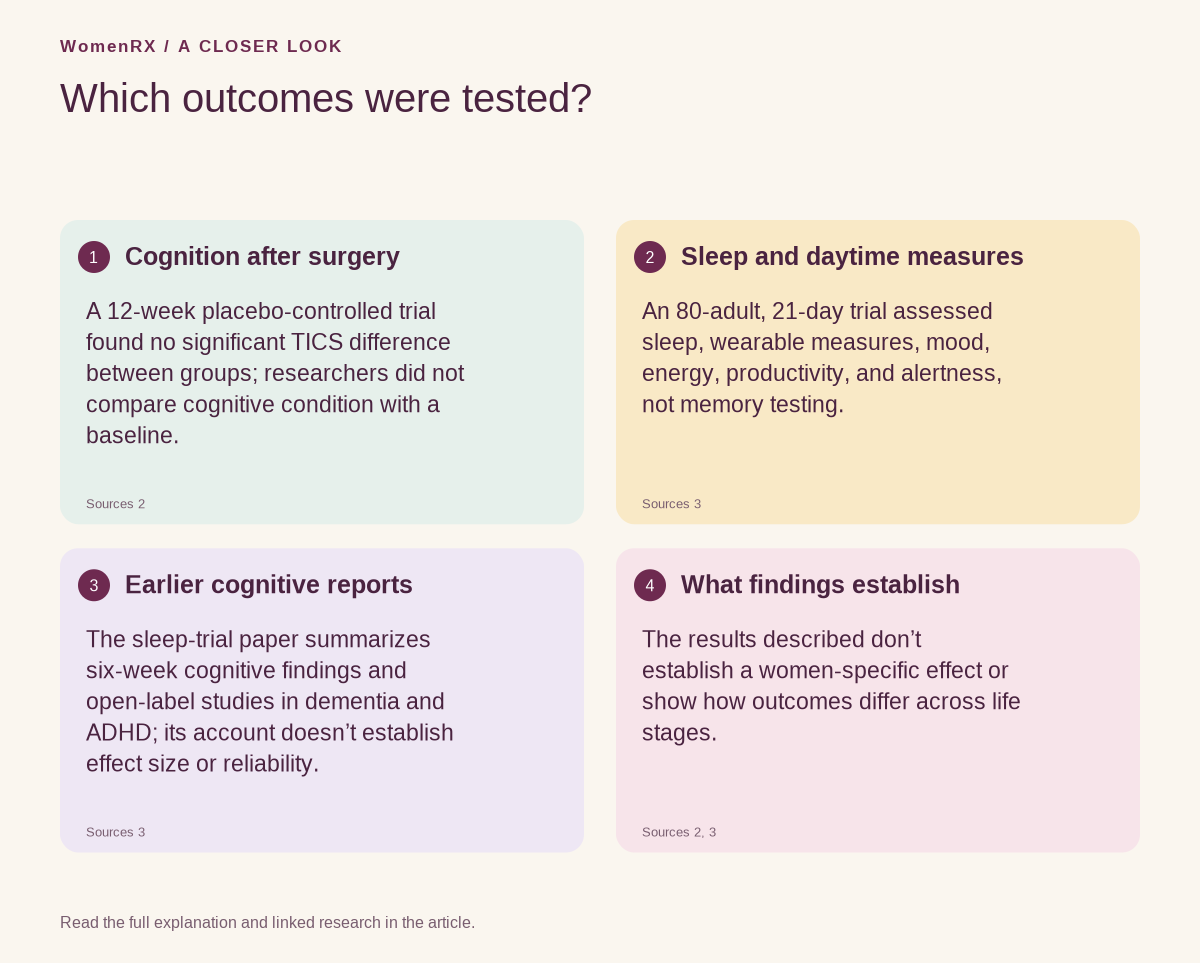
Which outcomes were tested?
Cognition after surgery: A 12-week placebo-controlled trial found no significant TICS difference between groups; researchers did not compare cognitive condition with a baseline.2
Sleep and daytime measures: An 80-adult, 21-day trial assessed sleep, wearable measures, mood, energy, productivity, and alertness, not memory testing.3
Earlier cognitive reports: The sleep-trial paper summarizes six-week cognitive findings and open-label studies in dementia and ADHD; its account doesn’t establish effect size or reliability.3
What findings establish: The results described don’t establish a women-specific effect or show how outcomes differ across life stages.23
Read the figure as text
These studies tested different things: one assessed cognition directly, another focused on sleep, and a separate set of findings is summarized secondhand in the sleep-trial paper.- Cognition after surgery: A 12-week placebo-controlled trial found no significant TICS difference between groups; researchers did not compare cognitive condition with a baseline.2
- Sleep and daytime measures: An 80-adult, 21-day trial assessed sleep, wearable measures, mood, energy, productivity, and alertness, not memory testing.3
- Earlier cognitive reports: The sleep-trial paper summarizes six-week cognitive findings and open-label studies in dementia and ADHD; its account doesn’t establish effect size or reliability.3
- What findings establish: The results described don’t establish a women-specific effect or show how outcomes differ across life stages.23
More questions, answered
Does magnesium L-threonate’s brain delivery prove it improves cognition?
No. A proposed or measured pathway for delivering magnesium to the brain is not the same as showing better memory, focus, or everyday functioning in a human trial. Those outcomes need to be tested directly. 1 3
Did the human studies show a benefit specific to women?
The results described here don’t establish a women-specific benefit or show whether outcomes differ during pregnancy, breastfeeding, or menopause stages. 2 3
Sources you can check
- Magnesium - Health Professional Fact SheetAccessed 2026-09-25Return to first citation
- A Randomized, Double-Blind, Placebo-Controlled Trial to Evaluate the Therapeutic Effect of Magnesium-L-Threonate Supplementation for Persistent Pain After Breast Cancer Surgery.Ni Y, Deng F, Yu S, Zhang J, Zhang X, Huang D, Zhou H. · Breast cancer (Dove Medical Press) · 2023Return to first citation
- Magnesium-L-threonate improves sleep quality and daytime functioning in adults with self-reported sleep problems: A randomized controlled trial.Hausenblas HA, Lynch T, Hooper S, Shrestha A, Rosendale D, Gu J. · Sleep medicine: X · 2024Return to first citation