Should You Take Magnesium Glycinate With Food?
If magnesium glycinate bothers your stomach, a meal is a practical option to try when the label allows, though lab research can't tell whether it prevents symptoms in people.
You don’t have to take magnesium glycinate on an empty stomach unless your product label says otherwise. If it feels uncomfortable, try taking the same product and amount with a meal and note how you feel. NIH guidance doesn’t give glycinate-specific food instructions, and a laboratory study can’t show whether food changes comfort or absorption in people. Check the label’s elemental magnesium amount. 1 2
Food is an option to try
If an empty-stomach dose feels uncomfortable, it’s reasonable to try taking it with a meal, provided the product label doesn’t direct you otherwise. NIH guidance doesn’t give magnesium glycinate-specific food instructions.
One study compared magnesium sources, including magnesium bisglycinate, after simulated digestion with and without food, then measured transport in a laboratory cell model. That experiment doesn’t answer whether taking magnesium glycinate with food changes comfort or absorption in people. 2 Another study included laboratory digestion comparisons and a small trial of a combined marine-derived magnesium and calcium product in healthy older adults. That trial doesn’t establish how food affects the tolerability of magnesium glycinate on its own. 3
Treat food timing as a practical comfort and routine choice, not as something the laboratory study establishes as improving absorption or sleep. Taking a dose at bedtime may be convenient, but the timing itself shouldn’t be treated as a guaranteed sleep benefit.
A simple way to test what feels better
Keep the product and amount the same, and change only whether you take it with a meal. Note the time, whether you took it with food, and any symptoms such as nausea, loose stools, or stomach cramping. This is a personal routine check, not a validated test of absorption. If you’re following specific label directions, stick with them; if the label is unclear, a pharmacist can help interpret it.
Check the Supplement Facts panel for the amount of elemental magnesium. That’s the magnesium amount to use when comparing products, not the total weight of the magnesium glycinate compound. 1 If digestive symptoms continue, don’t assume the glycinate form rules out a supplement-related effect. Supplemental magnesium can cause diarrhea, nausea, and abdominal cramping, particularly at higher intakes. 1
Pregnancy and breastfeeding change the intake context
The adult tolerable upper intake level (UL) for magnesium from supplements and medications is 350 mg per day. The same UL is listed for adults who are pregnant or breastfeeding. It does not include magnesium naturally present in food, and it’s a safety ceiling for those sources, not a recommended supplement dose. 1
The recommended dietary allowance (RDA), which counts magnesium from all sources, differs by age and life stage. For pregnancy, it’s 350 mg per day at ages 19-30 and 360 mg at ages 31-50. During lactation, it’s 310 mg at ages 19-30 and 320 mg at ages 31-50. 1 These are total daily intake recommendations, not directions to take that amount as a supplement. The guidance gives magnesium intake values, not separate food-timing instructions for magnesium glycinate in pregnancy or while breastfeeding.
If you have kidney disease, get advice before using a magnesium supplement: impaired kidney function can raise the risk of magnesium building up in the body. 1 Also check timing with a pharmacist if you take certain medicines. Magnesium can interfere with absorption of oral bisphosphonates and some antibiotics, so taking it with a meal won’t necessarily solve a medication-timing issue. 1
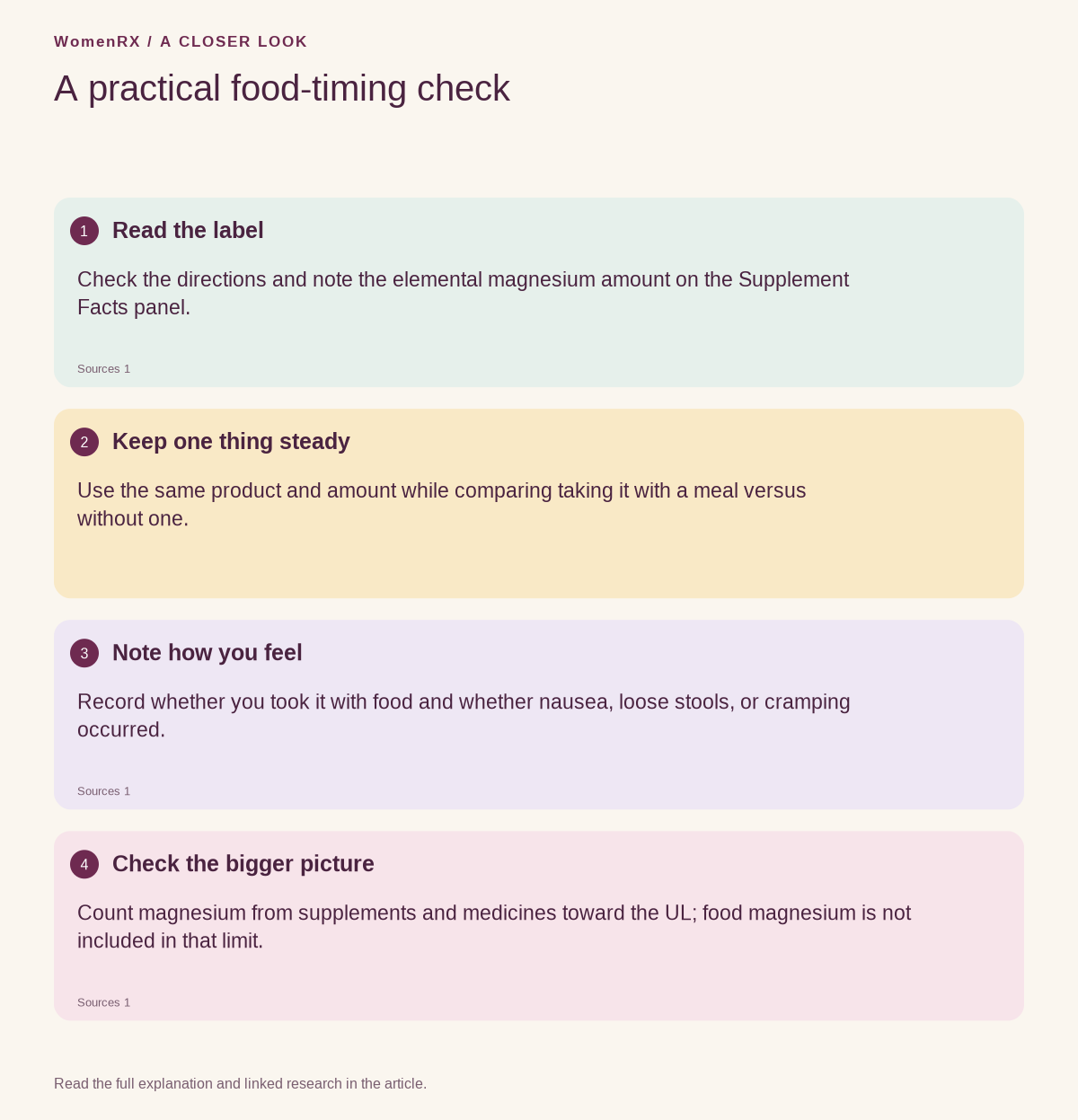
A practical food-timing check
Read the label: Check the directions and note the elemental magnesium amount on the Supplement Facts panel.1
Keep one thing steady: Use the same product and amount while comparing taking it with a meal versus without one.
Note how you feel: Record whether you took it with food and whether nausea, loose stools, or cramping occurred.1
Check the bigger picture: Count magnesium from supplements and medicines toward the UL; food magnesium is not included in that limit.1
Read the figure as text
A cautious way to see whether a meal makes your routine more comfortable, without treating the result as a test of absorption.- Read the label: Check the directions and note the elemental magnesium amount on the Supplement Facts panel.1
- Keep one thing steady: Use the same product and amount while comparing taking it with a meal versus without one.
- Note how you feel: Record whether you took it with food and whether nausea, loose stools, or cramping occurred.1
- Check the bigger picture: Count magnesium from supplements and medicines toward the UL; food magnesium is not included in that limit.1
More questions, answered
Does taking magnesium glycinate at bedtime help with sleep?
The laboratory study on magnesium bisglycinate tested simulated digestion and cell transport, not bedtime use or sleep in people, so it can’t establish a sleep benefit. 2 Choose a time that fits your routine and the product label.
How do I compare the amount in different products?
Compare the elemental magnesium amount on the Supplement Facts panel, rather than the total weight of the magnesium glycinate compound. 1
Sources you can check
- Magnesium - Health Professional Fact SheetAccessed 2026-09-25Return to first citation
- A Comparison of Marine and Non-Marine Magnesium Sources for Bioavailability and Modulation of TRPM6/TRPM7 Gene Expression in a Caco-2 Epithelial Cell Model.Demehin OA, Ryan M, Higgins T, Moura Motta B, Jähnichen T, O'Connell S. · Nutrients · 2026Return to first citation
- The bioaccessibility and tolerability of marine-derived sources of magnesium and calcium.Dowley A, Long-Smith CM, Demehin O, Nolan Y, O'Connell S, O'Gorman DM. · Methods (San Diego, Calif.) · 2024Return to first citation