Magnesium Glycinate: Read the Label, Read the Evidence
The form name tells you what kind of magnesium a product contains, but the elemental-magnesium amount and the evidence behind the product need a closer look.
Magnesium glycinate is a form of magnesium, but research on magnesium generally doesn’t prove that this form works better for sleep, absorption, or stomach comfort. One trial tested it in adults with low magnesium and asthma or COPD, not for menstrual, pregnancy, or menopause outcomes. To compare products, check the Supplement Facts panel for elemental magnesium, then consider your total intake, kidney health, and medication interactions. 12
Start with what the label measures
Magnesium glycinate is a named form of magnesium used in supplements. The useful comparison on a product label is not the weight of the whole magnesium-containing compound: the Supplement Facts panel lists the amount of elemental magnesium. Check that amount per serving, and check how many capsules or tablets make up a serving. That helps you compare products without mistaking the weight of the ingredient for the amount of magnesium. 1
The form name alone doesn’t show that a product is better absorbed or gentler. Magnesium absorption varies among forms; the NIH fact sheet describes some other forms, including citrate and chloride, as more bioavailable than oxide, but it does not establish a glycinate advantage. Claims about better absorption, sleep, or tolerability shouldn’t be treated as proven just because the label says glycinate or bisglycinate. 1
What the glycinate-specific study can tell you
A randomized, double-blind, placebo-controlled study tested magnesium glycinate as an add-on for 224 adults with confirmed low blood magnesium: 112 had asthma and 112 had COPD. Participants received glycinate or placebo alongside their usual treatment for 12 months. The abstract reports improvements in inflammatory markers and lung function in the groups receiving magnesium glycinate, and no serious adverse events compared with placebo. 2
That is evidence about a particular formulation in people with low magnesium and chronic lung conditions. It doesn’t establish benefits for people without those conditions, or show that glycinate is superior to other magnesium forms. The reported outcomes were related to inflammation and lung function, not sleep, menstrual symptoms, pregnancy, or menopause. The study abstract doesn’t report women-specific results, so its findings shouldn’t be presented as evidence of a benefit specifically for women. 2
Evidence about magnesium as a nutrient is broader, but it still can’t answer every question about a particular supplement form. For example, the NIH fact sheet discusses research on magnesium and migraine, blood pressure, and other health topics, but findings about magnesium overall aren’t proof that magnesium glycinate produces the same effects. 1
Use daily needs as context, not a supplement dose
Recommended magnesium intake includes food, drinks, and supplements. For women, the recommended daily allowance is 310 mg at ages 19-30 and 320 mg at ages 31-50 and 51 or older. During pregnancy, it is 350 mg at ages 19-30 and 360 mg at ages 31-50; during lactation, it is 310 mg and 320 mg for those age groups, respectively. These are total-intake targets, not instructions to take that amount as a supplement. 1
Magnesium is found in foods such as leafy greens, beans, nuts, seeds, and whole grains. A supplement label can help you see how much elemental magnesium it adds, but it doesn’t tell you whether you personally have a deficiency. Blood serum magnesium is the most commonly used test, yet it doesn’t accurately reflect total body magnesium or levels in specific tissues. 1
Safety checks before choosing a product
For adults, the upper intake level is 350 mg a day from supplements and magnesium-containing medicines. It does not include magnesium naturally present in food. This limit is not a target; higher supplemental or medicinal amounts can cause diarrhea, nausea, and abdominal cramping. The risk of magnesium building up in the body is greater when kidney function is impaired, because the kidneys remove excess magnesium. 1
Count magnesium from other products, too. Some antacids and laxatives contain it, so a supplement may not be your only source from medicines. If you have impaired kidney function, or regularly use magnesium-containing medicines, include that in your decision rather than judging a supplement by its front label alone. 1
Magnesium can also interfere with the absorption of oral bisphosphonates, tetracycline antibiotics such as doxycycline, and quinolone antibiotics such as ciprofloxacin. Ask a pharmacist how to separate these medicines from a magnesium product if you use them. Loop and thiazide diuretics can increase magnesium loss in urine, while potassium-sparing diuretics reduce magnesium excretion. Long-term use of some proton pump inhibitors has also been linked to low blood magnesium. 1
A sensible product check is straightforward: read the elemental-magnesium amount per serving, confirm the serving size, and account for other supplements and magnesium-containing medicines. Then weigh that against your total intake, health conditions, and medications. The formulation name is one part of the label, not proof of a special benefit.
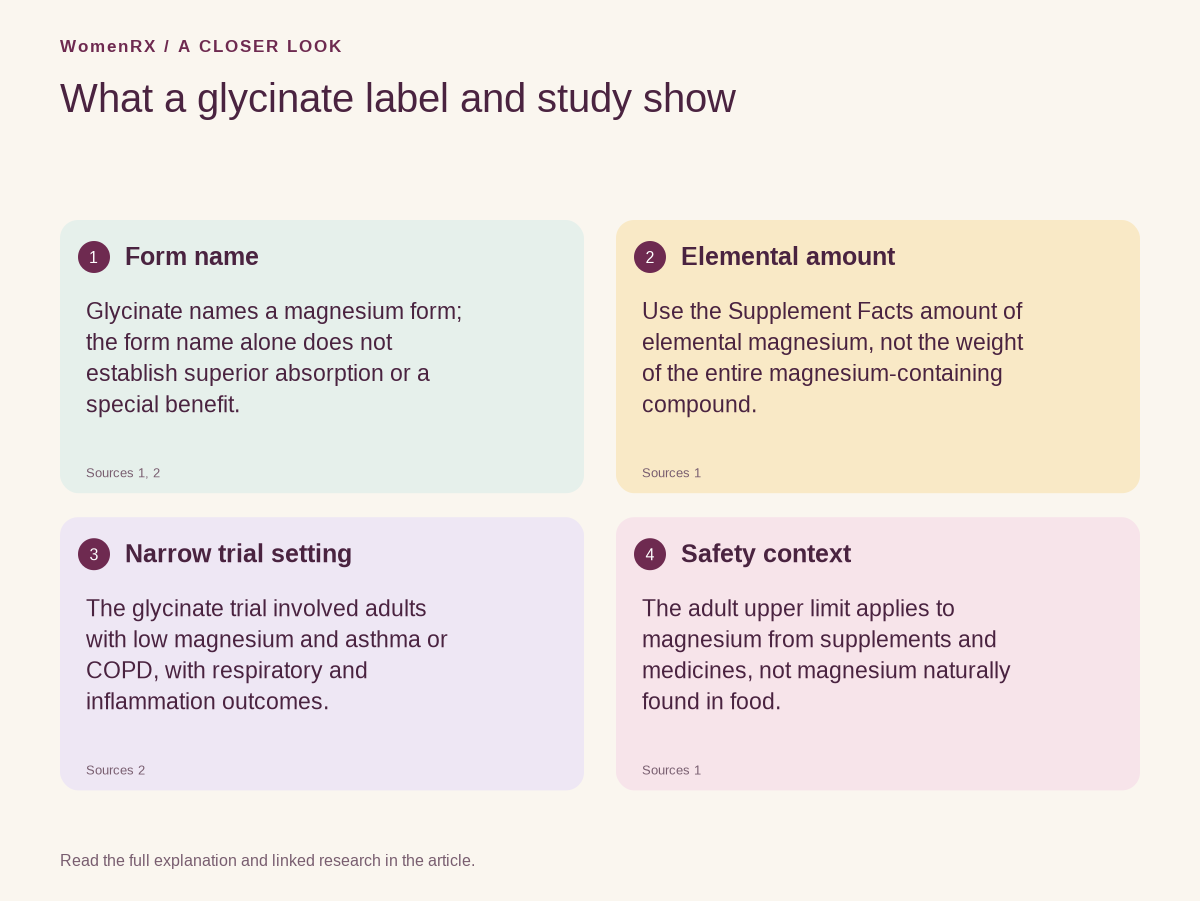
What a glycinate label and study show
Form name: Glycinate names a magnesium form; the form name alone does not establish superior absorption or a special benefit.12
Elemental amount: Use the Supplement Facts amount of elemental magnesium, not the weight of the entire magnesium-containing compound.1
Narrow trial setting: The glycinate trial involved adults with low magnesium and asthma or COPD, with respiratory and inflammation outcomes.2
Safety context: The adult upper limit applies to magnesium from supplements and medicines, not magnesium naturally found in food.1
Read the figure as text
Separate the amount printed on a product label from what formulation-specific research actually tested.- Form name: Glycinate names a magnesium form; the form name alone does not establish superior absorption or a special benefit.12
- Elemental amount: Use the Supplement Facts amount of elemental magnesium, not the weight of the entire magnesium-containing compound.1
- Narrow trial setting: The glycinate trial involved adults with low magnesium and asthma or COPD, with respiratory and inflammation outcomes.2
- Safety context: The adult upper limit applies to magnesium from supplements and medicines, not magnesium naturally found in food.1
Sources you can check
- Magnesium - Health Professional Fact SheetAccessed 2026-09-25Return to first citation
- Efficacy and safety of magnesium glycinate as add on therapy in hypomagnesemic asthma and chronic obstructive pulmonary disease patients: A randomised controlled study assessing inflammatory biomarkers.Maddirevula MK, Rajanandh MG, Wesley B. · Pulmonary pharmacology & therapeutics · 2026Return to first citation