Magnesium Glycinate: How to Read the Label and Sleep Claims
Check the elemental magnesium amount first, then ask whether the evidence matches the product’s specific sleep claim.
On the Supplement Facts panel, find the amount listed as magnesium: that’s elemental magnesium, not the weight of the whole glycinate compound. Check how many capsules make up a serving and what else is in the product. Then judge the sleep claim separately: magnesium studies about cramps or other outcomes don’t show that glycinate improves sleep. 1 2
Find the amount your body is being offered
“Magnesium glycinate” names the form of magnesium in a product. It doesn’t tell you the amount of elemental magnesium. On the Supplement Facts panel, look for Magnesium and note the quantity per serving. The panel declares elemental magnesium, not the weight of the entire magnesium-containing compound. Also check the serving size: it may include more than one capsule. 1
That makes the label more useful for comparing products. Two bottles can both say “magnesium glycinate” on the front but list different elemental amounts per serving or different numbers of capsules per serving. Compare the Supplement Facts panel, not a prominent number that may refer to the compound or a blend.
Treat the sleep promise as a separate claim
A clear amount tells you what the label declares. It doesn’t tell you whether the product helps with sleep. For that, look for research that tests the same form and a sleep outcome relevant to the promise, such as sleep quality or time to fall asleep. A study of magnesium for muscle cramps, for example, answers a different question.
That distinction matters even within one symptom area. A Cochrane review found that magnesium did not meaningfully reduce idiopathic cramps, which were studied largely in older adults. Evidence for pregnancy-associated cramps was conflicting, and the review couldn’t combine those trial results in a meta-analysis. These cramp findings don’t establish a sleep benefit for magnesium glycinate. 2
Magnesium forms can also differ in absorption. The NIH Office of Dietary Supplements says absorption varies by form and describes some forms, including citrate and chloride, as more bioavailable than oxide and sulfate. Those comparisons don’t show that glycinate improves sleep or that one form is best for every concern. 1
Read the rest of the label, too
Check the serving size and full ingredient list. If the product includes other active ingredients, the front-label sleep claim may refer to a blend rather than magnesium alone. The ingredient list can tell you what’s included; it can’t, by itself, show which ingredient produced a claimed effect.
A useful way to assess the claim is to ask: Was the same magnesium form tested? Did the study measure the sleep outcome named on the bottle? Was the tested product comparable to the one you’re considering? If those details aren’t clear, the claim may be more specific than the evidence you can verify from it.
Keep life stage and purpose in view
Pregnancy, breastfeeding, and menopause aren’t interchangeable evidence groups. In pregnancy, a Cochrane review of trials using varied magnesium formulations found that high-quality evidence wasn’t sufficient to show a general benefit from supplementation. Those trials don’t answer whether glycinate helps with sleep during pregnancy. 3
For breastfeeding or menopause, look for evidence that actually addresses the relevant life stage and concern rather than assuming a general sleep claim applies. The same principle holds for any goal: match the evidence to the form, outcome, and group being studied. A label can tell you what’s in the product, but it can’t establish that the product is appropriate or effective for a particular life stage.
Four checks before deciding
- Elemental amount: What amount of magnesium appears on Supplement Facts? 1
- Serving size: How many capsules make up that listed serving?
- Other ingredients: Is magnesium the only active ingredient, or is this a blend?
- Evidence match: Does the research test the form, sleep outcome, and life stage behind the claim?
If the first three answers are clear but the last one isn’t, you can still understand what the product contains. You just can’t use the label alone to conclude that it will improve your sleep.
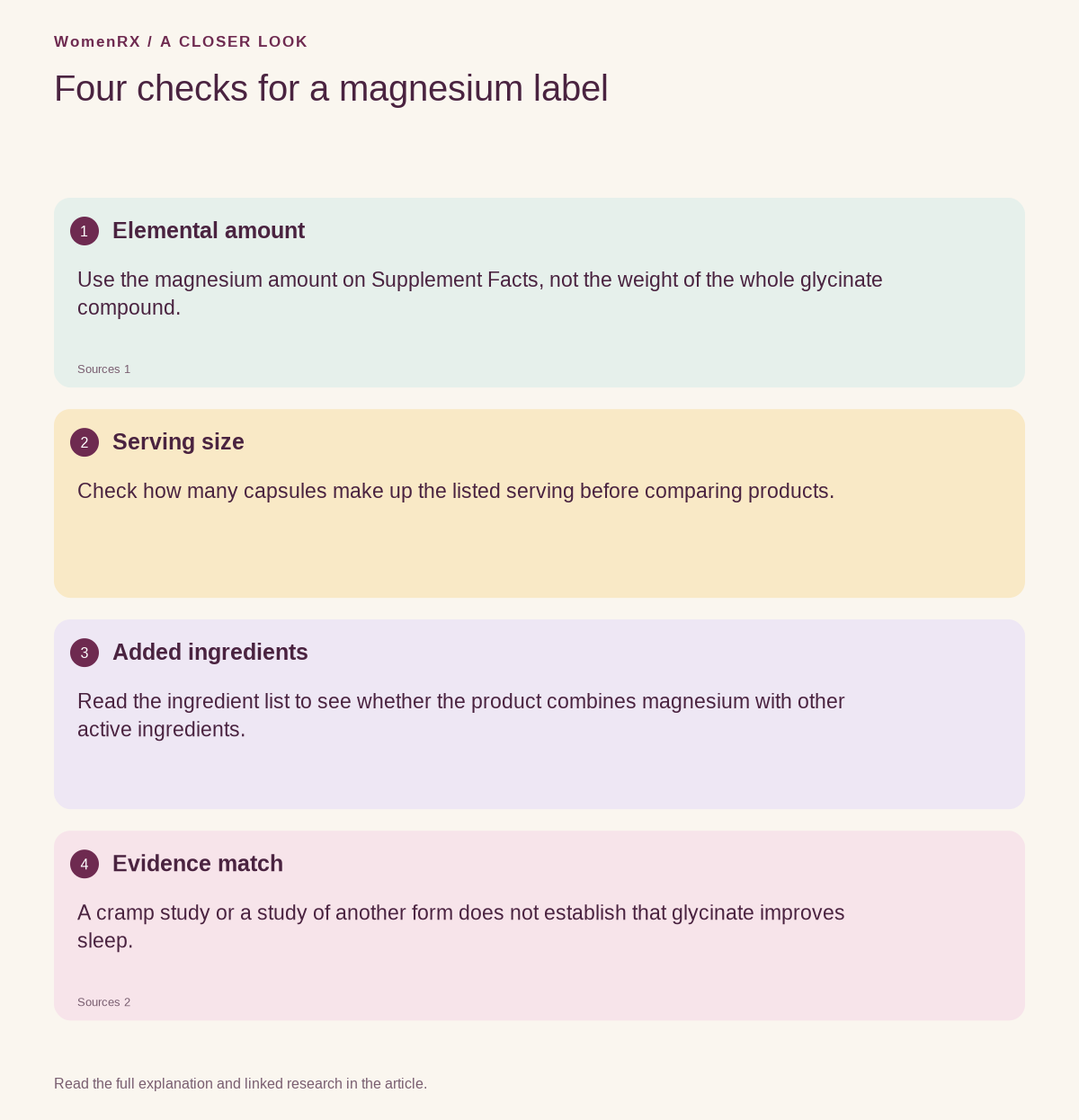
Four checks for a magnesium label
Elemental amount: Use the magnesium amount on Supplement Facts, not the weight of the whole glycinate compound.1
Serving size: Check how many capsules make up the listed serving before comparing products.
Added ingredients: Read the ingredient list to see whether the product combines magnesium with other active ingredients.
Evidence match: A cramp study or a study of another form does not establish that glycinate improves sleep.2
Read the figure as text
Separate the amount the label declares from what a sleep claim would need to demonstrate.- Elemental amount: Use the magnesium amount on Supplement Facts, not the weight of the whole glycinate compound.1
- Serving size: Check how many capsules make up the listed serving before comparing products.
- Added ingredients: Read the ingredient list to see whether the product combines magnesium with other active ingredients.
- Evidence match: A cramp study or a study of another form does not establish that glycinate improves sleep.2
Sources you can check
- Magnesium - Health Professional Fact SheetAccessed 2026-09-25Return to first citation
- Magnesium for skeletal muscle cramps.Garrison SR, Korownyk CS, Kolber MR, Allan GM, Musini VM, Sekhon RK, Dugré N. · The Cochrane database of systematic reviews · 2020Return to first citation
- Magnesium supplementation in pregnancy.Makrides M, Crosby DD, Bain E, Crowther CA. · The Cochrane database of systematic reviews · 2014Return to first citation