Rhodiola Research: What Human Studies Have Actually Tested
Human studies have tested rhodiola for fatigue, depression symptoms, and specific exercise tasks, with mixed results and limited evidence about effects in women.
Researchers have tested Rhodiola rosea for fatigue, symptoms of diagnosed depression, and performance on specific strength, attention, and sport tasks. Findings differ by outcome: one shift-work trial found fatigue results favoring placebo, depression trials did not agree, and exercise findings don’t establish a general boost in energy. A few studies included women, but they don’t establish a women-specific benefit. 2 4 5 8
Rhodiola rosea has been studied in people, but the question is what each study tested and whether its result applies beyond that setting. The research spans fatigue during shift work, diagnosed depression, and narrowly defined exercise or cognitive tasks. Those are different questions, and a result on one test doesn’t establish a broad effect on everyday energy or mood.
Fatigue: results differ by setting
In a randomized, placebo-controlled trial, 48 nursing students on clinical shifts took rhodiola or placebo for 42 days. At the end of the study, both reported fatigue measures favored placebo. The finding comes from a small, specific group, so it doesn’t settle every possible use of rhodiola for fatigue. It does mean the trial did not show improvement in these students. 2
A separate randomized study tested one administration of a standardized extract at two dose levels in 161 cadets. It reported results favoring rhodiola on a researcher-defined “antifatigue index.” That finding came from a particular measure and a uniform study population; it doesn’t resolve the different result in the nursing-student trial or show that rhodiola helps with fatigue generally. 6 2
Fatigue itself can have many causes, including sleep problems, stress, medicines, and health conditions. If tiredness lasts for weeks, identifying what may be contributing can be more useful than assuming one supplement addresses it. 1
Depression: one positive signal, one inconclusive comparison
A six-week placebo-controlled trial enrolled 89 people, described as men and women, with mild-to-moderate depression. The report describes improvements in depression measures among participants assigned to either of two rhodiola groups, while the placebo group did not show the same pattern. But those results don’t establish that women benefited specifically: the reported findings don’t provide a women-only effect. 8
In a different 12-week trial, 57 people with mild-to-moderate major depressive disorder were assigned to rhodiola, sertraline, or placebo. Scores declined in all three groups, but the differences between groups were not statistically significant. A change within a treatment group is not enough to show that the treatment caused the change; the comparison with the other groups matters. Taken together, these trials don’t establish rhodiola as a depression treatment. 5
Exercise and attention: specific tests, not everyday stamina
In a crossover study of 18 young adults, seven of them women, researchers tested strength exercises and cognitive tasks under different conditions. They reported trivial-to-small effects on mental fatigue and cognitive processing, alongside better results than placebo on some strength measures during a control-video condition. This is a limited finding about particular tests, not evidence of improved daily concentration or energy in women. 4
Other trials tested resistance exercise or sport-specific movements. A study of 27 resistance-trained adults reported better results than a no-capsule control on several strength and Stroop-test measures, while effects on other exercise outcomes were inconsistent. Its reported findings don’t establish a women-specific effect. 7 A separate trial enrolled 48 male collegiate dancers and measured performance on Jive tasks. It cannot answer whether rhodiola improves women’s exercise performance. 3
How to read a rhodiola result
Look at the outcome, the participants, and the comparison. A result on a brief attention test, a depression rating scale, or a set of strength exercises isn’t interchangeable with relief from persistent fatigue or improved mood in everyday life. Even where women were included, results from a mixed group don’t by themselves show whether the effect was the same for women or identify a women-specific benefit. 4 5 8
The products also need to be considered carefully. In discussing their trial, researchers noted uncertainty about which compounds in rhodiola are active and the importance of standardizing preparations. A finding with one standardized extract therefore doesn’t automatically establish the same effect for every product sold as rhodiola. 2
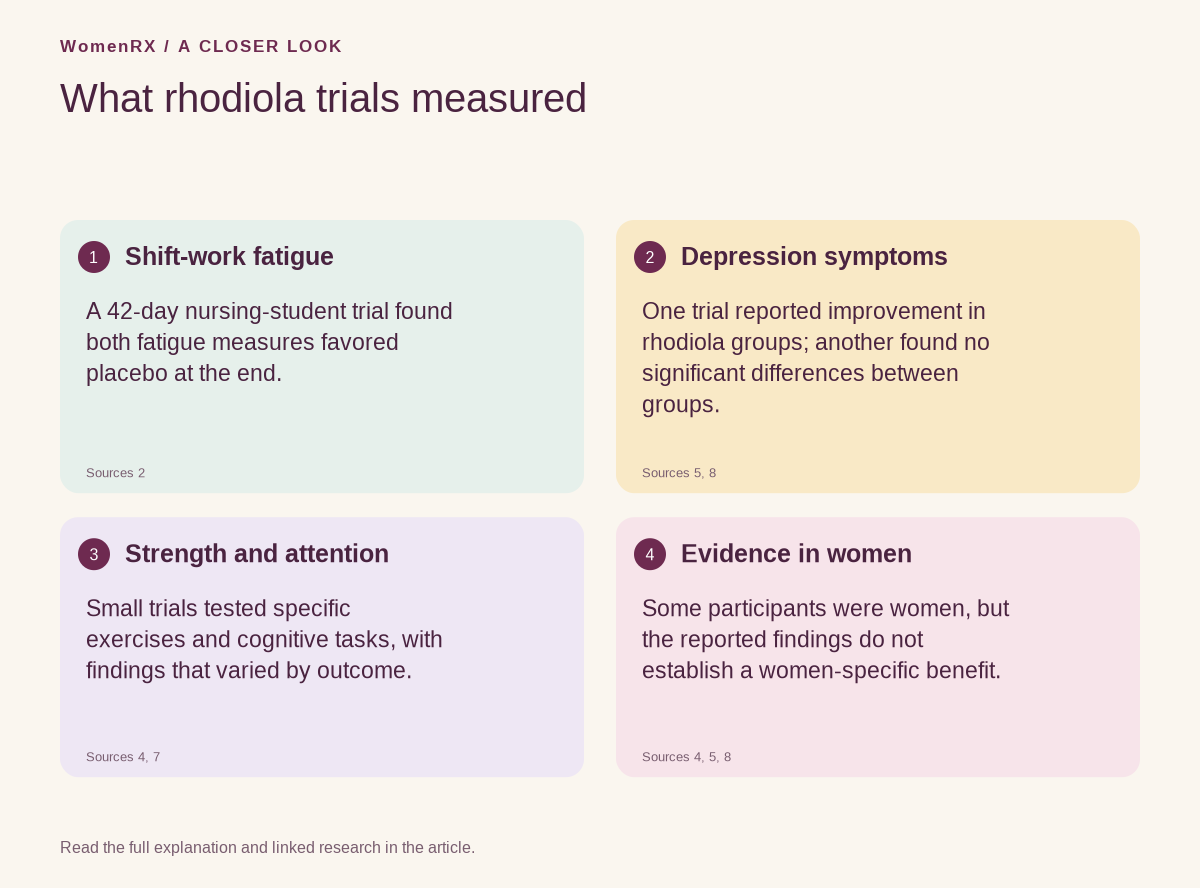
What rhodiola trials measured
Shift-work fatigue: A 42-day nursing-student trial found both fatigue measures favored placebo at the end.2
Depression symptoms: One trial reported improvement in rhodiola groups; another found no significant differences between groups.58
Strength and attention: Small trials tested specific exercises and cognitive tasks, with findings that varied by outcome.47
Evidence in women: Some participants were women, but the reported findings do not establish a women-specific benefit.458
Read the figure as text
The results depend on the outcome and study group. These categories show why findings from one kind of test don’t automatically transfer to another.- Shift-work fatigue: A 42-day nursing-student trial found both fatigue measures favored placebo at the end.2
- Depression symptoms: One trial reported improvement in rhodiola groups; another found no significant differences between groups.58
- Strength and attention: Small trials tested specific exercises and cognitive tasks, with findings that varied by outcome.47
- Evidence in women: Some participants were women, but the reported findings do not establish a women-specific benefit.458
Sources you can check
- Fatigue: MedlinePlusAccessed 2026-09-25Return to first citation
- Rhodiola rosea for mental and physical fatigue in nursing students: a randomized controlled trial.Punja S, Shamseer L, Olson K, Vohra S. · PloS one · 2014Return to first citation
- Effects of Caffeine and Rhodiola rosea, Alone and Combined, on DanceSport-Specific Jive Performance: A Randomized, Blinded, Placebo-Controlled Trial.Dai X, Liu M, Liu S, Tang J, Yu L, Liu C, Yu J, Li X, Chou T, Liu C. · Nutrients · 2026Return to first citation
- The Impact of Rhodiola Rosea Extract on Strength Performance in Alternative Bench-Press and Bench-Pull Exercises Under Resting and Mental Fatigue Conditions: A Randomized, Triple-Blinded, Placebo-Controlled, Crossover Trial.Marcos-Frutos D, Leban Ž, Li Z, Zhang X, Lara PM, Alix-Fages C, Jiménez-Martínez P, Zebboudji N, Caillet A, Redondo B, Vera J, Janicijevic D, García-Ramos A. · Nutrients · 2025Return to first citation
- Rhodiola rosea versus sertraline for major depressive disorder: A randomized placebo-controlled trial.Mao JJ, Xie SX, Zee J, Soeller I, Li QS, Rockwell K, Amsterdam JD. · Phytomedicine : international journal of phytotherapy and phytopharmacology · 2015Return to first citation
- A randomized trial of two different doses of a SHR-5 Rhodiola rosea extract versus placebo and control of capacity for mental work.Shevtsov VA, Zholus BI, Shervarly VI, Vol'skij VB, Korovin YP, Khristich MP, Roslyakova NA, Wikman G. · Phytomedicine : international journal of phytotherapy and phytopharmacology · 2003Return to first citation
- Dose-Response Effects of Short-Term Rhodiola rosea (Golden Root Extract) Supplementation on Anaerobic Exercise Performance and Cognitive Function in Resistance-Trained Athletes: A Randomized, Crossover, Double-Blind, and Placebo-Controlled Study.Koozehchian MS, Newton AT, Mabrey G, Bonness FM, Rafajlovska R, Naderi A. · Nutrients · 2025Return to first citation
- Clinical trial of Rhodiola rosea L. extract SHR-5 in the treatment of mild to moderate depression.Darbinyan V, Aslanyan G, Amroyan E, Gabrielyan E, Malmström C, Panossian A. · Nordic journal of psychiatry · 2007Return to first citation