Rhodiola for Fatigue: How Long Do Trials Take?
Rhodiola studies assess different outcomes over periods ranging from a single dose to six weeks, so their timelines don’t establish when you’ll feel better.
There isn’t one evidence-based timeline for rhodiola to relieve fatigue or stress. A small trial in nursing students assessed fatigue after 42 days and found results favored placebo; another study tested a single dose of the named SHR-5 extract in young cadets. The nursing and exercise-study abstracts don’t identify their extracts, so product comparability is unknown. 2 3 4
What the trial timelines actually mean
A study’s final assessment date tells you when researchers measured an outcome, not necessarily when someone first noticed a change. Rhodiola trials also don’t all test the same thing: feeling less worn out during shift work is different from completing a mental task under laboratory conditions.
In a randomized, placebo-controlled trial, 48 nursing students working clinical rotations received rhodiola or placebo for 42 days. Researchers assessed fatigue using the RAND-36 Vitality subscale and a visual scale for fatigue. At day 42, results favored placebo on both measures, meaning this study did not show that rhodiola eased these students’ fatigue. The abstract doesn’t identify the extract, so it can’t establish how its product compares with the named extract in another trial. 3 4
A much older trial studied a single dose of a standardized extract called SHR-5 in 161 cadets aged 19 to 21. It reported an improvement in an antifatigue index during testing of mental work capacity. That is a different outcome and population from ongoing, everyday fatigue. The abstract doesn’t give a dependable point at which a person should expect to feel a benefit, and this result can’t be treated as a promised response to a single dose. 4
A newer, very small crossover study offers another useful distinction. Eighteen healthy young adults, including seven women, took rhodiola or placebo in a four-day rhodiola supplementation protocol while completing strength exercises and mental tasks. The abstract doesn’t identify the extract. Rhodiola’s effects on mental fatigue and cognitive processing were described as trivial to small; some strength measures favored rhodiola in a condition without the mental-fatigue task. This was an exercise-performance experiment, not a trial showing relief from persistent fatigue or daily stress. 2
Fatigue, stress, and exercise aren’t interchangeable
The available trial findings are more specific than broad claims that rhodiola “helps stress.” The nursing-student trial measured fatigue, the cadet trial measured mental work capacity, and the newer study examined laboratory mental fatigue and strength performance. These results don’t establish a reliable timeline for reducing ongoing stress, anxiety, or fatigue in everyday life. 2 3 4
The product comparison is limited, too. The cadet study names SHR-5, but the nursing-student and exercise-study abstracts don’t identify their extracts. That means these reports don’t establish whether the products are comparable. When a study’s product, setting, and outcome aren’t all clear or alike, its assessment period can’t simply be applied to another rhodiola supplement or another reason for taking it. 2 3 4
A practical way to read a label or a claim is to ask: What outcome was measured, in whom, and at what assessment point? “Mental work capacity after a single dose” is not the same claim as “less fatigue after six weeks.” Neither gives a universal countdown to feeling better.
What the evidence says about women
The exercise study included seven women, but its total sample was only 18 healthy young adults and its main outcomes were performance and laboratory measures. The nursing-student study describes participants aged 18 to 55 but doesn’t report their sex in the available results. The cadet trial’s abstract doesn’t report participants’ sex. These studies therefore provide limited information about whether results differ for women. 2 3 4
The fatigue trials described here don’t establish rhodiola’s safety during pregnancy or breastfeeding. That’s a meaningful gap if you’re considering a supplement during either period; results from general adult or young-adult trials can’t answer that question. 2 3 4
Don’t let a supplement delay finding the cause
Fatigue can follow too little sleep or emotional stress, but it can also be a symptom of conditions such as anemia, thyroid disease, sleep disorders, infection, or depression. If tiredness lasts for weeks, MedlinePlus recommends contacting a health care provider to look for a cause. 1
That matters because a trial timeline isn’t a reason to wait out fatigue that may need attention. Rhodiola research doesn’t show that one product or waiting a particular number of days will address the cause of persistent tiredness.
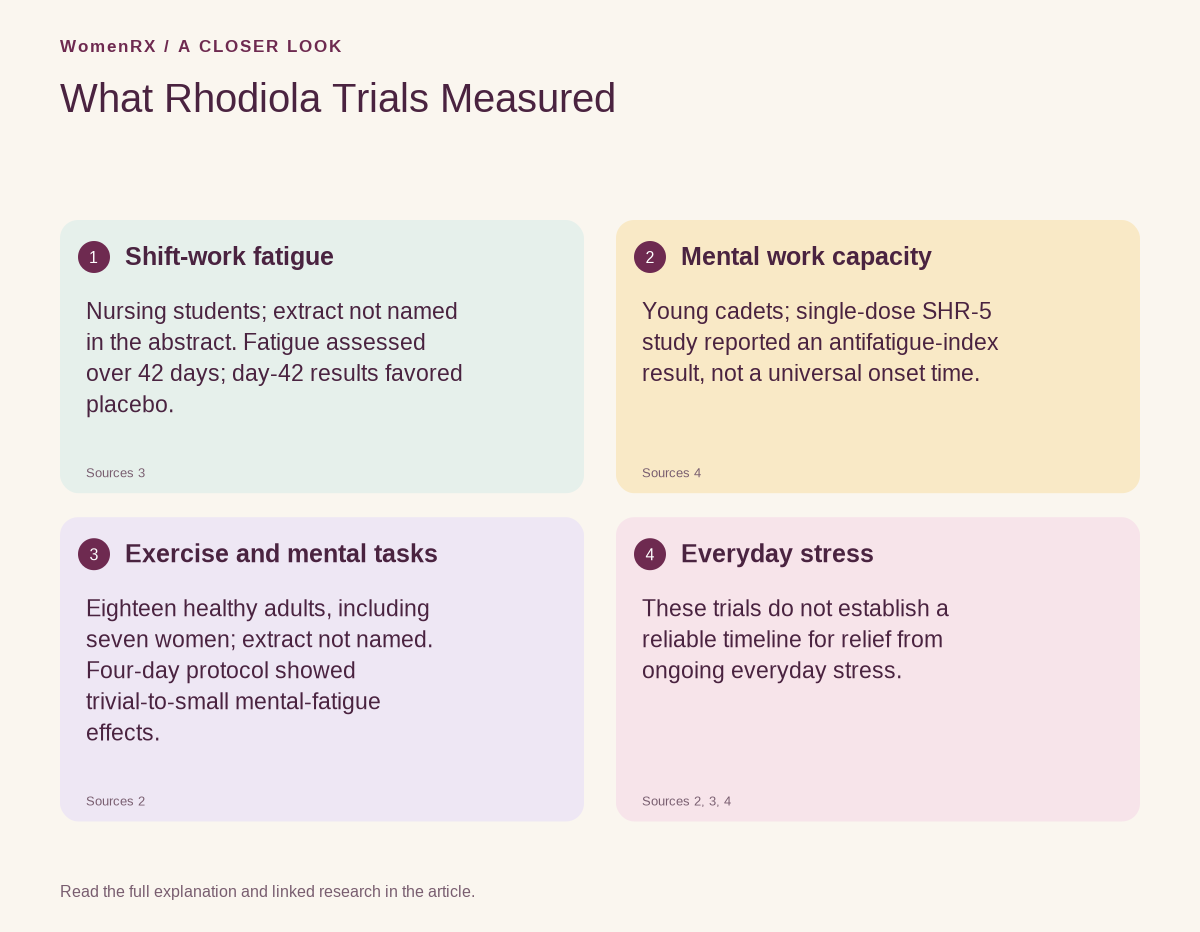
What Rhodiola Trials Measured
Shift-work fatigue: Nursing students; extract not named in the abstract. Fatigue assessed over 42 days; day-42 results favored placebo.3
Mental work capacity: Young cadets; single-dose SHR-5 study reported an antifatigue-index result, not a universal onset time.4
Exercise and mental tasks: Eighteen healthy adults, including seven women; extract not named. Four-day protocol showed trivial-to-small mental-fatigue effects.2
Everyday stress: These trials do not establish a reliable timeline for relief from ongoing everyday stress.234
Read the figure as text
The studies measure different outcomes over different periods. Their reports identify SHR-5 in one trial; the other two abstracts don’t name the extract, so product comparability is unknown.- Shift-work fatigue: Nursing students; extract not named in the abstract. Fatigue assessed over 42 days; day-42 results favored placebo.3
- Mental work capacity: Young cadets; single-dose SHR-5 study reported an antifatigue-index result, not a universal onset time.4
- Exercise and mental tasks: Eighteen healthy adults, including seven women; extract not named. Four-day protocol showed trivial-to-small mental-fatigue effects.2
- Everyday stress: These trials do not establish a reliable timeline for relief from ongoing everyday stress.234
More questions, answered
Does a six-week study mean rhodiola should work by then?
No. The nursing-student trial measured fatigue over 42 days, and its day-42 results favored placebo. A study’s measurement period isn’t a recommended waiting period or a reliable estimate of when someone would feel a benefit. 3
Do these studies show that rhodiola relieves everyday stress?
Not reliably. The cited trials focused on fatigue, mental work capacity, or short-term laboratory measures. They don’t establish a timeline for relief from ongoing everyday stress. 2 3 4
Sources you can check
- Fatigue: MedlinePlusAccessed 2026-09-25Return to first citation
- The Impact of Rhodiola Rosea Extract on Strength Performance in Alternative Bench-Press and Bench-Pull Exercises Under Resting and Mental Fatigue Conditions: A Randomized, Triple-Blinded, Placebo-Controlled, Crossover Trial.Marcos-Frutos D, Leban Ž, Li Z, Zhang X, Lara PM, Alix-Fages C, Jiménez-Martínez P, Zebboudji N, Caillet A, Redondo B, Vera J, Janicijevic D, García-Ramos A. · Nutrients · 2025Return to first citation
- Rhodiola rosea for mental and physical fatigue in nursing students: a randomized controlled trial.Punja S, Shamseer L, Olson K, Vohra S. · PloS one · 2014Return to first citation
- A randomized trial of two different doses of a SHR-5 Rhodiola rosea extract versus placebo and control of capacity for mental work.Shevtsov VA, Zholus BI, Shervarly VI, Vol'skij VB, Korovin YP, Khristich MP, Roslyakova NA, Wikman G. · Phytomedicine : international journal of phytotherapy and phytopharmacology · 2003Return to first citation