Rhodiola for Stress Fatigue: What the Evidence Actually Shows
Small, mixed studies offer a limited signal for fatigue, but they don’t establish rhodiola as a treatment for sleep problems or mood disorders.
Rhodiola has been studied most often for fatigue, mental performance, and stress-related symptoms. Results are mixed, and one small study summarized in a review found improvements in a burnout measure and some cognitive tests, but it also reported poor adherence. That isn’t proof rhodiola treats burnout, depression, anxiety, or insomnia, and results from one extract may not apply to another. 24
Fatigue is the clearest, though still limited, signal
Rhodiola rosea is often marketed for stress-related tiredness. The human evidence is more specific and less conclusive: studies have examined different kinds of fatigue, under different conditions, using different preparations. A review of clinical research describes mixed results across older fatigue studies, including some small positive findings and some little or no benefit. 2
One study summarized in that review involved 60 patients taking the standardized extract SHR-5. The review reports a greater improvement than placebo on the Pines Burnout scale and improvements on several cognitive tests. It also notes that adherence was poor. This is a signal worth distinguishing from no evidence at all, but a single small study with poor adherence cannot establish rhodiola as a reliable treatment for burnout or persistent fatigue. 2
Fatigue also has many possible causes, including too little sleep, medication effects, anemia, thyroid disease, sleep apnea, pregnancy, and depression. If tiredness lasts for weeks or is getting in the way of daily life, treating it as a supplement problem alone can miss the reason it’s happening. 1
Stress, mood, and sleep aren’t interchangeable outcomes
Research reviews describe rhodiola studies involving stress-related symptoms, fatigue, and mental performance, but the findings don’t make those outcomes interchangeable. A change in a fatigue score, for example, doesn’t show that a person’s underlying stressors have changed or that an anxiety disorder has been treated. A 2022 review calls the clinical evidence encouraging while also describing much of the overall evidence as preclinical. 4
The fatigue study described above measured burnout and cognitive outcomes, not whether rhodiola improved insomnia. A review notes reduced depressive symptoms in some rhodiola studies generally, but says studies of rhodiola for post-COVID fatigue or other neuropsychiatric symptoms had not yet been published. These preliminary findings do not establish rhodiola as a treatment for depression, anxiety, or sleep disorders. 2
A separate review of exercise research discusses physical performance in recreationally active men and women. That is a different question from stress-related fatigue in everyday life, and any possible effect on an exercise test should not be taken as evidence of a mood or sleep benefit. The review notes variation in results and in study methods and preparations. 5
The extract matters, and the label may not tell the whole story
“Rhodiola” does not identify one uniform product. Research has used named extracts, including SHR-5 and WS 1375, while products can differ in their extraction and standardization. That makes it hard to assume a result for a particular extract will apply to a different supplement simply because both list Rhodiola rosea. 23
Product identity is a practical concern, too. In a laboratory analysis of 13 supplements claiming to contain Rhodiola rosea, nearly 60% did not contain the declared amount of the plant material or its characteristic marker compounds. This was a small sample, not a survey of every product on the market, but it shows why evidence from a specified extract may not translate neatly to an unverified product. 3
If you’re comparing products, look for the plant name and extract details, and be cautious about treating a marketing claim as proof that a product matches one used in a study. The evidence doesn’t identify a universally reliable product or establish that a particular supplement will help your fatigue. 23
What the research says about women and safety
The review’s summary of the stress-related fatigue study does not provide a participant sex breakdown or women-specific results. A separate exercise review includes research in recreationally active males and females, but its summary does not report whether effects differed by sex. That exercise research cannot fill the gap for stress-related fatigue. 25
The efficacy findings described here don’t establish whether rhodiola is safe during pregnancy or breastfeeding. They also don’t provide enough information to confirm specific medication interactions or long-term safety.
The useful takeaway is narrow: rhodiola has been studied for fatigue and related performance measures, with mixed and limited results. It has not been shown by these findings to treat insomnia or a mood disorder. If fatigue persists, finding its cause is a more useful next step than assuming stress is the whole explanation. 12
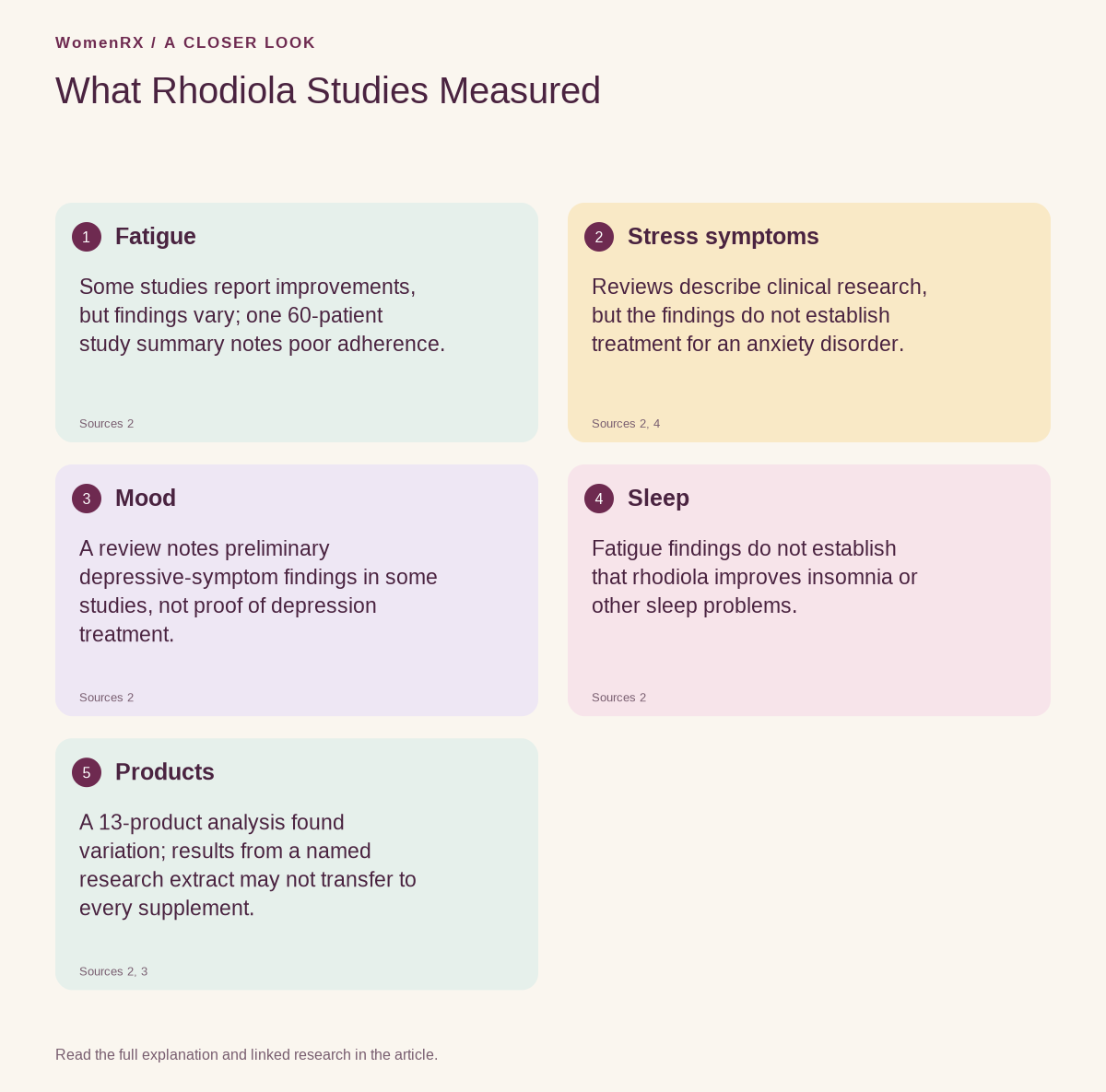
What Rhodiola Studies Measured
Fatigue: Some studies report improvements, but findings vary; one 60-patient study summary notes poor adherence.2
Stress symptoms: Reviews describe clinical research, but the findings do not establish treatment for an anxiety disorder.24
Mood: A review notes preliminary depressive-symptom findings in some studies, not proof of depression treatment.2
Sleep: Fatigue findings do not establish that rhodiola improves insomnia or other sleep problems.2
Products: A 13-product analysis found variation; results from a named research extract may not transfer to every supplement.23
Read the figure as text
Separate the outcomes tested from the broader claims often made about stress, mood, and sleep.- Fatigue: Some studies report improvements, but findings vary; one 60-patient study summary notes poor adherence.2
- Stress symptoms: Reviews describe clinical research, but the findings do not establish treatment for an anxiety disorder.24
- Mood: A review notes preliminary depressive-symptom findings in some studies, not proof of depression treatment.2
- Sleep: Fatigue findings do not establish that rhodiola improves insomnia or other sleep problems.2
- Products: A 13-product analysis found variation; results from a named research extract may not transfer to every supplement.23
More questions, answered
Does rhodiola help with insomnia?
The fatigue findings described in clinical reviews don’t establish an insomnia benefit. A change in daytime fatigue isn’t the same as evidence that a supplement improves sleep. 2
Do study results apply to every rhodiola supplement?
Not necessarily. Studies have used specific extracts, and a laboratory analysis of 13 products claiming to contain Rhodiola rosea found substantial variation in plant material and marker compounds. That small sample doesn’t tell us the quality of every product, but it cautions against assuming products are interchangeable. 23
Sources you can check
- Fatigue: MedlinePlusAccessed 2026-09-25Return to first citation
- Multi-target drugs for the treatment of cognitive impairment and fatigue in post-COVID syndrome: focus on Ginkgo biloba and Rhodiola rosea.Mueller JK, Müller WE. · Journal of neural transmission (Vienna, Austria : 1996) · 2024Return to first citation
- Comprehensive profiling of Rhodiola rosea roots and corresponding products: phytochemical insights and modulation of neuroinflammation in BV2 microglial cell model.Kołtun-Jasion M, Czerwiec K, Parzonko A, Bakiera A, Ożarowski M, Kiss AK. · Frontiers in pharmacology · 2025Return to first citation
- The Effectiveness of Rhodiola rosea L. Preparations in Alleviating Various Aspects of Life-Stress Symptoms and Stress-Induced Conditions-Encouraging Clinical Evidence.Ivanova Stojcheva E, Quintela JC. · Molecules (Basel, Switzerland) · 2022Return to first citation
- Rhodiola rosea as an adaptogen to enhance exercise performance: a review of the literature.Tinsley GM, Jagim AR, Potter GDM, Garner D, Galpin AJ. · The British journal of nutrition · 2024Return to first citation