What We Know About Long-Term Rhodiola Safety
Rhodiola studies described at 12 weeks offer a short-term snapshot, not a clear answer about continued use.
The human Rhodiola studies described in a depression review lasted 12 weeks. One reported no serious adverse events, but neither finding establishes safety with longer use, a different product, or during pregnancy or breastfeeding. If you’re deciding whether to continue, the useful questions are what’s in your supplement, whether you take medicines, and whether the symptom you hoped to help has changed. 2
If you take Rhodiola every day, “no serious side effects in a study” can sound like an answer to whether you should keep taking it. The missing piece is time. A 12-week finding tells you something about the people and extracts studied over those 12 weeks, not what happens after months or years of continued use. 2
What was studied, and for how long?
A review of Rhodiola research in depression describes one study of a standardized 340 mg extract over 12 weeks. Its reductions in depression symptom scores were not statistically significant. The review also describes a separate 12-week study of a standardized extract at 0.3 or 0.6 g per day; that study reported no serious adverse events. These amounts describe the research, not a dose to choose for yourself. 2
The absence of serious adverse events in one study is useful information, but it isn’t a long-term safety test. It also doesn’t mean that every Rhodiola product has the same safety profile. A narrative review focused on adaptogen use in athletes likewise describes Rhodiola evidence as preliminary and says research in that setting is insufficient for definitive conclusions about long-term safety. That athlete-focused assessment shouldn’t be treated as a safety study of all Rhodiola users. 3
Traditional use answers a different question. Rhodiola has a history of use as an herb, but that history cannot tell you the risk of taking your particular supplement alongside your medicines for an extended period. 1
Why the label matters
Rhodiola contains multiple compounds, including salidroside and rosavins. The depression studies described above used specific standardized extracts, while a bottle labeled Rhodiola rosea may have different extract details or additional ingredients. The plant name alone doesn’t establish that your product matches a studied one. 1 2
Before deciding to continue, look at the full label: the botanical name, the extract or standardization information if listed, and any other ingredients. A photo of the label is more useful for a medicine review than the word “Rhodiola” alone.
What about interactions with medicines?
One experimental study tested salidroside, a Rhodiola component, in rats and laboratory systems that included human liver material. It found no substantial direct inhibition of the selected drug-metabolizing enzymes in its laboratory tests. It did not test people taking a whole Rhodiola supplement with their medicines, so it cannot rule out an interaction for your product or medication. 1
If you take medicines, bring the exact supplement label and your medication list to a pharmacist or prescriber. You can ask: “Is there clinical interaction evidence for this product with any of my medicines, or are we making a decision with limited information?” That distinguishes a known interaction from an unanswered question rather than assuming either safety or danger.
When the reason you take it changes the decision
The 12-week depression-study findings do not establish safety during pregnancy or breastfeeding. They aren’t evidence that Rhodiola causes harm in either stage, either. If you’re pregnant, breastfeeding, or planning pregnancy, that uncertainty is worth raising before you decide to continue. 2
Also revisit what prompted you to try Rhodiola. For example, if you started it for fatigue or low mood and that symptom persists or worsens, the question is no longer only whether the supplement seems tolerable. It’s whether the symptom needs a closer look. Tell your clinician what has changed, when it changed, and whether it happened before or after you started the product. You don’t need to prove Rhodiola is the cause to make that conversation worthwhile.
A practical decision weighs the limited 12-week findings against your own situation: the exact product, how long you’ve used it, your medicines, and whether the problem you hoped to address is getting better. Short-term research can inform that discussion. It can’t settle the long-term question for you.
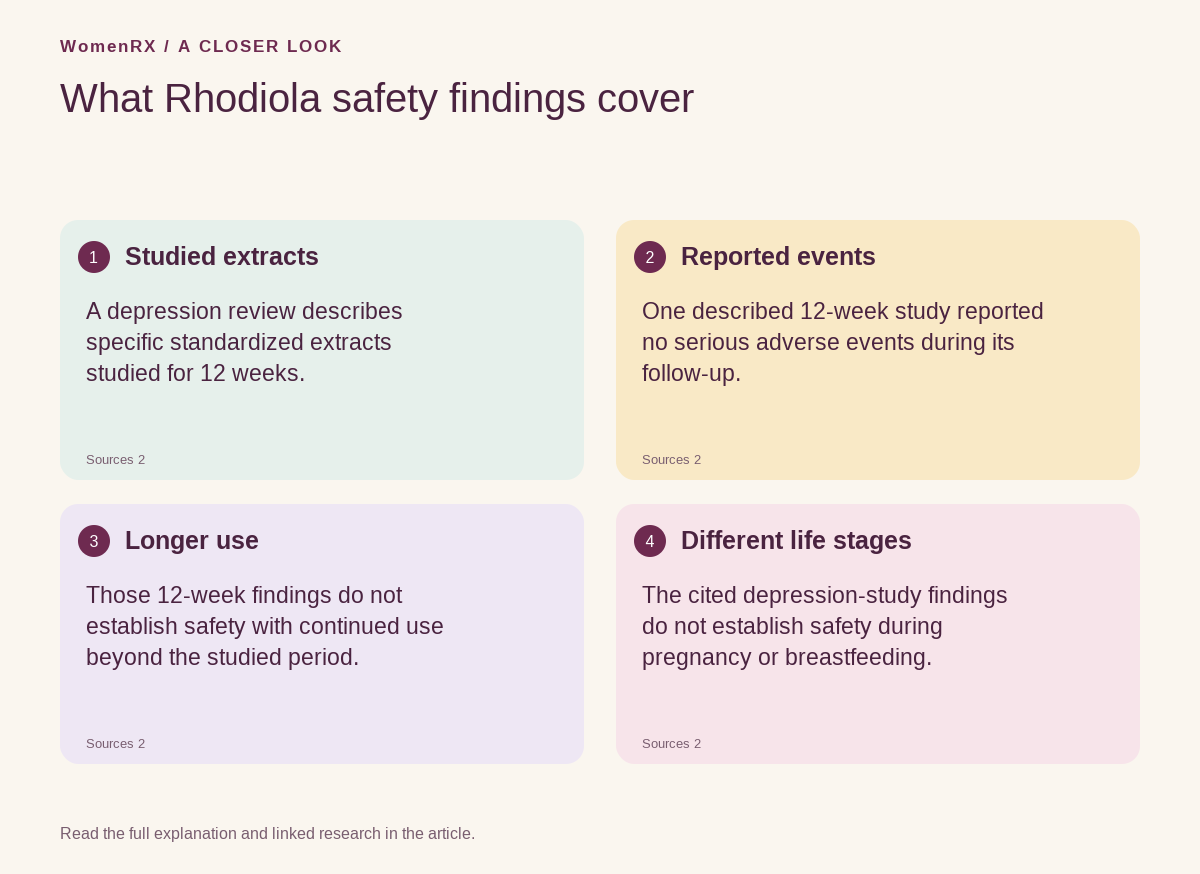
What Rhodiola safety findings cover
Studied extracts: A depression review describes specific standardized extracts studied for 12 weeks.2
Reported events: One described 12-week study reported no serious adverse events during its follow-up.2
Longer use: Those 12-week findings do not establish safety with continued use beyond the studied period.2
Different life stages: The cited depression-study findings do not establish safety during pregnancy or breastfeeding.2
Read the figure as text
The question changes when the product, duration, or person using it differs from what was studied.- Studied extracts: A depression review describes specific standardized extracts studied for 12 weeks.2
- Reported events: One described 12-week study reported no serious adverse events during its follow-up.2
- Longer use: Those 12-week findings do not establish safety with continued use beyond the studied period.2
- Different life stages: The cited depression-study findings do not establish safety during pregnancy or breastfeeding.2
Sources you can check
- The effect of salidroside, an active component of Rhodiola rosea, on the metabolic activity of rat and human cytochromes P450 in preclinical studies.Klaskova E, Jurica J, Danek PJ, Mlcuchova N, Eyrilmez SM, Borilova Linhartova P, Bednar D, Kamaraj R, Daniel WA, Zendulka O. · Pharmacological reports : PR · 2026Return to first citation
- Medicinal Plants for Major Depressive Disorder.Bertollo AG, Spohr L, Bearzi AÉ, Kreuz KM, Ignácio ZM. · Brain sciences · 2026Return to first citation
- Current Evidence and Practical Considerations for Adaptogen Use in Exercise Recovery, Training Adaptation, and Exercise Performance in Athletes: A Narrative Review.Książek A. · Nutrients · 2026Return to first citation