Rhodiola: How to Compare Study Doses and Safety
A milligram amount from a rhodiola study describes the extract and schedule tested, not a universal dose for every product.
Rhodiola studies tested specific extracts for limited periods, so their doses aren’t a prescription for a product with a different or unclear extract. Compare the botanical name, plant part, named extract, amount per serving, schedule, and other ingredients. Short-term tolerability findings don’t establish long-term safety or answer questions about pregnancy, breastfeeding, or fertility-related care. 12
A study dose is tied to the product tested
A dose can look like a simple number to copy. But in a clinical trial, it belongs to a particular product, group of participants, and schedule.
For example, a 14-day randomized trial enrolled 80 mildly anxious participants. The rhodiola group took the named extract Vitano at 200 mg twice daily, while the comparison group received no treatment. The study reported favorable tolerability, but it wasn’t placebo-controlled. Its results describe that extract and short study period, not every rhodiola product or longer use. 1
Another study gave 101 people with life-stress symptoms a different named extract, WS 1375, at 200 mg twice daily for four weeks. It was open-label and had no comparison group. The dose is a description of what researchers tested, not proof that the product helped because of rhodiola or that the same amount is appropriate for you. 2
Both studies used the same stated milligrams per dose, but different extracts and study designs. That doesn’t show the extracts are equivalent, and these studies don’t establish a universal rhodiola dose. 12
Compare the label with the study details
If you’re weighing a product, check whether its label gives enough information to make a meaningful comparison. You can write down:
- Botanical name: Does it identify Rhodiola rosea?
- Plant part: Does the label say which part of the plant is used? A study in women with menopausal complaints, for instance, tested a combination that included a rhodiola root extract. 3
- Extract name: Does the label name a specific extract? The trials above used products identified as Vitano and WS 1375. A different or unnamed extract isn’t automatically the same as either one. 12
- Amount and serving: Is the amount stated per capsule, serving, or daily schedule? Compare like with like, rather than matching a single number without its schedule.
- Other ingredients: Is rhodiola combined with another herb or ingredient? If so, a study of that combination can’t show what rhodiola alone contributed.
If the label doesn’t provide enough detail, you can’t confirm that it matches a study product. That’s a limit of the comparison, not proof that the product is ineffective or unsafe. Bring the label or a clear photo to a pharmacist or clinician if you want help reviewing it.
What short-term safety reports do and don’t tell you
The Vitano trial reported favorable tolerability over 14 days, and the WS 1375 study described the extract as generally well tolerated over four weeks. These findings apply to the products and study circumstances described. They don’t establish long-term safety. 12
A 12-week study in 220 women with menopausal complaints tested rhodiola as part of a black cohosh-rhodiola combination. Because it wasn’t a rhodiola-only product, the study can’t isolate rhodiola’s effects or settle the safety of other rhodiola products. 3
The study descriptions here don’t establish whether rhodiola is safe during pregnancy or breastfeeding, or whether it interacts with medicines used in fertility or reproductive-health care. That doesn’t demonstrate a specific harm or interaction. If one of those situations applies to you, ask a pharmacist or clinician about the exact product and your circumstances before deciding whether to use it. The key question is not just “How many milligrams?” but “What extract is this, and does the research apply to my situation?”
Compare a Label With a Study
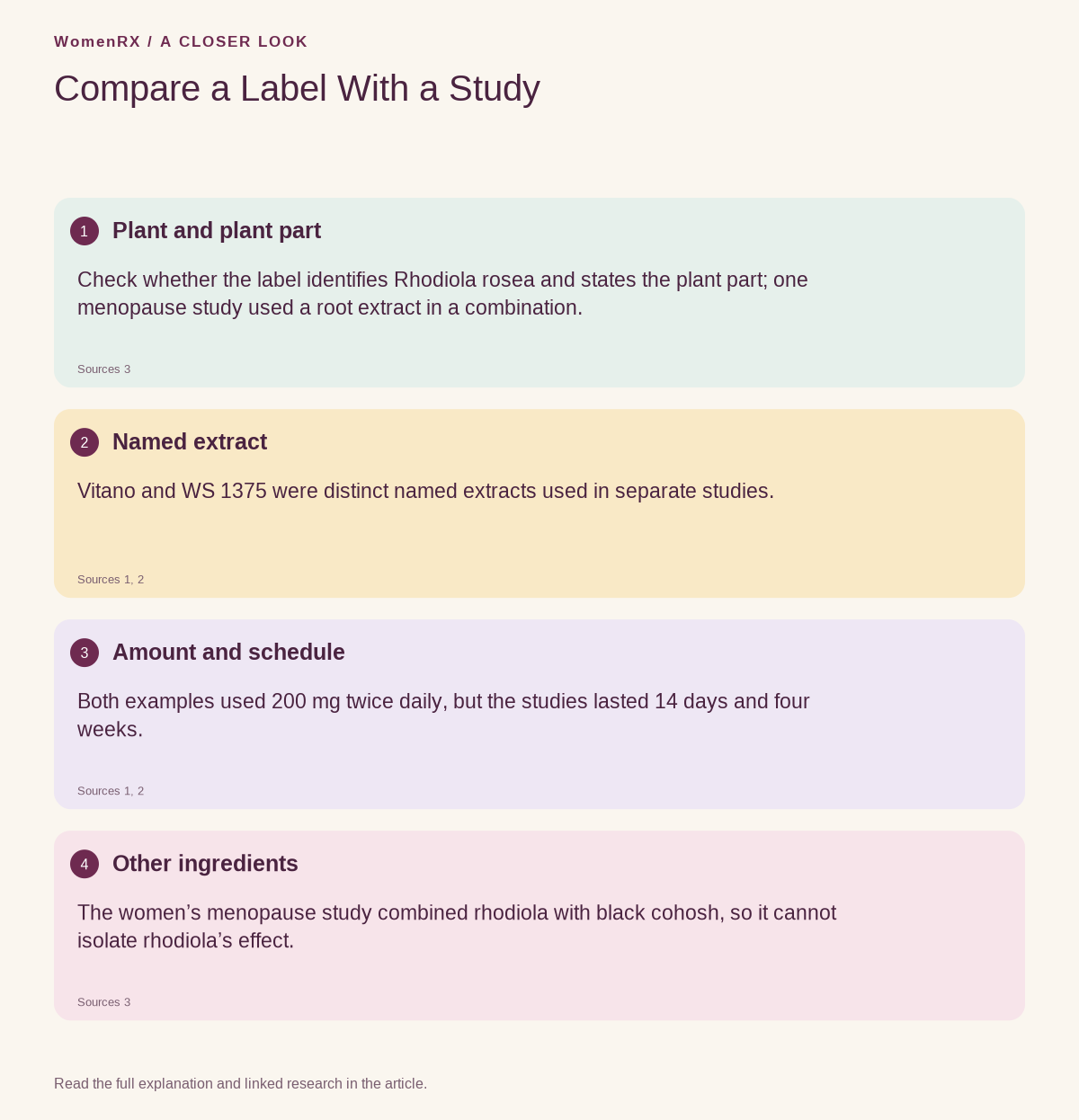
Plant and plant part: Check whether the label identifies Rhodiola rosea and states the plant part; one menopause study used a root extract in a combination.3
Named extract: Vitano and WS 1375 were distinct named extracts used in separate studies.12
Amount and schedule: Both examples used 200 mg twice daily, but the studies lasted 14 days and four weeks.12
Other ingredients: The women’s menopause study combined rhodiola with black cohosh, so it cannot isolate rhodiola’s effect.3
Read the figure as text
These details help show whether a product resembles what researchers tested and where the comparison has limits.- Plant and plant part: Check whether the label identifies Rhodiola rosea and states the plant part; one menopause study used a root extract in a combination.3
- Named extract: Vitano and WS 1375 were distinct named extracts used in separate studies.12
- Amount and schedule: Both examples used 200 mg twice daily, but the studies lasted 14 days and four weeks.12
- Other ingredients: The women’s menopause study combined rhodiola with black cohosh, so it cannot isolate rhodiola’s effect.3
More questions, answered
Does a study dose of 200 mg mean I should take 200 mg?
No. The 200 mg amount was part of specific schedules using named extracts in short studies. It doesn’t establish a dose for a different product or for you. 12
Does the menopause study show that rhodiola works on its own?
No. It tested rhodiola together with black cohosh, so the study can’t separate rhodiola’s effects from those of the combination. 3
Sources you can check
- The Effects of Rhodiola rosea L. Extract on Anxiety, Stress, Cognition and Other Mood Symptoms.Cropley M, Banks AP, Boyle J. · Phytotherapy research : PTR · 2015Return to first citation
- Therapeutic effects and safety of Rhodiola rosea extract WS® 1375 in subjects with life-stress symptoms--results of an open-label study.Edwards D, Heufelder A, Zimmermann A. · Phytotherapy research : PTR · 2012Return to first citation
- Actaea racemosa L. Is More Effective in Combination with Rhodiola rosea L. for Relief of Menopausal Symptoms: A Randomized, Double-Blind, Placebo-Controlled Study.Pkhaladze L, Davidova N, Khomasuridze A, Shengelia R, Panossian AG. · Pharmaceuticals (Basel, Switzerland) · 2020Return to first citation