Rhodiola Dose: What the Human Studies Actually Used
Rhodiola trials used different extracts and found mixed results, so a milligram amount on a bottle isn’t a proven daily dose for fatigue or stress.
There isn’t one rhodiola dose established for women with fatigue or stress. Human trials used specific extracts at different amounts and for different lengths of time, with results ranging from improvement in small, uncontrolled studies to worse fatigue in one placebo-controlled trial. Compare the extract details, not just the milligrams, and don’t treat a trial amount as a recommendation. 3457
Start with the extract, not the front-label number
A rhodiola label can make a dose look straightforward: a certain number of milligrams per serving. But that amount alone doesn’t tell you whether the product matches an extract used in a study. Trials tested named, specific extracts, and the researchers noted that rhodiola preparations can differ and that there isn’t clarity about which plant compounds are responsible for effects. Many products are standardized to rosavins, salidroside, or both; those details help describe a product, but don’t prove it works or make different extracts interchangeable. 36
When comparing products, look for the botanical name Rhodiola rosea, the stated extract or preparation, the amount per serving, and whether standardization to rosavins or salidroside is disclosed. Then ask whether those details match a human study. If the label gives only “rhodiola” and a milligram amount, it’s hard to make a meaningful comparison with research on a named extract. This is a comparison aid, not proof that a more detailed label means a better product.
The study amounts weren’t one consistent dose
The difference between trial amounts is a reason not to turn any one of them into a general daily target:
- In a 28-day randomized, placebo-controlled trial, 60 adults with stress-related fatigue, including men and women, received either 576 mg per day of the standardized SHR-5 extract or placebo. Some outcomes favored the extract, while others improved in both groups. The results apply to that extract and study population, not automatically to other products or to women as a separate group. 5
- In a 42-day randomized trial of 48 nursing students working shifts, participants took 364 mg of rhodiola or placebo at the start of their waking period, with the option of another capsule within four hours. Fatigue scores were worse in the rhodiola group than in the placebo group at day 42. The trial’s small size and specific population limit how broadly to apply the result, but it is a useful reminder that benefit can’t be assumed. 3
- An eight-week study of 100 people with prolonged or chronic fatigue reported improvement while participants took 400 mg per day of WS® 1375. Because it was open-label and had no placebo group, improvement over time doesn’t show that rhodiola caused the change. 4
- A four-week open-label study of 101 people with life-stress symptoms also reported improvement with 200 mg twice daily of WS® 1375. Without a comparison group, it can’t separate an extract effect from other explanations, including expectations or changes over time. 7
These studies don’t establish a single effective amount, a best extract, or a reliable duration for treating fatigue or stress. A number copied from one trial is not automatically appropriate for a different extract, product, or person.
What the evidence says about women
One controlled trial included both men and women, but the available report doesn’t give a women-only result. The nursing-student trial focuses on shift work, not a specific women’s life stage, and its abstract doesn’t report outcomes by sex. These results therefore don’t show whether effects differ during cycling years, perimenopause, or after menopause. 35
The adult trials described here don’t report outcomes in pregnancy or breastfeeding. That leaves safety in those situations unestablished; adult trial findings shouldn’t be treated as evidence of safety during pregnancy or while breastfeeding. 3457
Consider what’s behind the fatigue
Fatigue can follow too little sleep or stress, but it can also be a symptom of conditions such as anemia, thyroid disease, infection, depression, or a sleep disorder. If tiredness has lasted for several weeks, is interfering with ordinary activities, or isn’t improving with rest, looking for the cause is more useful than assuming a supplement is the answer. 1
For a product you’re considering, compare its full extract description with the study details, and check the label alongside your medicines with a pharmacist or prescriber. The trials summarized here don’t establish specific medicine interactions, so they aren’t enough to answer whether a particular combination is suitable for you. If stress is accompanied by severe trouble sleeping, loss of interest in usual activities, or difficulty managing daily tasks for two weeks or more, MedlinePlus recommends seeking help. 2
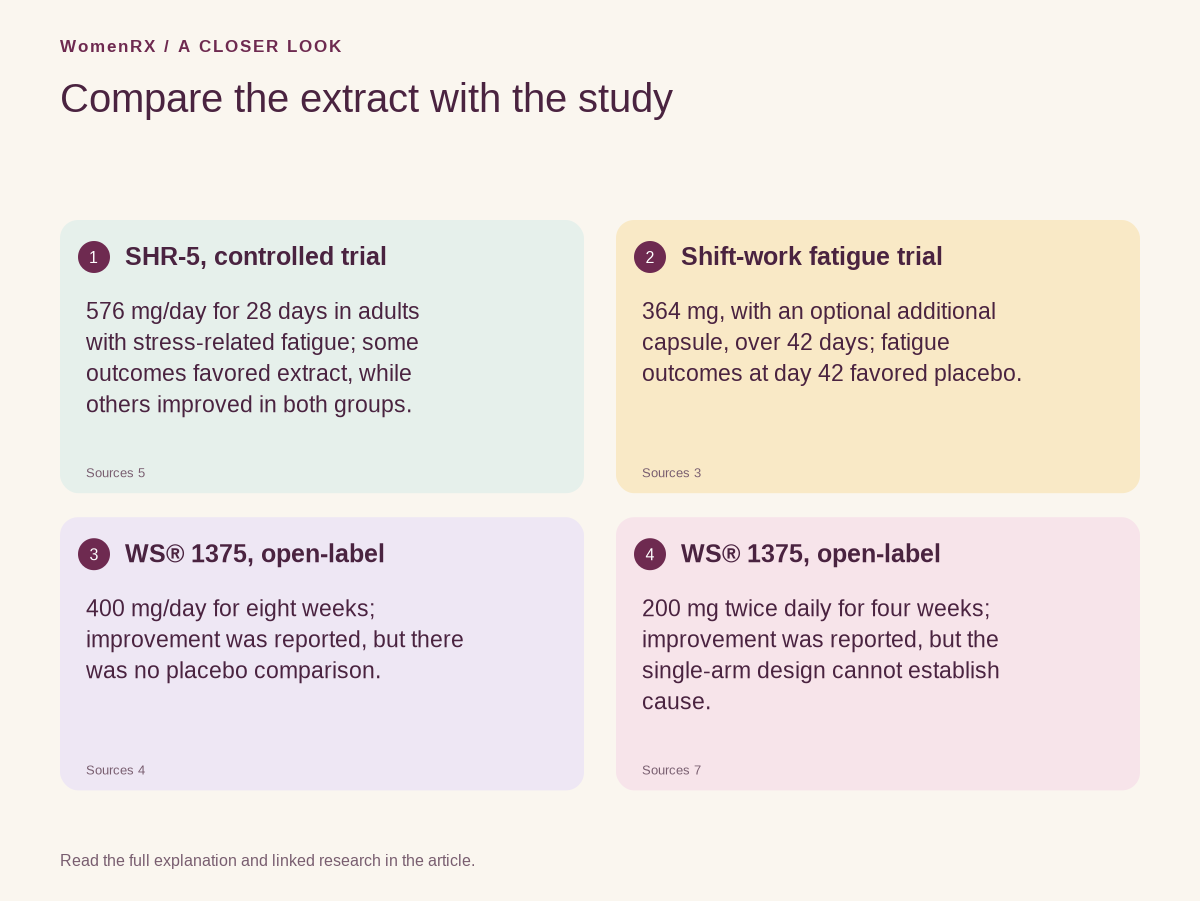
Compare the extract with the study
SHR-5, controlled trial: 576 mg/day for 28 days in adults with stress-related fatigue; some outcomes favored extract, while others improved in both groups.5
Shift-work fatigue trial: 364 mg, with an optional additional capsule, over 42 days; fatigue outcomes at day 42 favored placebo.3
WS® 1375, open-label: 400 mg/day for eight weeks; improvement was reported, but there was no placebo comparison.4
WS® 1375, open-label: 200 mg twice daily for four weeks; improvement was reported, but the single-arm design cannot establish cause.7
Read the figure as text
A trial amount only makes sense beside its extract, design, and outcome. These examples show why the same milligram figure shouldn’t be treated as a universal dose.- SHR-5, controlled trial: 576 mg/day for 28 days in adults with stress-related fatigue; some outcomes favored extract, while others improved in both groups.5
- Shift-work fatigue trial: 364 mg, with an optional additional capsule, over 42 days; fatigue outcomes at day 42 favored placebo.3
- WS® 1375, open-label: 400 mg/day for eight weeks; improvement was reported, but there was no placebo comparison.4
- WS® 1375, open-label: 200 mg twice daily for four weeks; improvement was reported, but the single-arm design cannot establish cause.7
More questions, answered
Does a higher milligram amount mean a stronger or better rhodiola product?
Not necessarily. Trials used named extracts with different amounts, and a milligram figure alone doesn’t show that two preparations are equivalent. Standardization details can help identify what a product contains, but don’t prove a benefit. 356
What if my fatigue keeps going?
Fatigue has many possible causes, including sleep problems, anemia, thyroid disease, infection, and depression. If it lasts several weeks, contact a healthcare provider to help identify the cause rather than relying on a supplement alone. 1
Sources you can check
- Fatigue: MedlinePlusAccessed 2026-09-25Return to first citation
- Stress: MedlinePlusAccessed 2026-09-25Return to first citation
- Rhodiola rosea for mental and physical fatigue in nursing students: a randomized controlled trial.Punja S, Shamseer L, Olson K, Vohra S. · PloS one · 2014Return to first citation
- Rhodiola rosea in Subjects with Prolonged or Chronic Fatigue Symptoms: Results of an Open-Label Clinical Trial.Lekomtseva Y, Zhukova I, Wacker A. · Complementary medicine research · 2017Return to first citation
- A randomised, double-blind, placebo-controlled, parallel-group study of the standardised extract shr-5 of the roots of Rhodiola rosea in the treatment of subjects with stress-related fatigue.Olsson EM, von Schéele B, Panossian AG. · Planta medica · 2009Return to first citation
- Rhodiola rosea as an adaptogen to enhance exercise performance: a review of the literature.Tinsley GM, Jagim AR, Potter GDM, Garner D, Galpin AJ. · The British journal of nutrition · 2024Return to first citation
- Therapeutic effects and safety of Rhodiola rosea extract WS® 1375 in subjects with life-stress symptoms--results of an open-label study.Edwards D, Heufelder A, Zimmermann A. · Phytotherapy research : PTR · 2012Return to first citation