How to Compare Rhodiola Labels Without Guessing
A detailed label can clarify what a Rhodiola product contains, but it can’t prove that it will ease fatigue or stress.
Start with the full species name, Rhodiola rosea, then check whether the label names the plant part and describes a powder or extract. Treat a stated rosavin or salidroside amount as a composition detail, not proof of benefit. Human evidence is limited: one small trial found trivial-to-small effects on mental fatigue, and its overall findings don’t tell us whether women respond differently. 4 2
Start with the full botanical name
Look for Rhodiola rosea, not just “Rhodiola.” The genus includes different species, and a marker compound by itself may not confirm which one is in a product. A review describes rosavin, rosarin, and rosin as compounds specific to R. rosea, while salidroside also occurs in other plants. So if a label highlights salidroside, that information alone doesn’t establish the species. 4
Next, check whether the label names the plant part, such as root and rhizome, and whether it describes the ingredient as a powder or an extract. If it gives details about how an extract was made, those can help you compare what the products say they contain. They don’t show that one is more effective for fatigue or stress.
Read “standardized” as a composition claim
A standardized extract identifies an amount of one or more selected compounds. For example, a tablet-formulation study described an extract standardized to 3% rosavin. That percentage describes the extract’s composition; the study tested how to formulate tablets, not whether that rosavin level relieves fatigue. 3
Look for the compound named and the amount or percentage stated. “Standardized” without saying what was measured leaves the composition unclear. Even a specific marker amount doesn’t establish that the product will improve energy, stress, or concentration. A particular percentage also shouldn’t be treated as a proven target for choosing a more effective product: the human trial described below did not establish that a marker level predicts those outcomes. 2 3
Ask what product testing actually measured
A laboratory analysis of 24 herbal drugs and seven commercial preparations found substantial variation in measured compounds. None of the commercial dietary products in that study met their declared rosavin and salidroside content. Those findings apply to the products tested, not every Rhodiola product on the market. They do show why a label’s stated content and a measured content are not automatically the same thing. 5
If a company provides a test report, look for whether it identifies the product tested and the compounds measured. “Quality tested” is less informative if it doesn’t say what was tested. For example, when comparing two labels, you could note whether each names its species, plant part, extract, marker compounds, and testing details, and mark missing information as unknown rather than assuming it matches.
A report about composition answers a different question from a human study. It may help you understand whether particular compounds were measured in a product; it doesn’t establish that the product reduces fatigue or is appropriate for your circumstances.
Keep the health claim close to the evidence
The word “adaptogen” and a history of traditional use aren’t, by themselves, proof that a product treats fatigue or stress. One randomized, placebo-controlled crossover trial studied 18 young healthy people, including seven women, after four days of Rhodiola supplementation. The reported effects on mental fatigue and cognitive outcomes were trivial to small. Some strength measures favored Rhodiola in a control-video condition, but that finding is not evidence that it relieves everyday tiredness. The study’s overall findings don’t tell us whether women responded differently. 2
That distinction matters when reading a product promise. A study of one extract in a short exercise experiment doesn’t establish that a different product, marker percentage, or routine will help with persistent fatigue or ongoing stress. This evidence doesn’t establish a women-specific benefit, either. 2
Consider life stage, and don’t overlook persistent fatigue
The human trial described above does not establish whether Rhodiola is safe during pregnancy or breastfeeding. A species name, a standardized extract, or the word “natural” can’t answer that safety question. If you’re pregnant, breastfeeding, or planning to use a supplement alongside other care, discuss the specific product with a clinician who knows your situation. This evidence also doesn’t establish an interaction profile, so the label alone can’t answer whether a product fits with your medicines or other supplements.
Fatigue can have many causes, including pregnancy, sleep disorders, anemia, thyroid disease, depression, and other medical conditions. If tiredness hasn’t improved after several weeks, MedlinePlus advises contacting a health care provider to look into the cause. A supplement label can help you compare products, but it can’t explain why you feel tired. 1
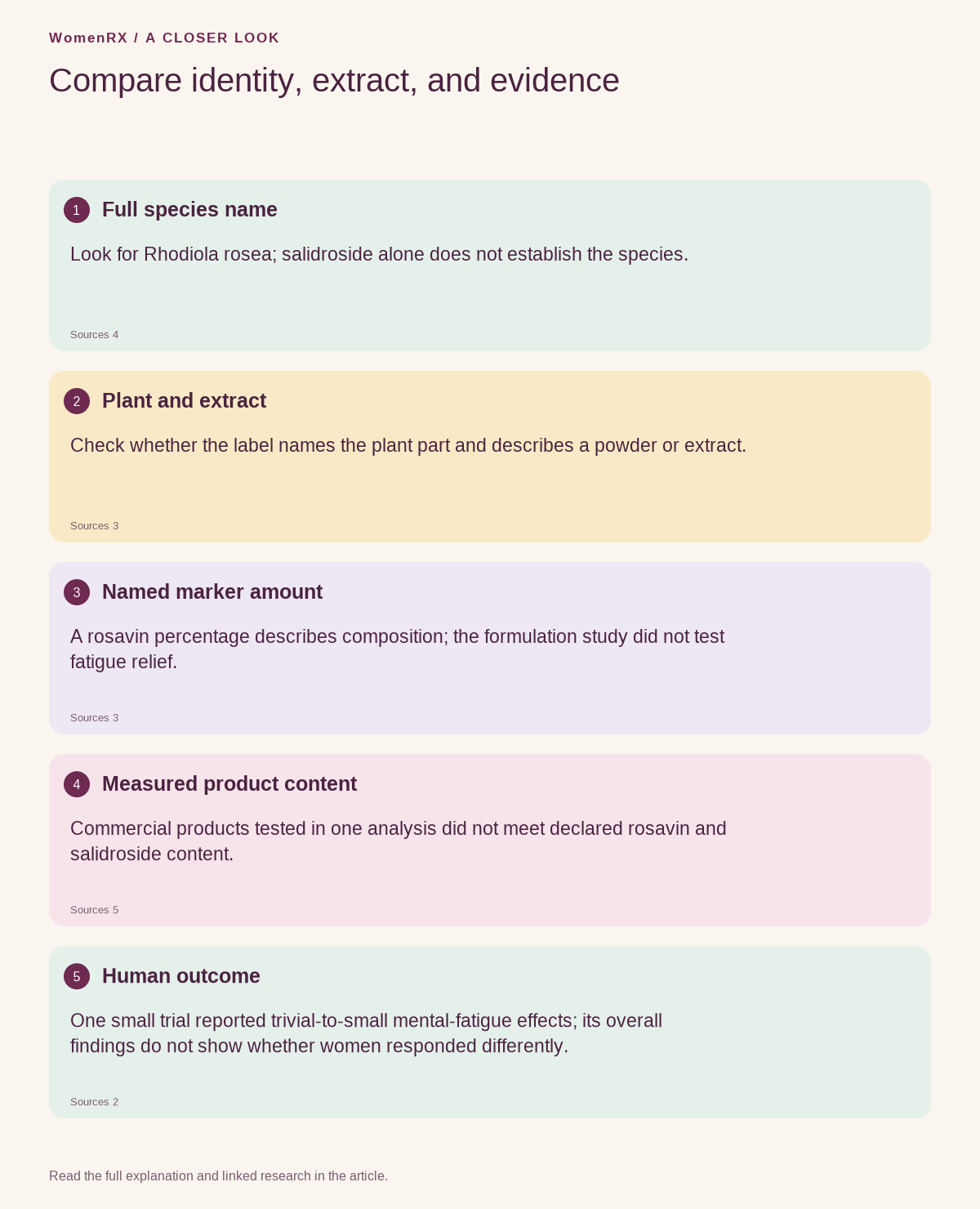
Compare identity, extract, and evidence
Full species name: Look for Rhodiola rosea; salidroside alone does not establish the species.4
Plant and extract: Check whether the label names the plant part and describes a powder or extract.3
Named marker amount: A rosavin percentage describes composition; the formulation study did not test fatigue relief.3
Measured product content: Commercial products tested in one analysis did not meet declared rosavin and salidroside content.5
Human outcome: One small trial reported trivial-to-small mental-fatigue effects; its overall findings do not show whether women responded differently.2
Read the figure as text
Use these checks to separate what a label identifies or measures from what human research has shown.- Full species name: Look for Rhodiola rosea; salidroside alone does not establish the species.4
- Plant and extract: Check whether the label names the plant part and describes a powder or extract.3
- Named marker amount: A rosavin percentage describes composition; the formulation study did not test fatigue relief.3
- Measured product content: Commercial products tested in one analysis did not meet declared rosavin and salidroside content.5
- Human outcome: One small trial reported trivial-to-small mental-fatigue effects; its overall findings do not show whether women responded differently.2
More questions, answered
Does a higher rosavin percentage mean a product works better?
Not based on this evidence. A percentage tells you about a measured compound, while the cited 3% rosavin study focused on making tablets, not testing fatigue relief. 3
Does salidroside confirm that a product contains Rhodiola rosea?
No. Salidroside occurs in other plants too. The review describes rosavin, rosarin, and rosin as compounds specific to R. rosea, so salidroside alone doesn’t establish the species. 4
Sources you can check
- Fatigue: MedlinePlusAccessed 2026-09-25Return to first citation
- The Impact of Rhodiola Rosea Extract on Strength Performance in Alternative Bench-Press and Bench-Pull Exercises Under Resting and Mental Fatigue Conditions: A Randomized, Triple-Blinded, Placebo-Controlled, Crossover Trial.Marcos-Frutos D, Leban Ž, Li Z, Zhang X, Lara PM, Alix-Fages C, Jiménez-Martínez P, Zebboudji N, Caillet A, Redondo B, Vera J, Janicijevic D, García-Ramos A. · Nutrients · 2025Return to first citation
- Development of Orally Disintegrating Tablets of Standardized Rhodiola rosea Extract.Brante O, Bagons RT, Niedra S, Mazurs A, Mauriņa B, Bernatoniene J, Logviss K. · Pharmaceuticals (Basel, Switzerland) · 2025Return to first citation
- Phenolic Compounds of Rhodiola rosea L. as the Potential Alternative Therapy in the Treatment of Chronic Diseases.Bernatoniene J, Jakstas V, Kopustinskiene DM. · International journal of molecular sciences · 2023Return to first citation
- A supercritical fluid workflow for the quality assessment of herbal drugs and commercial preparations from Rhodiola rosea.Langeder J, Grienke U. · Phytochemical analysis : PCA · 2021Return to first citation