Magnesium L-Threonate: What Brain Claims and Safety Mean
A small human trial offers a short-term sleep signal, but it doesn’t establish a memory benefit or show that magnesium L-threonate is risk-free.
Magnesium L-threonate has limited human evidence: one small, three-week trial in adults with self-reported sleep problems found improvements in several sleep and daytime measures, but it did not test memory or focus. The trial’s 1-gram compound amount provided about 75 mg of elemental magnesium. Check the Supplement Facts panel for elemental magnesium, and count it alongside other supplements and magnesium-containing medicines. 1 2
What human research can tell you
Magnesium L-threonate is often promoted for memory, focus, or sleep. A proposed brain-related mechanism is not the same as a demonstrated benefit in daily life. The clearest human result comes from a randomized, double-blind trial of 80 adults ages 35-55 who reported sleep problems. For 21 days, participants received 1 gram per day of magnesium L-threonate or a placebo. Some wearable-recorded sleep and activity measures, as well as several self-reported mood and daytime measures, favored the supplement. The study did not test whether participants’ memory or focus improved. 2
That is a short-term finding in a small group, not proof of lasting benefit or broad safety. The study recorded four adverse events in the magnesium L-threonate group and 13 in the placebo group; reported events in the supplement group included leg cramps, nighttime waking, and sunken eyes. The trial authors described the supplement as well tolerated, but three weeks cannot settle questions about longer-term use. 2
The trial paper briefly summarizes earlier human cognition findings, but those summaries don’t provide enough information to judge the overall strength or quality of that evidence. So it’s reasonable to treat memory and focus claims as less certain than the short-term sleep findings, rather than treating a proposed brain mechanism as clinical proof. 2
Compare elemental magnesium, not compound weight
A label may name magnesium L-threonate as the ingredient, but the amount that matters when comparing magnesium intake is the elemental magnesium listed in the Supplement Facts panel. The trial’s 1-gram amount of magnesium L-threonate was reported as providing about 75 mg of bioavailable elemental magnesium. Those figures describe different things: the weight of the compound and the amount of magnesium it supplies. Don’t assume the compound weight is your magnesium total. 1 2
For adult women, the recommended magnesium intake from all sources is 310 mg daily at ages 19-30 and 320 mg at ages 31 and older. During pregnancy, the recommended intake is 350 mg at ages 19-30 and 360 mg at ages 31-50; during lactation, it is 310 mg and 320 mg, respectively. These are general magnesium nutrition targets, not magnesium L-threonate doses or evidence that this product improves pregnancy, breastfeeding, or menopause-related symptoms. 1
For adults, the upper limit of 350 mg per day applies to magnesium from supplements and medicines, not magnesium naturally present in food. It is a limit for supplemental and medicinal magnesium intake, not a target. When comparing products, consider the elemental magnesium in all supplements and magnesium-containing medicines rather than looking at the weight of a single compound. 1
Side effects, kidney function, and medicines
High supplemental or medicinal magnesium intake can cause diarrhea, nausea, and abdominal cramps. Very high amounts can be toxic. The risk is greater with impaired kidney function because the kidneys help remove excess magnesium. This makes a short trial with few reported events a poor reason to assume a product is risk-free for everyone. 1 2
Magnesium can also affect how some oral medicines are absorbed. It can reduce absorption of oral bisphosphonates, such as alendronate, and can bind tetracycline and quinolone antibiotics, including doxycycline and ciprofloxacin. NIH guidance describes separating magnesium from these medicines: at least two hours before or after an oral bisphosphonate; for a tetracycline or quinolone antibiotic, take the antibiotic at least two hours before the magnesium supplement or four to six hours after it. Follow the instructions for your own medicine and ask a pharmacist if the timing is unclear. 1
Some diuretics can increase magnesium loss in urine, while potassium-sparing diuretics can reduce magnesium excretion. Long-term use of proton pump inhibitors can also be associated with low magnesium. These are reasons to review your full medication and supplement list if you’re considering regular magnesium, not reasons to add more automatically. 1
What this trial does not establish for women’s life stages
The sleep trial included adults ages 35-55, but the reported information does not give a women-specific result or establish effects during pregnancy, breastfeeding, or menopause. General magnesium intake recommendations for pregnancy and lactation do not fill that product-specific evidence gap. If you’re pregnant or breastfeeding, keep the distinction clear: nutrition guidance for magnesium overall is not proof that magnesium L-threonate has been studied for safety or benefit in that life stage. 1 2
For menopause, these findings likewise don’t show that magnesium L-threonate improves memory, focus, sleep, or menopause symptoms specifically. The practical decision is to judge the product as a magnesium supplement with limited short-term human findings, check its elemental magnesium, and consider your kidney function and medicines rather than relying on the brain-health marketing claim.
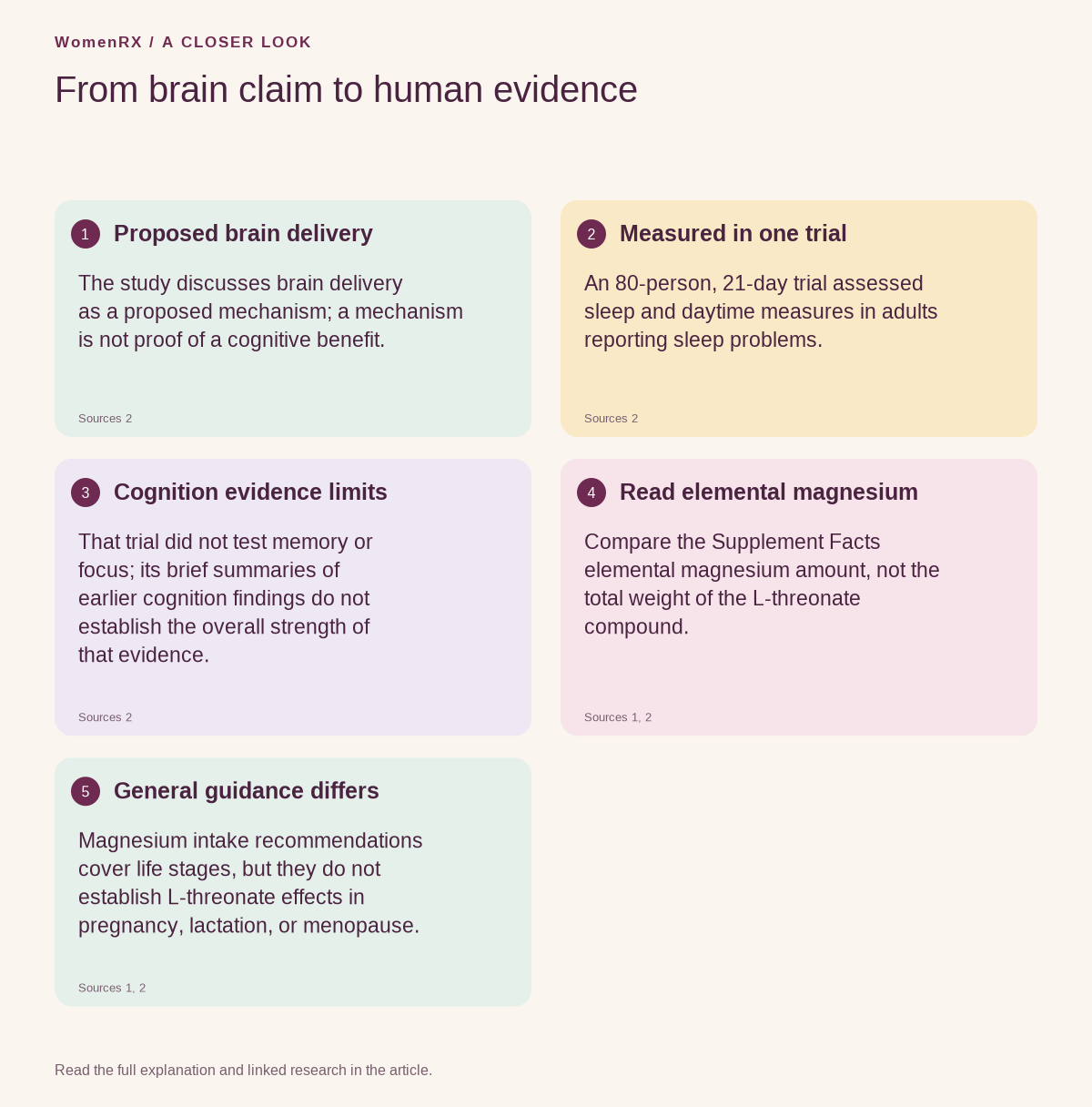
From brain claim to human evidence
Proposed brain delivery: The study discusses brain delivery as a proposed mechanism; a mechanism is not proof of a cognitive benefit.2
Measured in one trial: An 80-person, 21-day trial assessed sleep and daytime measures in adults reporting sleep problems.2
Cognition evidence limits: That trial did not test memory or focus; its brief summaries of earlier cognition findings do not establish the overall strength of that evidence.2
Read elemental magnesium: Compare the Supplement Facts elemental magnesium amount, not the total weight of the L-threonate compound.12
General guidance differs: Magnesium intake recommendations cover life stages, but they do not establish L-threonate effects in pregnancy, lactation, or menopause.12
Read the figure as text
Separate a proposed explanation from what the described human trial actually measured, and see how to read the product amount.- Proposed brain delivery: The study discusses brain delivery as a proposed mechanism; a mechanism is not proof of a cognitive benefit.2
- Measured in one trial: An 80-person, 21-day trial assessed sleep and daytime measures in adults reporting sleep problems.2
- Cognition evidence limits: That trial did not test memory or focus; its brief summaries of earlier cognition findings do not establish the overall strength of that evidence.2
- Read elemental magnesium: Compare the Supplement Facts elemental magnesium amount, not the total weight of the L-threonate compound.12
- General guidance differs: Magnesium intake recommendations cover life stages, but they do not establish L-threonate effects in pregnancy, lactation, or menopause.12
More questions, answered
Does magnesium L-threonate cross into the brain?
The trial paper discusses brain delivery as a proposed mechanism, drawing on preclinical research. That doesn’t establish that the supplement produces a meaningful memory or focus improvement in people; the sleep trial itself didn’t measure those outcomes. 2
Does the adult upper limit include magnesium in food?
No. The 350 mg adult upper limit applies to magnesium from supplements and medicines. It does not include magnesium naturally present in food. 1
Sources you can check
- Magnesium - Health Professional Fact SheetAccessed 2026-09-25Return to first citation
- Magnesium-L-threonate improves sleep quality and daytime functioning in adults with self-reported sleep problems: A randomized controlled trial.Hausenblas HA, Lynch T, Hooper S, Shrestha A, Rosendale D, Gu J. · Sleep medicine: X · 2024Return to first citation