Magnesium Glycinate: What It May Help With
Magnesium research doesn’t establish that the glycinate form reliably treats sleep problems or other symptoms.
Magnesium glycinate is a form of magnesium, but evidence about magnesium supplements in general isn’t proof that this form helps a particular symptom. A review of adult sleep trials found mixed results and low to very low certainty; it didn’t support magnesium as a routine insomnia treatment. Kidney disease matters for safety, and a pharmacist can check a specific product against your medicines. 1 3
The form and the claim aren’t the same thing
A bottle labeled magnesium glycinate makes a claim about the form of magnesium in the product. It doesn’t, by itself, show that the supplement will improve sleep, anxiety, muscle cramps, or another symptom. To establish that, studies need to test the form and measure the outcome people care about.
That distinction matters because much of the research is about magnesium supplementation generally, or about other forms. Results from those studies can’t automatically be credited to glycinate.
What the sleep evidence says
Sleep is a common reason people consider magnesium. A 2026 systematic review included 12 randomized trials of magnesium alone for sleep, insomnia, or poor sleep in adults. The studies varied in magnesium form, dose, length, and outcome measures, and their findings were inconsistent. The reviewers judged the evidence low to very low in certainty and concluded it doesn’t support magnesium as a routine insomnia treatment. Some adults may see modest improvement on certain self-reported measures, but the results don’t establish that glycinate works for sleep. 1
That’s a cautious answer, not proof that no one could benefit. It means the research doesn’t give a dependable basis for expecting a particular result, and the review doesn’t establish a glycinate-specific sleep effect.
General magnesium findings don’t prove a glycinate benefit
A large review of 78 randomized trials found modest average changes in some cardiometabolic measures with magnesium supplementation. The authors said the clinical importance of these changes was uncertain, and the trials used different approaches. Those findings concern magnesium overall, not proof that magnesium glycinate prevents or treats a condition. 3
The same distinction applies to individual studies. For example, a trial in adults with type 2 diabetes tested magnesium oxide, not glycinate. It found a modest, statistically non-significant difference in average HbA1c change between groups over 12 months. That result cannot establish an effect for glycinate or be used as a reason to take it for blood sugar. 2
What about women’s needs?
The cited sleep review concerns adults generally, and the cardiometabolic review doesn’t establish a special effect of glycinate for women. These findings don’t answer whether glycinate helps menstrual symptoms, is useful in pregnancy, or eases menopause-related symptoms. A general magnesium result shouldn’t be treated as proof of a benefit in any of those situations. 1 3
Suitability depends on more than the label
Kidney function is a key safety consideration: the kidneys help remove magnesium, and the cardiometabolic review notes a higher risk of magnesium accumulation in people with chronic kidney disease. The most commonly reported supplement side effect in that review was diarrhea. If you have kidney disease, don’t assume an over-the-counter magnesium product is suitable just because it’s a supplement. 3
If you take regular medicines, ask a pharmacist to check the exact product against your medication list. The evidence cited here doesn’t establish a specific interaction for glycinate, so it wouldn’t be responsible to name one or assume the form is interaction-free. Bring the product label, rather than relying on the name alone.
Look for evidence about the symptom you want to change
Start with the reason you’re considering it. If you’re hoping for better sleep, the current adult trial evidence doesn’t make magnesium a dependable insomnia treatment, and it doesn’t show that glycinate is the answer. If you’re considering it for another symptom, look for evidence that tests the glycinate form and measures that specific outcome. If you have kidney disease or take medicines, check suitability before starting. A product’s form is one detail; it isn’t evidence that the product will help you.
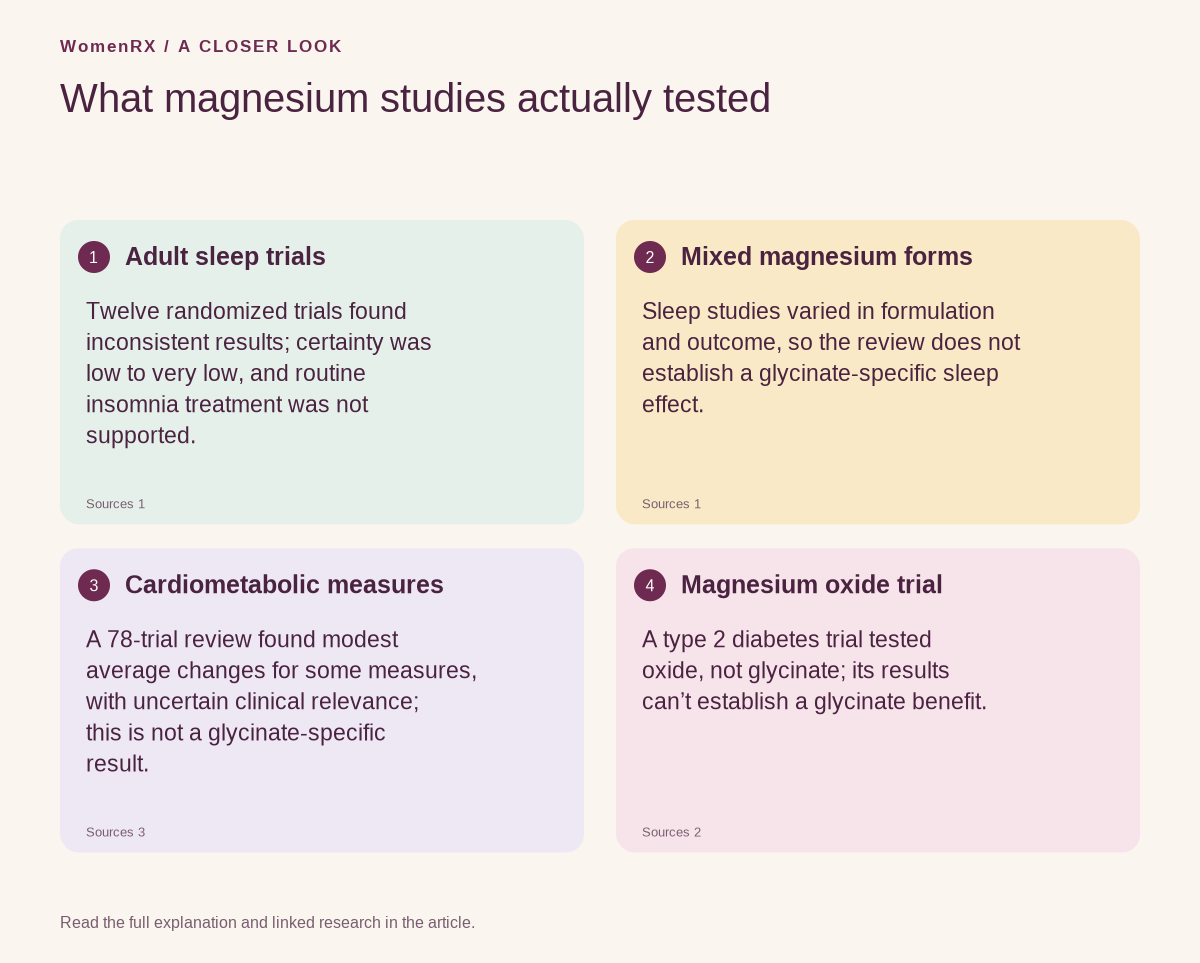
What magnesium studies actually tested
Adult sleep trials: Twelve randomized trials found inconsistent results; certainty was low to very low, and routine insomnia treatment was not supported.1
Mixed magnesium forms: Sleep studies varied in formulation and outcome, so the review does not establish a glycinate-specific sleep effect.1
Cardiometabolic measures: A 78-trial review found modest average changes for some measures, with uncertain clinical relevance; this is not a glycinate-specific result.3
Magnesium oxide trial: A type 2 diabetes trial tested oxide, not glycinate; its results can’t establish a glycinate benefit.2
Read the figure as text
These distinctions show why findings about magnesium overall shouldn’t be mistaken for proof about glycinate or a specific symptom.- Adult sleep trials: Twelve randomized trials found inconsistent results; certainty was low to very low, and routine insomnia treatment was not supported.1
- Mixed magnesium forms: Sleep studies varied in formulation and outcome, so the review does not establish a glycinate-specific sleep effect.1
- Cardiometabolic measures: A 78-trial review found modest average changes for some measures, with uncertain clinical relevance; this is not a glycinate-specific result.3
- Magnesium oxide trial: A type 2 diabetes trial tested oxide, not glycinate; its results can’t establish a glycinate benefit.2
Sources you can check
- Magnesium Supplementation for Sleep in Adults: A Systematic Review of Randomized Controlled Trials.Lopresti AL, Smith SJ, Drummond PD. · Journal of dietary supplements · 2026Return to first citation
- The effect of oral magnesium supplementation on glycemic control and metabolic parameters in type 2 diabetes mellitus: a double-blind randomized controlled trial.Al-Maqbali JS, Al Alawi AM, Osman A, Al-Farqani A, Kumar S, Al Futisi A, Al-Mamari A, Al-Zakwani I, Al Za'abi M. · Frontiers in endocrinology · 2026Return to first citation
- Comprehensive Effects of Magnesium Supplementation on Cardiometabolic Risk Factors: A Systematic Review and Dose-Response Meta-Analysis.Mohammadi S, Palermo A, Ojani P, Alaghemand N, Pirayvatlou PS, Mirkarimi M, Mavi SA, Tahouri K, Shokouhifar S, Ettehad Y, Borzabadi A, Ashtary-Larky D, Suzuki K, Bouzas C, Rodrigue... · Nutrients · 2026Return to first citation